How ISO 22000 Helps Food Exporters Meet Global Standards
The food sector has been witnessing increased competition each year on the global front. Food products have to fulfil stringent requirements regarding their safety and quality before entering international marketplaces. It becomes imperative for exporters of food products to ensure that the food safety standards are consistent and maintained by them. This is where the importance of ISO 22000 Certification comes into the picture.
No matter whether you are a food processor, manufacturer, packer or exporter, ISO 22000 food safety certification in India will help you gain credibility in the eyes of international consumers. Global Certification for Quality and Sustainability is a professional organisation providing certification services to businesses seeking international recognition in terms of their food safety management system.
What is ISO 22000 Certification?
The ISO 22000 Certification is an internationally recognised food safety management system standard framed by the International Organisation for Standardisation (ISO). This system encompasses food safety principles, HACCP, and risk-based management techniques to provide food safety in all stages of the food supply chain.
From the procurement of raw materials, food processing, packaging, storage, transportation, and distribution, ISO 22000 ensures that food is safe for consumption by customers.
Need for ISO 22000 Certification for Food Exporters
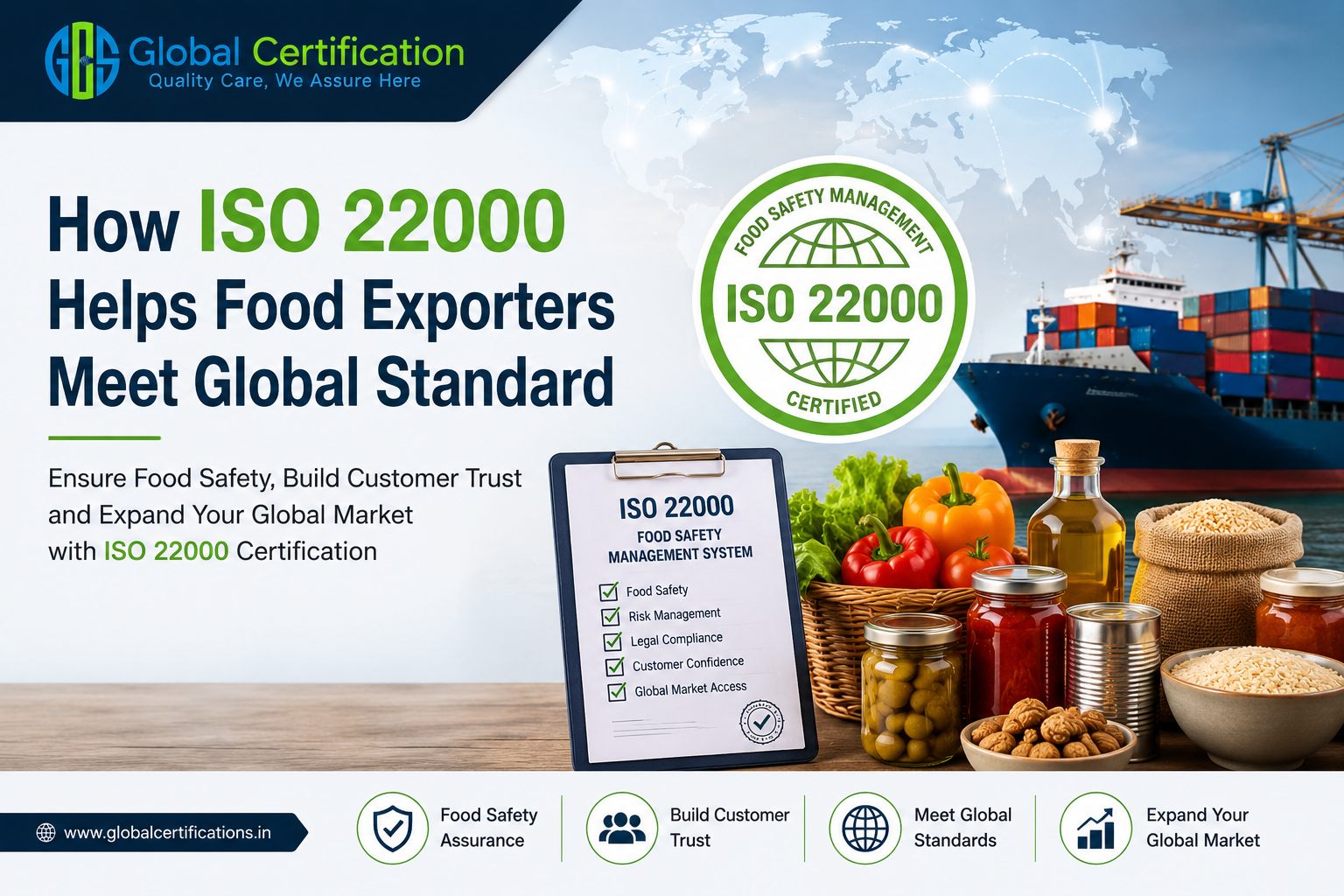
Food exporters have to follow stringent international laws to access foreign markets. Countries like the USA, Canada, European countries, Australia, and Gulf countries require suppliers to have an effective food safety management system in place.
There are several benefits of ISO 22000 Certification in India for food exporters:
- Shows the commitment to food safety
- Meets the international buyer’s requirements
- Improvement in the quality and consistency of the product
- Reduced contamination of food products
- Improved customer confidence
- Makes export approval easier
- Improved market competitiveness in foreign countries
For exporters, getting this certification plays a vital role in getting a contract from international buyers.
How ISO 22000 Supports Food Exporters
Ensures Compliance with International Food Safety Standards
Another huge advantage offered by ISO 22000 requirements to food exporters is that they conform to internationally recognised standards for food safety.
Many international retailers and buyers prefer partners who have been certified regarding food safety management systems since their operations are less risky.
The certification proves that your company uses standardised measures to detect, manage, and monitor any possible food safety hazards.
Improve Product Traceability
There is a need for complete traceability of all stages of the food supply chain in global markets. ISO 22000 provides the means through which manufacturers/exporters can trace ingredients, batches, and the final product with ease.
Such an ability is useful when dealing with recalls.
Reduces Food Safety Risks
Any contamination of the food leads to financial losses, rejections, poor image, and penalties.
ISO 22000 for Food Manufacturers stresses risk management by identifying the risks in terms of biological, physical, and chemical hazards in food products.
Benefits of ISO 22000 Certification for Food Manufacturers
The benefits of ISO 22000 certification for food producers will last for many years to come.
More Efficient Operations
This certificate motivates organisations to optimize production processes, document all activities, and facilitate communication among departments. In this way, the organization can become more efficient and productive.
Greater Consumer Trust
International customers appreciate suppliers with certifications because they represent trustworthiness and dedication to high-quality products. Certificates make it easier for organizations to create long-term connections with importers and distributors from different countries.
Market Expansion
Most world-renowned retailers insist on certification of food safety as a condition of joining their supplier network. Food Export Certification under ISO 22000 will provide greater access to new markets and foreign clients.
Key Requirements for ISO 22000 Certification
Companies applying for ISO 22000 certification for food safety in India should know some basics about requirements.
Some important requirements include:
- Documentation for Food Safety Management System
- Hazard identification and risk assessment
- Implementation of HACCP
- Good Manufacturing Practices (GMP)
- Employee training and awareness
- Evaluation and management of suppliers
- Internal audits
- Corrective and preventive actions
- Continuous improvement of processes
- Management review and performance evaluation
By meeting all these requirements, companies will ensure their sustainable food safety performance.
ISO 22000 Certification Consultant to Choose in India
It may be difficult to implement ISO 22000 without professional assistance. With the help of an ISO 22000 certification consultant in India, companies will easily implement this standard.
An experienced consultant will help companies to:
- Perform gap analysis
- Develop necessary documentation
- Train employees
- Implement food safety practices
- Perform internal audits
- Prepare for audit of certification
- Comply with international standards
Professional assistance will help companies to complete implementation faster.
Why Choose Global Certification for Quality and Sustainability?
International Certifications for Food Manufacturers, Exporters & Processors | Global Certification for Quality and Sustainability is committed to ensuring that the food business entities achieve internationally recognised certifications without any hesitation.
The organisation works with experienced professionals who provide food manufacturers, exporters, processors, and packaging businesses with support to implement efficient Food Safety Management Systems as per international guidelines.
The structured methodology ensures that clients get appropriate assistance from assessment till the certification process, which allows the organisations to enhance operational efficiency besides meeting customer and regulatory requirements.
Conclusion
As food safety requirements keep increasing globally, organisations need to be compliant with the standards that are internationally recognised. ISO 22000 Certification will help food exporting firms have better food safety management systems, minimise their risks, build trust among customers and enter international marketplaces smoothly.
Whether you want to get ISO 22000 Certification in India, seek ISO 22000 requirements for food exporters, or any other assistance regarding an ISO 22000 certification consultant in India, Global Certification for Quality and Sustainability can be helpful for you.
ISO 22000 certification for food manufacturers is not only about compliance but much more than that.