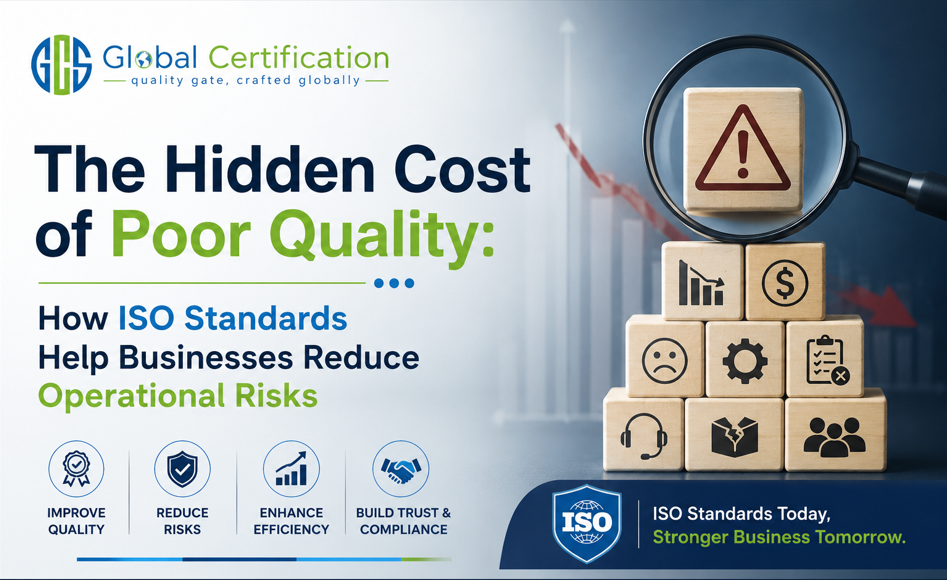
The Hidden Cost of Poor Quality: How ISO Standards Help Businesses Reduce Operational Risks
The negative impact of poor quality could be much more expensive than the cost to fix the issue related to defective products and services. Inconsistency in delivery, consumer complaints, product recalls, rework, misuse of resources, problems with compliance and a bad name could all influence profits negatively over time. Quality management becomes crucial for companies seeking steady development and growth.
This is where the role of ISO standards in quality management becomes quite obvious. Through well-designed processes and responsibilities, ISO standards allow organisations to see risks in their operations and lower expenses from poor quality.
1. Understanding the Hidden Cost of Poor Quality
The cost of bad quality encompasses both direct and indirect costs. The direct cost of replacing poor quality products is easy to identify for a firm, while other costs may not be so obvious.
Poor quality procedures will lead to:
- Increased wastage of materials and production
- Wastage due to rework and repetition of procedures
- Increased delivery times
- Increased costs of customer services
- Productivity loss for employees
- Complaints from customers and returns
- Costs of non-compliance
- Business loss opportunities
- Damaged reputation
If these costs are sustained over a long period, they will reduce the profits that an enterprise makes. A good quality management procedure will help companies avoid many of these issues.
2. How ISO Standards for Quality Management Reduce Risk
The ISO standards are international frameworks that assist companies in having organised process management within the company. Rather than depending on the personal knowledge of certain people, companies may set up certain processes.
ISO management systems based on quality management allow companies to see where they have risks, measure their performance, take corrective measures, and keep improving all the time.
All this may help businesses go from responding to issues to preventing them.
3. Improved Process Consistency
One of the biggest benefits of ISO implementation is better process consistency. The clearer the procedures the staff members should follow, the less they rely on the judgment of each person and the fewer mistakes they may make.
Consistent processes may help companies to keep providing products and services of high quality while growing. It may be especially important for companies managing several teams, offices, suppliers, and manufacturing processes.
Consistent processes make it easier to see where the problem is and how it should be improved.
4. Reducing Waste and Operational Inefficiencies
Inefficient production often generates needless work. The faulty product may have to be repaired, substituted or created anew. Likewise, an ineffective process might imply repetition of actions by employees.
ISO management systems imply that organisations should control their processes, find any possible inefficiencies, and take corrective and preventive actions. Thus, instead of dealing with the same issue several times, companies can save their resources and increase efficiency.
Gradually, such measures will lead to reduced operating expenses.
5. Enhancing Customer Trust
Quality affects customer satisfaction. Customers always expect organisations to deliver them reliable products and services without any difficulties. Numerous quality issues might easily discourage customers and make them turn to the competition.
The ISO certification proves that the organisation has developed a management system based on certain standards. Although the certification does not guarantee that every product or service will be perfect, it shows that the organisation controls its processes and works towards constant improvement.
For organisations competing in domestic and foreign markets, such an approach will enhance their reputation among customers and other stakeholders.
6. ISO Certification in India: Supporting Business Growth
Firms from India are functioning in highly competitive markets where issues of quality, reliability, and compliance play an important role in making purchasing decisions. In India, ISO certification allows firms to develop formalised management systems and demonstrate their commitment to quality.
Depending on organisational activities and goals, businesses in India can apply different ISO management system standards concerning such areas as quality management, environmental management, information security management, occupational health and safety, and many others.
It is important to apply standards depending on real organisational needs and not seek certifications just for marketing purposes.
7. Reasons Why Businesses in India May Need an ISO Consultant
It is hard to understand and apply ISO requirements in practice, especially for organisations that seek certification for the first time. An experienced ISO consultant in India can assist businesses in understanding all the requirements and developing management systems.
The right consultant will allow businesses to be prepared for the certification audit and make sure that management systems do not become just additional paperwork but reflect real business activity.
8. Choosing Professional ISO Certification and BIS Support
Furthermore, in some cases, there may be a need for assistance in meeting the requirements related to the products or regulatory bodies depending on their industry. In such cases, BIS professional certification services can assist organisations in getting familiar with relevant Bureau of Indian Standards requirements and in getting product certification wherever necessary.
Professional management system certification can involve working with competent certification bodies and consultants to establish the right management system and get ready for the assessment.
9. Build Quality Before Problems Become Expensive
Poor quality can impact just about any aspect of an organisation. From inefficient use of resources and process delays to customer dissatisfaction and even reputational damage, poor quality can be very costly as it develops into more serious issues.
An organised management approach based on internationally recognised ISO standards of quality management can help businesses mitigate risks, improve their processes, save time and money, and build customer trust.
Global Certification for Quality and Sustainability provides organisations with assistance in implementing a good management system and obtaining ISO certification for businesses.