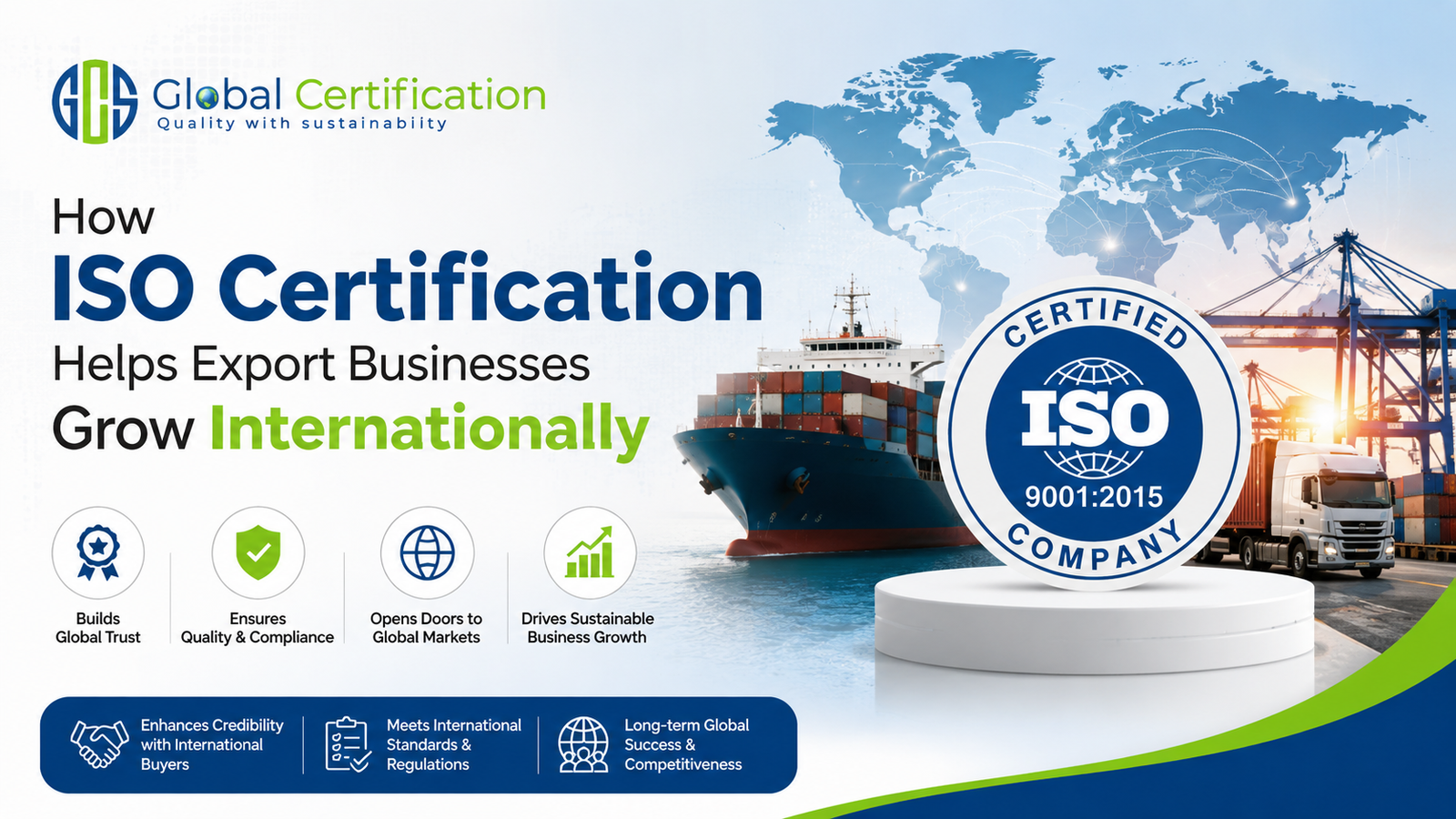
How ISO Certification Helps Export Businesses Grow Internationally
Going global and expanding one’s market base is a landmark achievement for a business. But successful business operations in the international market go beyond producing high-quality products and offering competitive prices. The international customers are aware of the standards that have to be met by a business prior to establishing a partnership. This is where ISO certification for exporters proves its necessity.
Being a food producer, a manufacturer or an industrial exporter, an internationally certified ISO company shows its commitment to quality, safety and sustainability. Global Certification for Quality and Sustainability provides exporters with internationally certified ISO certificates that will allow them to compete successfully on the international market.
1. What Is ISO Certification?
ISO (International Organisation for Standardisation) develops worldwide standards that facilitate better quality, process efficiency, environmentally sustainable operations, and customer satisfaction for businesses.
For exporters, an ISO certification of their export business is evidence of the fact that their products and business processes conform to international standards. ISO certification increases their credibility and helps them to get access to new markets.
2. Importance of ISO Certification for Export Businesses
International customers usually favour suppliers who have internationally accredited quality management systems. Some importers, distributors, and retailers even demand ISO certification before signing contracts.
Advantages of ISO certification in international business transactions are:
- Greater credibility in foreign markets
- Greater customer trust
- Greater consistency in production
- Compliance with international laws and regulations
- Operational risk reduction
- Improved supply chain management
- More chances of export business cooperation in the long term
ISO certification makes exporters more competitive in entering new countries.
3. ISO Certification Builds Trust with International Buyers
The main challenge for exporters is getting the confidence of their overseas clients. Clients might be unaware of your company; therefore, certification becomes a significant issue in supplier selection.
International buyers can rely on your ISO certification, knowing that your organisation follows established standards for quality management, production, safety, and improvement.
That makes customers feel safe regarding the quality of the products, the manufacturing process and their timely delivery, thus making it possible to get international contracts.
4. ISO 22000 Food Safety Certification in India for Food Exporters
Food exporters deal with strict international food safety standards. Countries importing the food require manufacturers to have good hygiene and safety systems during production.
Getting ISO 22000 food safety certification in India shows that your company works by international food safety management standards.
Advantages include:
- better food safety control
- export compliance
- less risk of food contamination
- customer trust
- access to international food markets
It could be really useful for food manufacturers who export processed foods, spices, dairy products, beverages, sea food and agricultural products.
5. ISO Certification for Manufacturers Expanding Globally
Manufacturing firms that offer their products in foreign markets should ensure quality and comply with customers’ needs and regulations.
ISO certification for manufacturers ensures that businesses have the following advantages:
- Increased efficiency in production
- Fewer defective products
- Improved quality control
- Standardized manufacturing process
- More satisfied customers
- Efficient supply chain management
Besides making exports easier, the above aspects increase the efficiency of the business in operations.
6. Global Trade Certification Increases Market Access Opportunities
Most countries and multinational companies favor doing business with certified firms because it shows that your business complies with international standards.
Certification may help businesses:
- Expand into new export markets
- Qualify for buyer requirements
- Take part in global tenders
- Establish strong international business relationships
- Create a strong international image
For growing exporters, certification is usually considered more of a business development tool than a necessity.
7. Choosing the Best ISO Certification for Exporters
The best ISO certifications for exporters depend on the industry and destination market. Among some of the common certifications that may be required are:
- ISO 9001 – Quality Management System
- ISO 14001 – Environmental Management System
- ISO 22000 – Food Safety Management System
- ISO 45001 – Occupational Health and Safety Management
- ISO 27001 – Information Security Management
Some exporters choose to get multiple certifications in order to satisfy their customers’ needs and industry standards.
8. The Advantages of ISO Certification for Sustainable Business Development
In addition to allowing businesses to penetrate into foreign markets, ISO certification provides the best framework for sustainable development.
Sustainable benefits include:
- Enhanced operational effectiveness
- Decreased production costs
- Enhanced risk management
- Increased customer retention
- Enhanced employee involvement
- Continual business improvement
- Greater competitiveness internationally
As international markets become increasingly competitive, certified companies are well-equipped to get repeat orders and develop long-term business relationships with foreign clients.
9. Partner with Global Certification for Quality and Sustainability
Getting international ISO certification requires expert guidance, documentation, implementation assistance, audits, and adherence to regulations.
Global Certification for Quality and Sustainability offers certified services for exporters, manufacturers, food industries, and companies looking to be internationally recognised. The experienced professionals will assist in obtaining the certification with ease while making sure that your company adheres to the global standards.
No matter whether you intend to get ISO certification for exporters, ISO certification for export business or ISO certification for international trade, expert guidance will ease the process and help you to reach international success faster.
10. Conclusion
The international trade requires quality, consistency and reliability. Companies that have chosen to acquire ISO certification for export have gained a great advantage in terms of competitiveness in today’s world. It doesn’t matter whether you need ISO 22000 food safety certification in India for food exporters or ISO certification for manufacturers in international trade, the obtained certifications will create new opportunities for your company and improve relations with foreign partners.
Should you plan to become an international company, cooperation with Global Certification for Quality and Sustainability will ensure that you receive the necessary international trade certification.