How to Choose the Right ISO Standard for Your Business
In the contemporary competitive corporate landscape, obtaining international certifications is no longer a mere symbol of credibility; it is a way of gaining an edge in business. If you run a company in manufacturing, food processing, healthcare services, logistics, or any other sector, opting for the proper ISO certification for businesses can benefit you in terms of operational efficiency, customer satisfaction, and compliance.
But with several ISO standards being available, many companies find it difficult to figure out which one will suit their business best. Knowing your business objectives and compliance needs is the key to getting the right ISO standard for your business. The help of Global Certification for Quality and Sustainability makes it easy to obtain ISO certifications.
1. What Are ISO Standards?
The ISO (International Organisation for Standardisation) is an organisation that produces globally recognised standards that enable companies to increase quality, safety, efficiency, and consistency of their operations. These standards give organisations a systematic way of managing the process and making sure that products or services are consistent with the expectations of customers.
Selecting the proper ISO certificate for business depends on various factors.
2. Reasons Why Selecting the Proper ISO Standard Is Important
Selecting the proper ISO standard will not only result in a certificate but also enable organisations to:
- Increase efficiency of the process
- Increase customer trust and confidence
- Comply with legal regulations
- Reduce the risk of operations
- Increase the quality of products or services
- Increase business opportunities in local and foreign markets
Instead of obtaining many certificates, businesses should first think about the standards that fit their business objectives.
3. Understand Your Business Requirements
Before embarking on the process of obtaining ISO certification, conduct an analysis of your company’s needs by posing several crucial questions:
- Which sector do you belong to?
- What are the major challenges in operations faced by your company?
- Are there any customer or statutory requirements that need to be met?
- Is there a need to enhance quality, food safety, environmental performance, or occupational safety?
The answers will define the most appropriate choice of ISO certification.
Some examples are:
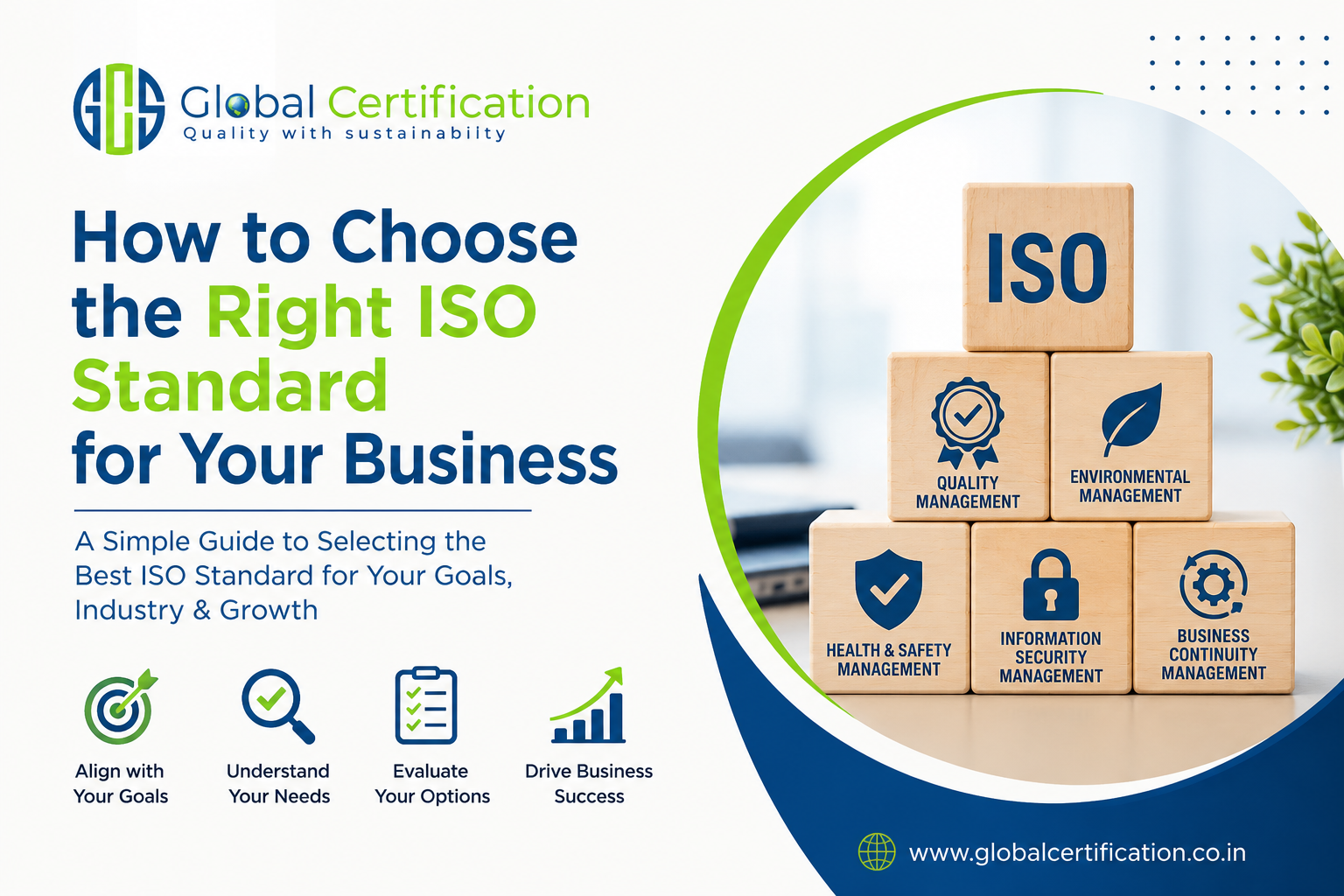
Manufacturing organisations usually need ISO 9001 for quality management.
Food-related businesses find the ISO 22000 food safety certificate useful in India.
Companies worried about the environment will need ISO 14001.
Occupational health and safety-conscious organisations will need ISO 45001.
4. Common ISO Standards for Businesses
4.1 ISO 9001 – Quality Management System
ISO 9001 is considered to be one of the most used ISO standards among companies. The main concern of this particular standard is the improvement of quality management, customer satisfaction and continuous improvement of business operations.
It can be used by any company regardless of the size and field.
4.2 ISO 14001 – Environmental Management
Companies trying to minimise their environmental footprint and meet environmental regulations usually opt for ISO 14001. This standard encourages sustainable business operation and effective use of resources.
4.3 ISO 45001 – Occupational Health and Safety
The companies which face workplace safety risks can consider ISO 45001 as an additional tool to create a safer environment as well as minimise accidents.
4.4 ISO 22000 – Food Safety Management
This standard can be especially useful for those companies that deal with the production, processing, packing, storage, transportation and distribution of food products. So, food safety certification in India ISO 22000 is what you need.
5. Why Food Businesses Should Consider ISO 22000
Food safety is a major issue not only among customers but also with the regulatory bodies. Getting ISO 22000 Food Safety Certification in India enables companies to:
- Enhance their food safety management systems
- Deliver upon customer and regulatory demands
- Increase their supply chain confidence
- Avoid any kind of food contamination
- Improve their brand image
- Enter international markets
Having an ISO 22000 Food Safety certification consultant in India enables companies to have a better understanding of the process of certification.
6. The ISO Certification Process
ISO certification typically involves the following steps:
6.1. Assessment
Assess your current management system and discover what needs to be improved.
6.2. Documentation
Prepare documentation necessary for the chosen ISO standard.
6.3. Implementation
Implement the management system and ensure that employees know what they need to do.
6.4. Internal Audit
Carry out internal audits to ensure compliance and discover what needs to be done.
6.5. Certification Audit
An independent third party carries out an audit of your company’s compliance with ISO standards.
6.6. Continuous Improvement
Once you get certified, you can keep on improving your management system.
7. Why Work with an ISO Consultant?
While organizations may go ahead to seek certification on their own, professional assistance makes the process very easy.
There is an ISO 22000 consulting company in India that can assist organisations to:
- Familiarise themselves with certification requirements
- Prepare required documents
- Train their employees
- Carry out internal audits
- Handle non-conformities
- Improve audit readiness
- Minimise certification time
Professional assistance guarantees ease of implementation while ensuring adherence to international standards.
8. Why Select Global Certification for Quality and Sustainability?
There is a company known as Global Certification for Quality and Sustainability which offers professional support to organisations seeking to receive effective ISO certification services.
Through their experienced consultants, they assist organisations in selecting appropriate certifications, preparing required documents, implementing management systems, and finally completing the process of ISO certification. Whether you require quality management, environmental management, occupational safety, or ISO 22000 food safety certification in India, their consultants will give you proper advice depending on your organisational needs.
9. Conclusion
Making the proper choice of ISO standards is a very vital investment in your firm’s future. Instead of going for ISO certification that follows trends in the market, it would be wise to consider what your company needs and what the regulations require.
Regardless of whether you go for ISO certification in general or seek ISO 22000 food safety certification in India, proper selection of the correct standards will increase efficiency and help you grow sustainably. Thanks to Global Certification for Quality and Sustainability, along with an ISO 22000 certification consultant in India, your certification process is much easier.