Step-by-Step Process to Get ISO 22000 Food Safety Certification in India
The safety of food products has become one of the biggest concerns for food product manufacturing firms, restaurants, food packaging companies, exporting firms, and food processing industries. The current demand of customers for their food products is safety, hygienic, and quality food products. In addition, the government regulations have become increasingly stringent over time. It is here that the ISO 22000 Food Safety Certification has its importance.
ISO 22000 is a food safety management system standard. It aims to assist organisations in identifying, controlling, and minimising the risk of food safety hazards. Many firms in India have been implementing ISO 22000 to improve their safety and become global players. In this blog post, we will discuss the entire process of ISO 22000 certification, along with how GCQS can assist you.
1. What is ISO 22000 Food Safety Certification?
The Food Safety Certificate under ISO 22000 is one such international certification that has been formulated by ISO (International Organisation for Standardisation). It is formulated using the Food Safety Management System and ensures the food safety of all kinds of foods.
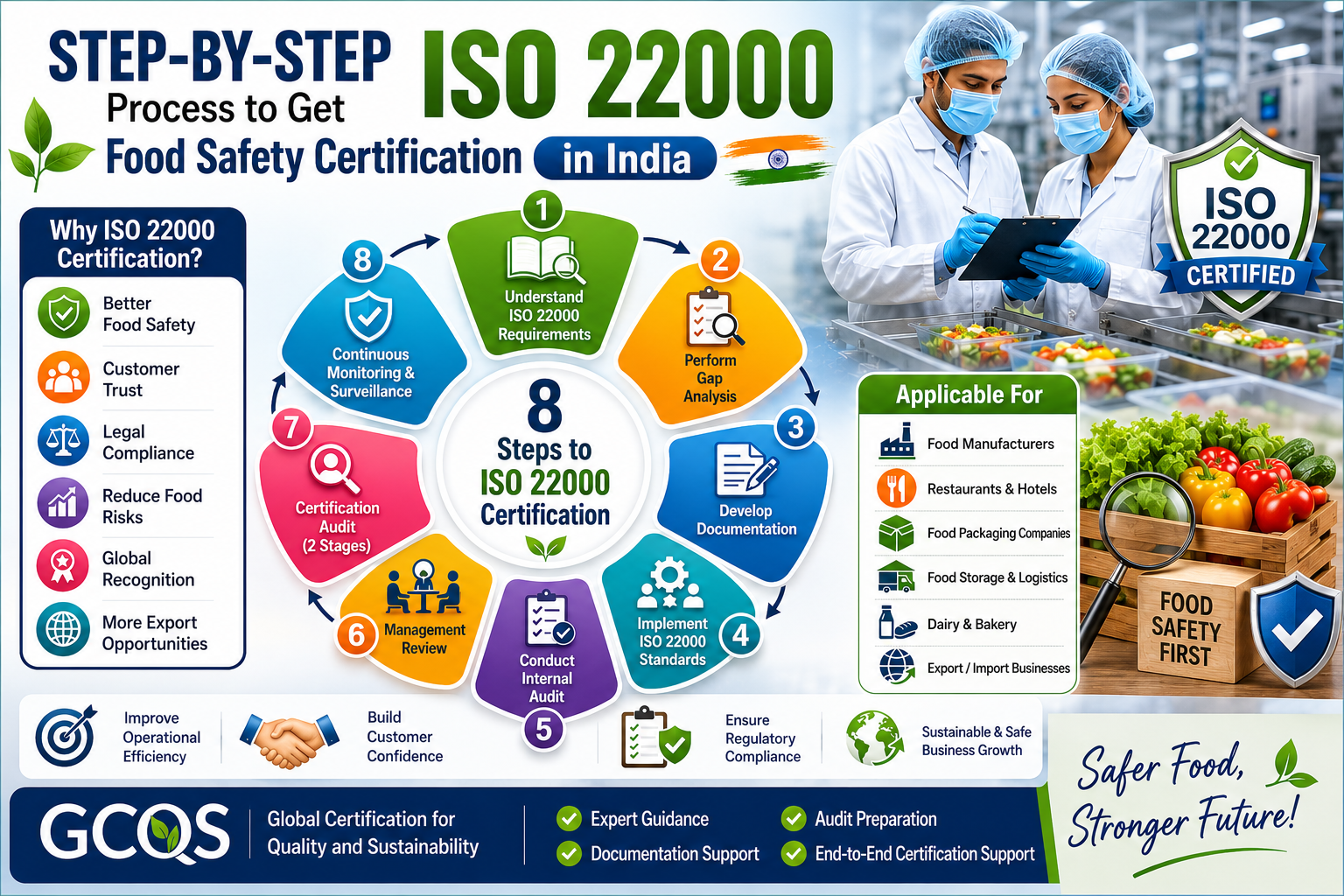
Such a food safety certification is applicable for any kind of food establishment, such as:
- Manufacturing food industries
- Hotels and restaurants
- Food packaging industries
- Food storage industries
- Food transport industry
- Dairy and bakery industry
- Food export/import industry
Obtaining Food Safety Certification in India helps businesses improve operational efficiency, customer confidence, and regulatory compliance.
2. Why is ISO 22000 Certification Important?
There are several advantages associated with ISO 22000 food safety certification in India, such as:
- Better food safety standards
- Better legal compliance
- More trust from customers
- Less food contamination
- Reputation building
- Export potential
- Efficient process management
For food organisations that want to be successful in the market both nationally and internationally, certification is an important competitive advantage.
3. Step-by-Step ISO 22000 Certification Process
3.1. Understand ISO 22000 Requirements
The first phase of getting an ISO 22000 certificate involves comprehending the requirements of this standard. The organisation needs to know what concerns related to food safety, risks, documentation, hygiene management, and operations exist.
This standard incorporates some important components, including:
- HACCP principles
- Prerequisite programs (PRPs)
- Food safety management systems
- Risk-based approach
- Continuous improvement
Cooperation with an experienced certification body, such as Global Certification for Quality and Sustainability (GCQS), can help in better comprehension of requirements.
3.2. Perform a Gap Analysis
Gap analysis involves determining how current activities and practices differ from those prescribed by ISO 22000.
In this phase, the company assesses:
- Current practices for food safety
- Documentation
- Training
- Hygiene standards
- Risk management processes
This assessment helps organizations understand what improvements are needed before applying for certification.
3.3. Develop Food Safety Management System Documentation
Documenting is one of the critical components required when it comes to the ISO 22000 Food Safety Certification process.
Firms are required to document:
- Food safety policy
- Standard operating procedures
- Hazard analysis documents
- Risk assessment results
- Monitoring methods
- Actions required to correct non-compliance
With proper documentation, businesses are assured of consistency, which makes it easier to pass audits.
3.4. Implementation of ISO 22000 Standards
After preparing the necessary documents, firms have to implement the food safety management system within all departments.
This involves:
- Employee training
- Food handling protocols
- Sanitation practices
- Supplier relations
- Food safety risk monitoring processes
- Internal communication systems
Successful implementation ensures that food safety practices become part of daily operations.
3.5. Conduct Internal Audit
Preceding the final audit, the organization must undertake an internal audit to ensure that the system is working properly.
Internal audits may help in detecting:
- Nonconformities
- Weaknesses in operation
- Documentation gaps
- Areas requiring improvements
Appropriate corrective measures must be made prior to the formal audit process.
3.6. Management Review
The management must evaluate the performance of the food safety management system.
Some elements considered during the management review include:
- Audit results
- Customer complaints
- Risk analysis
- Areas for improvement
It is crucial to have management participation for successful Food Safety Certification in India.
3.7. Certification Audit
Two step process followed by the certifying body during final audit:
Step 1: Audit
The auditor inspects the documents, policy, and readiness of the company for certification.
Step 2: Audit
The auditor reviews the implementation of the food safety management system by the company.
Once it is ensured that the company meets all requirements, then ISO 22000 food safety certification is provided to the company in India.
3.8. Continuous Monitoring and Surveillance
The ISO certification is a continuous process where the company needs to comply with the ISO certification through continuous monitoring and surveillance audits.
4. Why Choose Global Certification for Quality and Sustainability (GCQS)?
ISO 22000 Food Safety Certification – Global Certification for Quality and Sustainability (GCQS) delivers professional certification services for companies who wish to acquire ISO 22000 Food Safety Certification.
GCQS assists companies in:
- Providing professional guidance during the entire process of obtaining certification
- Document preparation
- Auditing preparation
- Compliance with food safety standards
- Food safety solutions for each particular industry
GCQS ensures professional support from experienced auditors, and its customer-oriented approach allows organisations to obtain globally recognised food safety certification efficiently.
5. Conclusion
Food safety is crucial for every company that participates in the food supply chain. Acquisition of ISO 22000 Food Safety Certification will not only improve food safety and quality but will also increase client trust in your business.
Going through the right process of ISO 22000 Food Safety Certification will help minimise food safety risks and increase effectiveness in operations.
Should you be interested in getting a reliable Food Safety Certification in India, Global Certification for Quality and Sustainability (GCQS) will assist you in the whole process of obtaining certification.