FSSAI License in India (2026): Apply Online, Fees, Documents, Eligibility, Types & Registration Process
For those who wish to set up a food-related business in India, it is necessary that various legal procedures be fulfilled. And acquiring the FSSAI license is at the top of those legal requirements. Whether it is a restaurant, cloud kitchen, food manufacturing plant, grocery shop, bakery, caterer, or even a food business online, getting the FSSAI registration done guarantees all legal compliance.
By 2026, the procedure of registering with FSSAI online in India will have become very convenient with the digitisation of the process. With the professional guidance provided by the Global Certification for Quality and Sustainability (GCQS), it is possible to get your FSSAI registration completed without hassle.
1. What is an FSSAI License?
Food Safety and Standards Authority of India (FSSAI) is the regulatory body set up by the Government of India to ensure that the food manufactured, sold, distributed, imported or exported is safe. FBO must first register/obtain their FSSAI Registration/license before commencing their business activities.
Registration/license issued under FSSAI contains a 14-digit registration/license number that enables the tracking of food safety and quality standards.
An FSSAI license is mandatory for:
- Restaurants
- Hotels
- Food manufacturers
- Caterers
- Food delivery businesses
- Cloud kitchens
- Dairy units
- Bakeries
- Grocery stores
- Importers and exporters
- Online food sellers
2. Why is FSSAI Registration Important?
There are various advantages for food businesses in India if they obtain an FSSAI license.
2.1 Legal Operation
By obtaining FSSAI registration, businesses can operate legally without having to face any legal repercussions.
2.2 Customer Trust Building
Customers like companies that maintain hygiene and safety standards for their food. An FSSAI license number will help build customer trust.
2.3 Business Growth
An FSSAI license is essential for establishing partnerships with online e-commerce sites, food chains, or any aggregator.
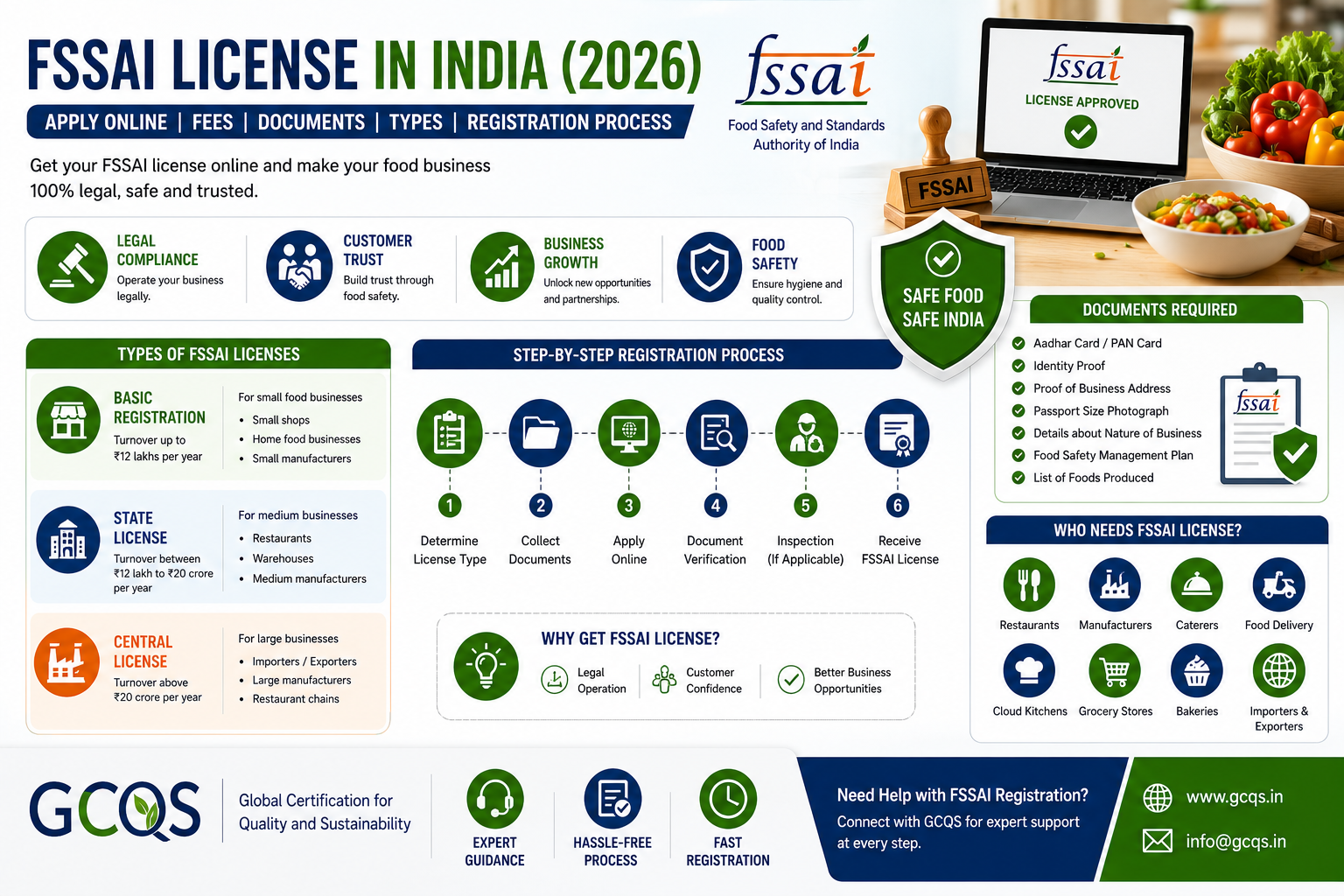
3. Types of FSSAI Licenses in India
The kind of FSSAI license needed will vary according to the turnover and the nature of the business.
3. 1. FSSAI Basic Registration
A basic registration will be appropriate for small food businesses with a turnover of up to ₹12 lakhs per year.
Applicable to:
- Small retail shops
- Home food businesses
- Small food manufacturers
3.2. State FSSAI License
A business with a turnover between ₹12 lakh and ₹20 crore will need a State License.
Applicable to:
- Medium-sized restaurants
- Warehouses
- Transports
- Medium-scale food manufacturers
3.3. Central FSSAI License
A Central License will be required by large businesses with a turnover of more than ₹20 crore per year.
Applicable to:
- Importers/Exporters
- Large manufacturers
- Large restaurant chains
4. Eligibility for FSSAI Registration
Each individual or organization indulged in any food related activity should apply for FSSAI registration.
These entities can be:
- Proprietorship Firm
- Partnership Firm
- LLP
- Private Limited Firm
- NGO
- Co-operative Societies
- Food Startups
Even small-scale kitchens that sell food via online mediums have to apply for registration based on their sales volume.
5. FSSAI Registration Documents
Online application for the FSSAI registration in India can be a simple process. The documents needed for the application might vary based on the type of license applied for.
Some common documents are as follows:
- Aadhar Card/PAN Card
- Passport Size Photograph
- Proof of Business Address
- Identity Proof of the applicant
- Details about the nature of the business
- Partnership Deed/Incorporation Certificate
- Food Safety Management Plan
- List of Foods Produced
- NOC from Municipality (If any)
Extra documents needed for the central license include:
- Import-Export Code (IEC)
- Water Testing Report
- Authority Letter
- Layout Plan of the Food Unit
6. Step-by-Step FSSAI Registration Process in India
7.1 Step 1: Determine the Type of License
Firstly, you need to know which type of license you require, namely Basic Registration, State License, or Central License.
7.2 Step 2: Collect Necessary Documents
It includes gathering all the documents concerning business registration, identification and proof of identity, and food activities.
7.3 Step 3: Make an Online Application
Applications for FSSAI registration in India can be made via the official FoSCoS platform.
7.4 Step 4: Verify the Documents
Document verification will be conducted by the concerned authority.
7.5 Step 5: Inspections (If Any)
In some instances, inspections may be carried out at the business premises.
7.6 Step 6: Issue the FSSAI Certificate/License
The issuance of the license comes after the approval process.
8. Common Reasons for FSSAI Application Rejection
A lot of applications are denied due to errors such as:
- Incomplete documentation
- Incomplete filling of application forms
- Incorrect choice of business category
- Mismatch in address information
- Food safety violations
Seeking professional guidance from companies such as Global Certification for Quality and Sustainability (GCQS) helps you to prevent any mistake that can lead to denial of your application.
9. Help with FSSAI Registration from Global Certification for Quality and Sustainability (GCQS)
Global Certification for Quality and Sustainability (GCQS) helps you obtain an FSSAI license and registration services.
The service includes:
- License consultation
- Documentations
- Online application filing
- Renewals
- Food safety compliance
- Fast registration
No matter whether you run a startup food business or a food manufacturing firm, GCQS will make your registration process easy.
10. Conclusion
The necessity of obtaining an FSSAI license cannot be overlooked for any business that sells food products in India. This is because the license is not only mandatory but will help improve their food quality. In 2026, registering for an FSSAI license online in India has been made much easier.
With the assistance provided by Global Certification for Quality and Sustainability (GCQS), any organisation can register for an FSSAI license without any hassles.