ISO 22000 vs HACCP: What’s the Difference?
Food Safety has become one of the foremost concerns for organisations dealing with food products. Whether it is food manufacturers, eateries, food export firms, or packaging units, the importance of hygiene and safety cannot be underestimated. There are various forms of food safety management systems, but HACCP and ISO 22000 have gained popularity among businesses.
The following article will enable us to gain insights into the fundamental differences between HACCP and ISO 22000 food safety and certification systems. We will understand the reasons behind the adoption of the ISO 22000 food safety system by Indian organisations.
1. Understanding HACCP
The abbreviation stands for Hazard Analysis and Critical Control Points. HACCP is a proactive approach to possible food hazards during the whole process of food manufacturing.
The main focus of the HACCP methodology is the hazards in food safety, including:
- Biology hazards
- Chemical hazards
- Physical hazards
There are seven fundamental principles of operation of the HACCP methodology:
- Conducting hazard analysis
- Identifying critical control points
- Defining critical limits
- Controlling control points
- Implementing corrective actions
- Verification
- Record-keeping
The application of HACCP is crucial in the food industry; therefore, it is widely considered the foundation of modern food safety systems.
2. What is ISO 22000?
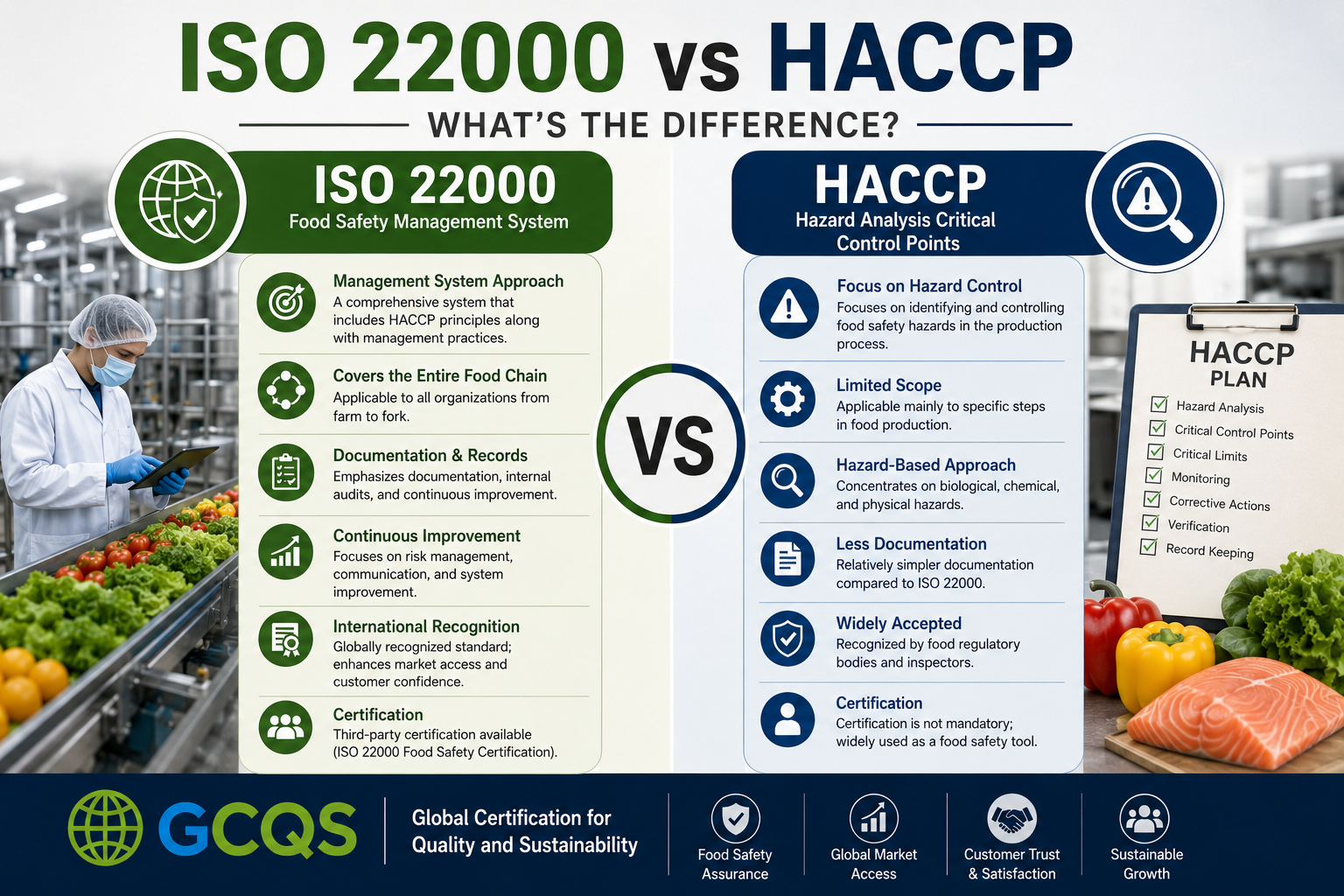
ISO 22000 is a globally acclaimed standard for food safety management systems created by ISO. The standard blends the concepts of HACCP with management system aspects for a comprehensive food safety management system.
The main aim of ISO 22000 is to provide food safety for the entire process of the food supply chain from farm to fork.
Organisations certified with ISO 22000 food safety certification in India prove that they meet internationally recognised food safety standards and have an effective management system.
3. Main Difference Between HACCP and ISO 22000
While HACCP can be part of ISO 22000, both concepts are not entirely alike because HACCP emphasises only the control of the food hazards, whereas ISO 22000 provides a food safety management system.
3.1. Scope of the System
The scope of HACCP revolves around identifying and controlling food safety hazards in the process of production.
The scope of ISO 22000 is much wider and covers such aspects as:
- HACCP principles
- Risk management
- Communication procedures
- Documentation
- Leadership
- Improvement
Thus, ISO 22000 is a broader concept than HACCP.
3.2. International Recognition
HACCP has gained wide acceptance worldwide, particularly among food regulatory bodies and inspectors.
On the contrary, ISO 22000 is a globally standardised certification accepted in many countries and industries. Firms engaged in international trade tend to choose ISO 22000 food safety certification in India since it enhances their international reputation.
3.3. Structure of Certification
In general, HACCP certification primarily concentrates on food hazards management strategies.
Certification under ISO 22000 adopts a systematic management structure, like other ISO standards, that consists of:
- Internal audit
- Risk-based approach
- Management evaluation
- Staff training
- Document management
Such a system enhances organisational performance.
3.4. Food Chain Coverage
The application scope of HACCP is limited to food manufacturing processes.
Conversely, ISO 22000 covers the whole food chain that involves:
- Food manufacturers
- Package manufacturers
- Transport services
- Cold storage
- Food service establishments
- Grocery stores
3.5. Continuous Improvement
HACCP food safety hazard management approach is primarily concerned with food safety hazard management.
Continuous Improvement and Monitoring are the focus of the ISO 22000 food safety standard. The organisations periodically evaluate the effectiveness of their management system and seek ways to enhance their effectiveness in terms of food safety.
4. Why adopt the ISO 22000 Food Safety Certificate over HACCP?
In today’s era, most organisations opt for ISO 22000 certification rather than HACCP due to its worldwide acceptance and managerial approach.
The following are some factors for implementing the ISO 22000 food safety certificate in India:
4.1 Enhancement of Food Safety Control
ISO 22000 enables the organisation to increase its food safety control system and reduce contamination risks.
4.2 Increased Customer Confidence
The customers always like those organizations who follow internationally accepted food safety standards.
4.3 Market Advantage
There is a great possibility of penetrating the foreign market if an organisation implements ISO 22000 certification.
4.4 Reputation
An ISO 22000 food safety certified food business enjoys increased customer confidence.
4.5 Compliance
The organisations can satisfy all their food safety requirements with ISO 22000 implementation.
5. Which One Should Your Business Choose?
The selection between HACCP and ISO 22000 will depend on the business needs.
HACCP will serve well in cases where the aim is basic hazard control.
ISO 22000 is the best option when seeking a worldwide food safety management system that comes with several benefits.
Businesses intending to go international, improve their operations, and increase customer trust should opt for ISO 22000 food safety certification in India.
6. Benefits of Using Global Certification for Quality and Sustainability (GCQS) Services
The Global Certification for Quality and Sustainability is a company that provides certification and compliance services to businesses from different sectors. The team at Global Certification for Quality and Sustainability (GCQS) provides quality support in helping food companies attain their food safety management system needs and gain internationally recognised certifications.
7. Conclusion
Both HACCP and ISO 22000 must be taken into consideration in relation to the food safety management system. In this regard, HACCP becomes extremely important in that its role involves laying down the framework in relation to hazard analysis and hazard control, whereas ISO 22000 helps frame HACCP.
In respect of food safety management, there is a trend on the part of different firms to get themselves certified as safe providers of food products in India under ISO 22000.
In association with well-known food safety management system certification agencies like Global Certification for Quality and Sustainability (GCQS), food safety management systems can be implemented effectively.