How to Choose the Right ISO Certification for Your Business
Getting ISO certification for your business in today’s tough business competition does not just mean following regulations but a strategy to enhance quality, efficiency, credibility, and customer satisfaction. Regardless of whether you are running a manufacturing firm, a food-processing facility, a healthcare organisation, an educational institution, or even an IT company, opting for the right ISO standard can be helpful in attaining sustainable growth.
However, due to the availability of various ISO standards, it may become difficult for you to decide which one is suitable for your organisation. In this guide, we shall look at how to select the best ISO certification for companies and how working with Global Certification for Quality and Sustainability can make the process easier.
1. What Is ISO Certification?
ISO (International Organisation for Standardisation) sets international standards, which assist organisations in bettering their process, ensuring quality, improving safety, and meeting customer demands. ISO certifications show that an organisation operates using internationally acknowledged management systems and practices.
Various ISO certifications for organisations cater to different operational needs and comply with certain industry-specific needs.
2. Importance of ISO Certification for your Businesses
Some benefits of ISO certifications include:
- Better efficiency
- Higher customer satisfaction
- Effective risk management
- Improved credibility and trustworthiness
- Regulatory compliance
- Entry into international markets
- Better business performance and profitability
It can give businesses a competitive edge if they seek to grow in the long run through the acquisition of the appropriate ISO certifications in India.
3. Understanding Different ISO Standards
It is necessary to know about the commonly adopted ISO standards before choosing any certification.
3.1 ISO 9001 – Quality Management System
The ISO 9001 standard is the most widely known standard worldwide. It is related to quality management and customer satisfaction.
Good fit for:
- Manufacturing firms
- Service firms
- Educational institutions
- Healthcare firms
- Firms of medium and small size
If you want to make improvements in the quality of products, customer satisfaction, and operations, then ISO 9001 is one of the best ISO certifications that can be obtained by companies from different industries.
3.2 ISO 14001 – Environmental Management System
The ISO 14001 standard helps organisations reduce their impact on the environment.
Good fit for:
- Manufacturing industry
- Construction companies
- Energy companies
Companies having big responsibility for environment.
3.3 ISO 45001 – Occupational Health and Safety Management
ISO 45001 is about occupational safety and health.
Suitable for:
- Companies involved in construction
- Manufacturing firms
- Logistics firms
- Industrial firms
This ensures that there will be less workplace risk.
3.4 ISO 27001 – Information Security Management
ISO 27001 guarantees the safety of information related to the company and its customers.
Suitable for:
- IT firms
- Firms dealing with software
- Financial institutions
- E-commerce firms
Organisations handling confidential data can benefit greatly from this certification.
4. Choosing ISO Certification for Food Industries
The food business sector has unique issues regarding food safety, hygiene, and compliance with regulations. Hence, the selection of a suitable certification is of utmost importance.
4.1 ISO 22000 Food Safety Certification
In the case of food manufacturers, processors, exporters, restaurants, and the packaging industry, ISO certification for the food industry is extremely important.
ISO 22000 food safety certification in India is especially tailored towards ensuring that a proper food safety management system (FSMS) is in place.
Benefits of ISO 22000 Certification
- Improved food safety practices
- Regulatory compliance
- Customer confidence
- Improved risk management
- Exporting opportunities
- Prevention of food contamination
Those companies that deal in food manufacturing and distribution should seriously consider ISO 22000 food safety certification in India.
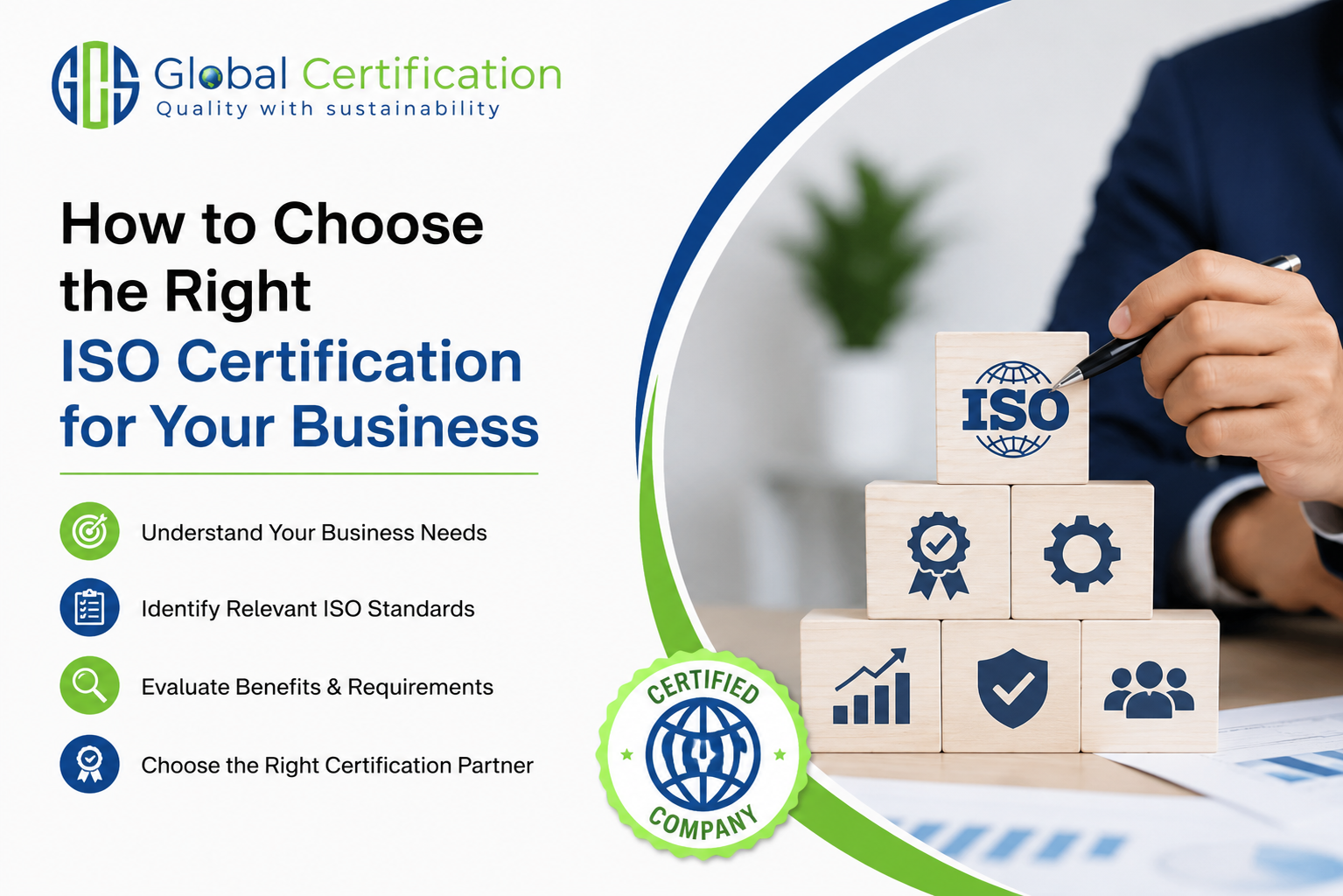
5. Factors to Consider When Choosing the Right ISO Certification
5.1. Identify Your Industry Requirements
There are various industry-specific challenges and regulations for which there will be different management systems. Determine the unique difficulties and regulatory requirements of your business sector before opting for any certification.
5. 2. Set the Goals of Your Business
Consider whether:
- You desire improvement in the quality of goods and services
- Food safety is the goal of your business
- Environmental sustainability is of primary importance for your business
- Or, you are looking for more data security in your business
- The goals of your business will decide your ISO certification choice.
5.3. Consider the Requirements of Customers
Many customers and government agencies prefer to deal with those companies that have certain certifications. By determining the customer’s needs and expectations, one may choose an ISO certification for the business.
5.4. Consider the Regulatory Compliances
Some sectors are governed by law. The appropriate ISO certification can comply with the legal requirements of the business and improve its control procedures.
5.5. Future Planning
Choose those ISO certificates that not only fulfil the current requirements of your business but also help in expanding the business in the future.
6. Why Work with Global Certification for Quality and Sustainability?
It might become challenging to get an ISO certification without the right information. Global Certification for Quality and Sustainability is an organisation that offers professional services in obtaining the most appropriate ISO standard for your organisation.
Professional certification services enable organisations to:
- Understand certification requirements
- Undertake a gap assessment
- Develop an appropriate management system
- Prepare for an audit
- Maintain compliance
If you require ISO 9001, ISO 14001, ISO 45001, or ISO 22000 food safety certifications in India, you will ensure a smooth process through the professionals.
7. Conclusion
The choice of ISO certifications for your business will depend on the kind of industry you operate within, your goals, regulatory considerations, and growth prospects. There are various ISO certifications available for organisations covering areas such as quality management, environmental sustainability, health and safety, among others.
ISO certification for food industries is especially critical for businesses involved in the production and handling of foodstuffs. This includes ISO 22000 food safety certifications in India that help maintain high levels of safety in food industries.
This and other types of ISO certifications for companies can be easily obtained by collaborating with Global Certification for Quality and Sustainability.