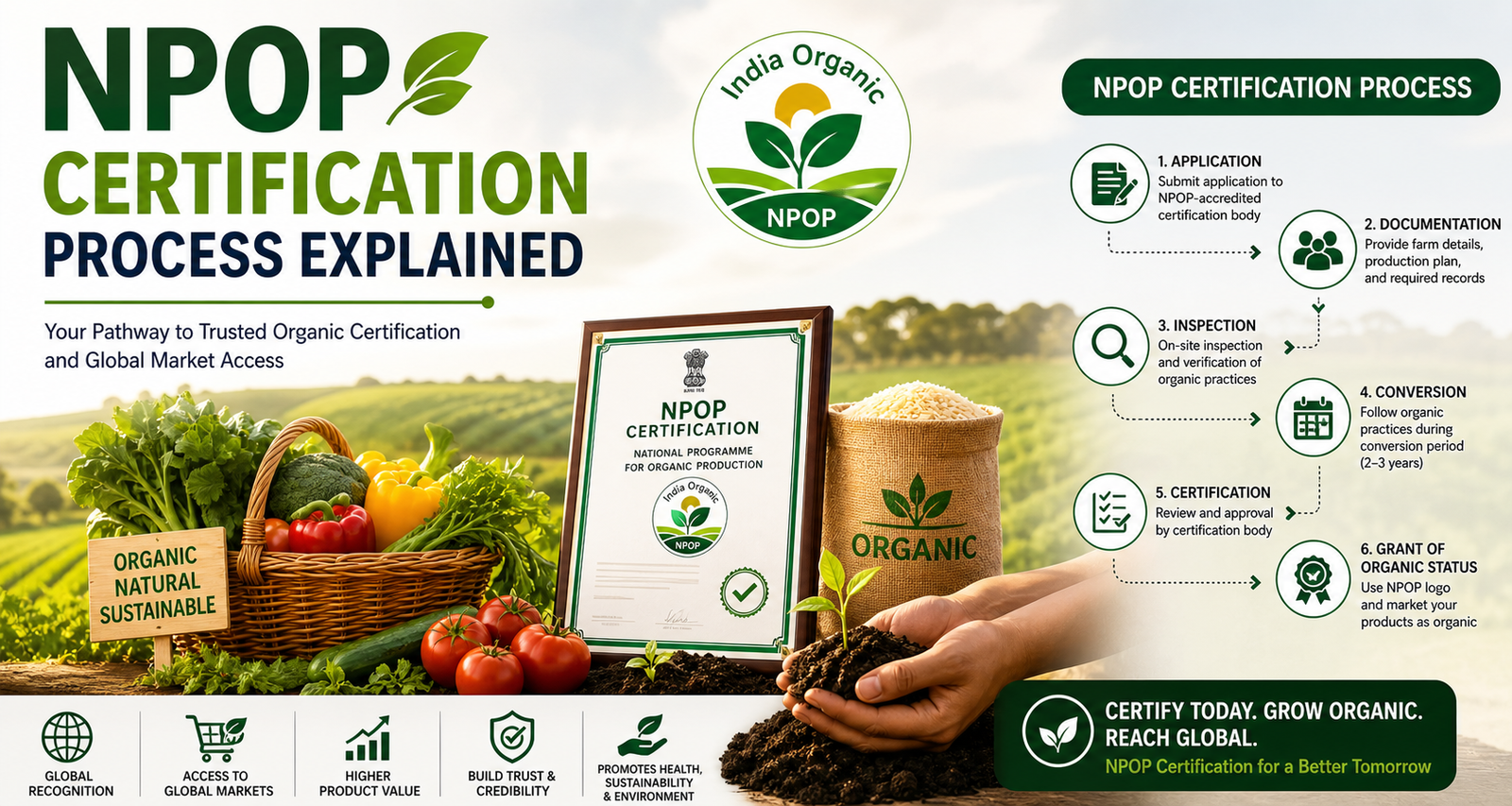
NPOP Certification Process Explained
In the light of increasing consumer demands for organic and chemical-free goods, certification has now become extremely important for businesses seeking to establish themselves and move ahead into niche markets. The NPOP certification scheme is a vital factor for Indian businesses in regulating organic production. It makes sure that the agricultural and processed food products being produced conform to high organic standards. With the right kind of assistance from GCQS, a business can get through its NPOP certification without any problems.
1. What Is NPOP Certification?
The acronym NPOP stands for National Programme for Organic Production. It is a government-certification system in India.
The NPOP certification is executed by the Agricultural and Processed Food Products Export Development Authority (APEDA), an organisation run by the Ministry of Commerce.
The purpose of NPOP certification is to make sure that products branded as “organic” follow all the organic farming standards.
2. Why NPOP Certification is Important
Organic certification is not just a label, it is a mark of trust and compliance.
Key Benefits:
- ensures the authenticity of organic products
- builds consumer confidence
- enables export of organic products
- increases product value and pricing
- meets international organic standards
NPOP certification is recognised globally and is essential for exporting organic products from India.
3. Who Needs NPOP Certification?
NPOP certification is required for businesses involved in:
- organic farming
- food processing units
- organic product exporters
- packaging and labelling units
- traders and distributors of organic goods
It applies to both agricultural products and processed organic foods.
4. Step-by-Step NPOP Certification Process
Knowledge of the process makes it easy for organisations to be well-prepared and prevent any delay in the procedure.
4.1 Step 1: Application Process
The first step involves applying to a certified agency accredited under NPOP.
The application process requires:
- the applicant’s details,
- details about the farm/facility,
- type of product,
- production process.
4.2 Step 2: Selecting the Certification Agency
Select a certification body certified under NPOP.
They undertake the inspection, validation, and certification process.
4.3 Step 3: Preparing Documentation
Documentation requirements include:
- history of the farm,
- details of the land,
- plan for organic farming,
- details on inputs used,
- processing procedures (if applicable).
4.4 Step 4: On-Site Inspection
The certifying body performs an inspection of the farm/facility physically.
This involves:
- inspection of farming practices
- confirmation of inputs
- review of records
- no use of prohibited materials
4.5 Step 5: Conversion
In cases where the farm is not organic initially, a conversion period (usually 2-3 years) should occur.
This entails:
- prohibition of use of chemical fertilizers/pesticides
- adherence to organic farming practices
4.6 Step 6: Certification Process
- Upon inspection, findings are reviewed by the certifying body.
- If found to comply, certification will be awarded to the business.
4.7 Step 7: Grant of Organic Status
Having been certified, the business can market the produce as “Organic” according to the NPOP certification program.
5. Key Requirements for NPOP Certification
To become certified, businesses must follow strict organic standards:
5.1 Chemical-free Production
Artificial fertilizers, pesticides, and GMOs are prohibited.
5.2 Soil and Plant Management
Employ natural methods like composting and crop rotation.
5.3 Traceability
Maintain detailed records of all production and logistical procedures.
5.4 Segregation
Dedicate separate processes for handling and storing organic and conventional produce.
6. Timeline for NPOP Certification
This depends on the level of preparedness of the business.
- Application and Inspection: 1-2 months
- Conversion Process: 2-3 years (if required)
- Certification Approval: post-inspection clearance
Organic-compliant organisations will be able to complete certification quickly.
7. Common Challenges in NPOP Certification
Some of the problems that may arise in business include:
- failure to produce adequate documentation
- failure to adhere to organic practices
- confusion about the conversion process
- delay in the inspection and approval process
- failure to segregate produce
Such problems may cause delays in the certification process if not sorted out.
8. How GCQS Assists in NPOP Certification
Global Certification for Quality and Sustainability (GCQS) assists in the NPOP certification process.
GCQS assists in:
- filling applications
- documenting procedures
- formulating an organic production plan
- preparation for the inspection process
- adhering to certification procedures
renewal and auditing of the certification process
9. Benefits of NPOP Certification for Exporters
9.1 Global Market Access
Certification by NPOP is accepted worldwide, allowing for exports.
9.2 Increased Market Price
Organic products have higher prices.
9.3 Increased Credibility
Creates credibility among health-conscious consumers.
9.4 Compliance With Regulations
Ensures compliance with organic regulations in India and internationally.
10. Conclusion
NPOP certification is important for companies that want to manufacture and export organic products from India. This certification helps them comply with high standards and gain consumer and international buyer confidence.
While NPOP certification is quite extensive and requires a lot of paperwork and inspections, with careful planning and professional help, it will not pose any problems. With assistance provided by GCQS, companies can get their NPOP certification smoothly.
The benefits of NPOP certification are obvious; however, it requires some effort to obtain.