How Much Does ProTerra Certification Cost in India?
With an increasing emphasis worldwide among consumers and companies toward sustainability, ethical sourcing, and being environmentally conscious, ProTerra Certification in India is emerging as an important certificate for companies operating in the domains of agriculture, food production, feed production, and logistics. Businesses that want to enter international markets can obtain ProTerra certification.
The question that crops up in such cases is: What is the cost of ProTerra Certification in India? Well, there are several things that affect the cost of obtaining this certification.
In this article, we will look at the various factors that affect the costs of ProTerra Certification, the steps involved, the documentation needed, and the role of ProTerra certification consultants.
1. What is ProTerra Certification?
ProTerra certification is an internationally acknowledged standard for sustainability, which represents social responsibility, environmental sustainability, traceability, and production that does not contain any GMOs. This type of certification is very preferable for companies engaged in agricultural products such as soy, corn, sugar, and similar items.
ProTerra certification allows a company to comply with the international standards of sustainability, and thus, its credibility is improved.
2. Why is ProTerra Certification Required in India?
India is among the top countries that produce agricultural and food items. Nowadays, everything depends on the issue of sustainability; therefore, firms adopting sustainable practices earn more profit. Various benefits can be derived from ProTerra certification in India:
- International market access
- Creating a good reputation
- Customer trust
- Effective supply chain management
- Following the international standards of sustainability
Competitive advantage in international business operations.
3. Factors Affecting ProTerra Certification Cost in India
Costs for certification are not constant but vary according to each particular organisation. There are various aspects that influence the costs incurred in the certification process.
3.1. Company size
Generally, larger companies with many plants, production units or large supply chains will incur higher costs when obtaining certifications due to the need for extensive audits.
3.2. Certification scope
The certification scope is a very important factor that determines costs. Costs associated with the certification of a single facility within a company are likely to be lower than in a company certifying multiple sites.
3.3. Duration of the audit
Fees for certification are calculated according to the audit duration. Large companies with complicated operations and extensive records can take longer during the audit period.
3.4. Supplier chain complexity
Companies involved in dealing with many suppliers, processors, distributors and exporters tend to have increased costs due to the need for extensive audits.
3.5. Consultants for certification
Many companies employ ProTerra certification consultants to help them with the certification process. Consultant costs depend on the extent of services offered by the consultant.
4. Estimated Cost of ProTerra Certification in India
Despite wide variation in cost, the following expenses can be expected when getting certified:
4.1 Gap Assessment and Analysis
Pre-certification gap analysis helps determine gaps that need to be addressed before certification. The process may include consultancy fees and other assessments.
4.2 Sustainability Documentation and Development
This step includes creating sustainability plans, tracking processes, monitoring suppliers, and documenting other processes.
4.3 Audit Fees for Certification
The certification agency will charge the organisation audit fees according to various factors, such as the size and operational complexities of the organisation.
4.4 Surveillance Audits per Year
For maintaining the ProTerra certification, organizations need to have regular surveillance audits conducted periodically.
4.5 Employee Training and Awareness
Training programs for employees may be required to meet ProTerra requirements and sustainability needs.
The cost of certification in India varies from moderate to high, depending on organizational size and certification level. Small and medium organizations usually incur lower costs compared to large export organizations.
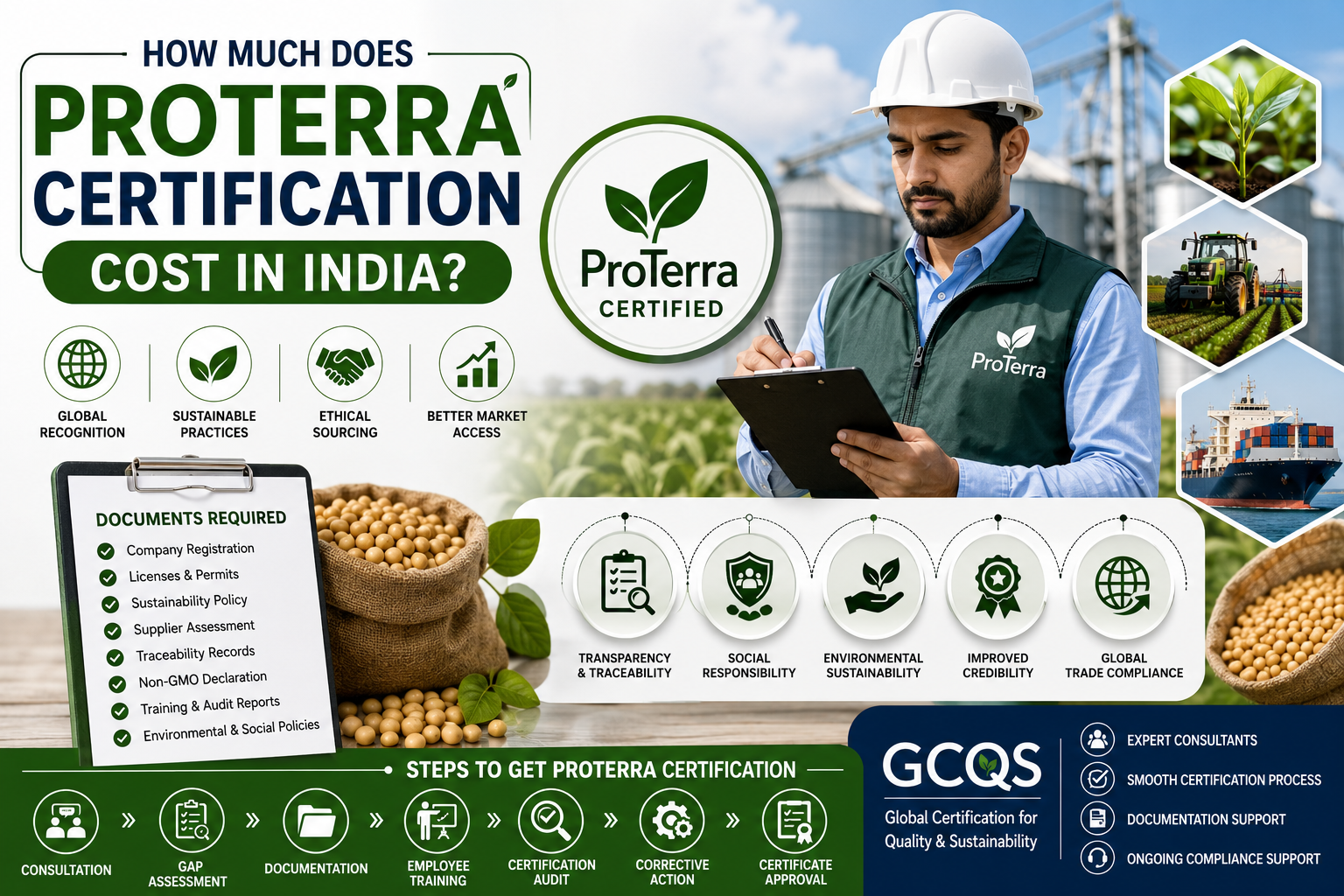
5. Documents Required for ProTerra Certification Approval
The preparation of documentation forms one of the crucial processes in the certification process. Documentation ensures that auditors are able to confirm ProTerra requirements.
Documents Required for ProTerra Certification Approval Are as Follows:
- Registration documents
- License documents
- Structure information
- Sustainability policy documents
- Supplier assessment documents
- Documentation on traceability/chain-of-custody
- Non-GMO testing documents (where applicable)
- Training documents
- Policies on environmental management
- Policies related to social responsibilities/labor compliance
- Production and operation documents
- Audit report documents
- Action plan documents
These documents are likely to enhance the speed of the certification process while minimising any form of delay.
6. Role of ProTerra Certification Consultants
Most companies tend to hire ProTerra certification consultants who have experience in order to facilitate the certification process.
Some of the things that consultants usually help with include:
- Gap assessment and preparation for readiness
- Documentations
- Training employees
- Process improvement suggestions
- Conducting internal audits
- Preparing for certification audits
- Keeping an eye on compliance issues
Professional guidance can help businesses avoid common mistakes and achieve certification more efficiently.
7. Steps to Obtain ProTerra Certification in India
Steps involved in getting certified include:
7.1 Step 1: First Consultation
This entails discussing certification criteria and organisational preparedness for certification.
7.2 Step 2: Gap Assessment
Gaps that need correction to make the organisation adhere to ProTerra requirements will be identified.
7.3 Step 3: Documentation
Documentation of requirements that need to be met in line with ProTerraâs requirements.
7.4 Step 4: Employee Training
Training of employees on sustainability requirements.
7.5 Step 5: Certification Audit
Carried out by an authorised certification body.
7.6 Step 6: Corrective Action
Correcting nonconformities.
7.7 Step 7: Certificate Approval
Certificate approved when there is conformance.
8. Conclusion
There are various elements that could affect costs associated with ProTerra certification, including the size of the organisation, complexity, audit, and consulting, among others. Despite the existence of costs associated with certification, the benefits, such as market accessibility, credibility, and performance sustainability, make it worth certifying.
Organisations intending to get the ProTerra certification will have to take into account some aspects like preparation, record-keeping, and availability of consultants to assist in securing the certification. This will make it easier for organisations to obtain ProTerra Certification Approval.