FSMS Certification in India: Everything You Need to Know About ISO 22000 Standards
In the food industry these days, it is very important to make sure the food is safe to eat. People who buy food, government officials, store owners and buyers from countries all want food companies to make sure their food is good and safe. This is where getting a Food Safety Management System certification in India is really helpful.
A good Food Safety Management System helps companies find problems that can make food unsafe, control them and stop them from happening in the place all along the line from farm to table. One of the known standards for keeping food safe is the ISO 22000 certification in India. When a company gets this certification, it shows that they are serious about making food and following the rules that the government sets. Food Safety Management System certification in India is very important for food companies.
1. What is FSMS Certification?
Food Safety Management System certification is a way to find out what can go wrong with food and stop it. It makes sure that food is safe from the time it is made to the time it is eaten.
A company that has a Food Safety Management System certification can do these things:
- Â Identify things that can make food unsafe
- Put in place controls to prevent problems
- Make their operations work better
- Do what the law says they must do
- Make customers trust them
For people who make food, process food, sell food, package food and get food from one place to another, having a Food Safety Management System certification in India is getting more important if they want to keep growing and selling food. Food Safety Management System certification is really important for these companies.
2. Understanding ISO 22000 Standards in India
The ISO 22000 standards in India give us a framework that is accepted over the world for setting up and running a Food Safety Management System.
This system is developed by the International Organisation for Standardisation, which is also known as ISO.
- The ISO 22000 standards include things like
- Hazard Analysis and Critical Control Points, which is also called HACCP
- Prerequisite Programs, which are also called PRPs
- Thinking about risks
- Always trying to improve
- Making sure everyone in the food chain talks to each other effectively
The ISO 22000 standards apply to every organisation that is involved in the food supply chain, no matter how big or small it is.
The ISO 22000 standards are important for the Food Safety Management System in India.
3. Why is ISO 22000 Certification Important?
Obtaining ISO 22000 certification in India gives food businesses benefits.
3.1 Enhanced Food Safety
The ISO 22000 certification helps organisations find hazards and take steps to prevent food safety risks.
3.2 Regulatory Compliance
ISO 22000 helps businesses follow food safety rules and laws in India and other countries.
3.3 Increased Customer Confidence
Partners like working with organisations that have an ISO 22000 food safety certification.
3.4 Better Market Opportunities
Businesses with ISO 22000 certification can easily enter international markets, especially when exporting food products.
3.5 Improved Operational Efficiency
A proper Food Safety Management System helps businesses simplify processes reduce waste, and boost productivity with ISO 22000.
4. Who Should Obtain ISO 22000 Certification?
The standard applies to any organisation in the food chain, including:
- Food manufacturers
- Food processing units
- Dairy and beverage companies
- Catering services
- Restaurants and hotels
- Food packaging manufacturers
- Cold storage facilities
- Warehousing and logistics providers
- Agricultural producers
- Ingredient suppliers
Whether a company’s small or large, getting Management System certification under ISO 22000 shows it cares about food safety.
5. Key Requirements of the ISO 22000 Standards
To get ISO 22000 certification in India, organisations must meet requirements, including:
5.1 Food Safety Policy
The organization must have a clear food safety policy that matches its business goals. The policy must focus on food safety.
5.2 Hazard Analysis
The organization must. Assess potential food safety hazards during production. Food safety hazards are a concern.
5.3 Operational Controls
The organization must put in place controls to prevent contamination and food safety incidents. Food safety incidents can be prevented.
5.4 Communication Management
The organization must communicate effectively with suppliers, customers, regulatory authorities and internal teams. Effective communication is crucial.
5.5 Monitoring and Verification
The organization must regularly. Verify its food safety controls. Food safety controls must be checked.
5.6 Continuous Improvement
The organization must always. Improve its Food Safety Management System to keep its certification. The system must be improved.
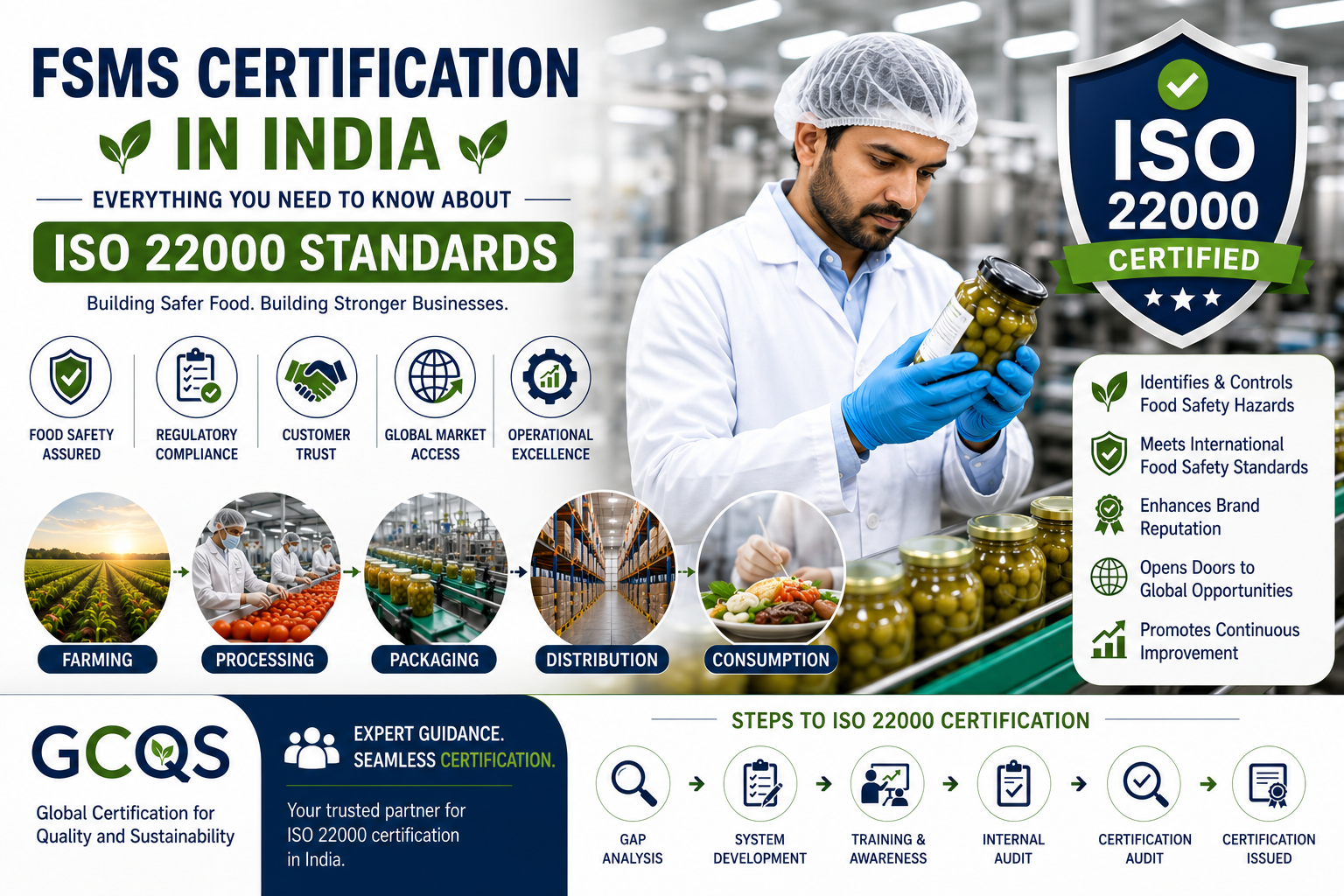
6. Steps to Obtain ISO 22000 Certification in India
6.1. Gap Analysis
A detailed assessment is done to find gaps between practices and ISO 22000 requirements. The assessment helps identify gaps.
6.2. System Development
Policies, procedures and food safety controls are set up according to the standard. The standard provides guidelines.
6.3. Employee Training
Staff members get training on food safety principles and system requirements. Employees must understand food safety.
6.4. Internal Audit
Internal audits are done to check system effectiveness and find improvement opportunities. Audits help improve the system.
6.5. Certification Audit
An accredited certification body does an audit to check compliance. The audit checks compliance.
6.6. Certification Issuance
If the audit is successful, the organisation gets ISO 22000 certification in India. The organisation receives certification.
7. How GCQS Helps Businesses Achieve Certification
Global Certification for Quality and Sustainability provides guidance and support to organizations that want to get Food Safety Management System certification in India.
They help with everything from the meeting to getting ready for certification.
The team at Global Certification for Quality and Sustainability works closely with organizations to make sure they follow the ISO 22000 standards in India without disrupting their work.
If you are looking for the people to help you with ISO 22000 certification in India Global Certification for Quality and Sustainability can help you get certified quickly and make sure your system works well in the long run.
8. Choosing the Best ISO 22000 Consultants in India
When you pick a consultant, you should think about these things:
- How much experience do they have in your industry
- How well they know the food safety rules
- If they have successfully implemented these systems before
- If they can tailor their help to your needs
- If they will support you after you get certified
- If they have a track record with their clients
Working with the best people can make it easier to get certified and improve your results.
8.Conclusion
As people care more and more about food safety, it has become very important for companies to have a Food Safety Management System in place.
Getting certified in India can help companies do better with food safety, follow the rules and gain the trust of their customers.
By following the ISO 22000 standards in India, food companies can create a system that is recognised worldwide and helps them provide quality and safety to their customers.
With the help of Global Certification for Quality and Sustainability, companies can get ISO 22000 certified in India. Become stronger in the food industry.