Documents Required for FSSAI Registration in India
The Indian food industry is among the most flourishing industries, with several new food enterprises coming into existence each year. If you plan to establish your own restaurant, cloud kitchen, food manufacturing company, bakery, or even an online food business, getting FSSAI Registration in India becomes mandatory. The FSSAI registration guarantees that your food enterprise is following safety and hygiene norms prescribed by the Food Safety & Standards Authority of India (FSSAI).
It is important to get familiar with the FSSAI registration process and gather all the documentation requirements beforehand to make sure there is no delay in registering your business.
1. What is FSSAI Registration?
The FSSAI Registration is an important and compulsory document for all food business operators (FBOs) engaged in the production, manufacture, packing, distribution, storage, transport, and sale of any food product. This registration indicates that your business is adhering to food safety norms and supplying quality food products to your customers.
Based upon the scale and annual turnover of your business, you may require either of these registrations:
- Basic FSSAI Registration
- FSSAI State License
- Central FSSAI License
Proper submission of FSSAI application documents is crucial for obtaining approval from the authorities.
2. Why is FSSAI Registration Important?
There are some advantages of the FSSAI license, which include:
- Gives customers the confidence to trust you.
- Compliance with food safety regulations.
- Brand reputation enhancement.
- Makes expansion and partnership easy.
- Aids in avoiding any legal action and fines.
- Allows businesses to sell their goods on online marketplaces.
Each entrepreneur looking forward to registering for an FSSAI license for a food business needs to be aware of the documentation needed.
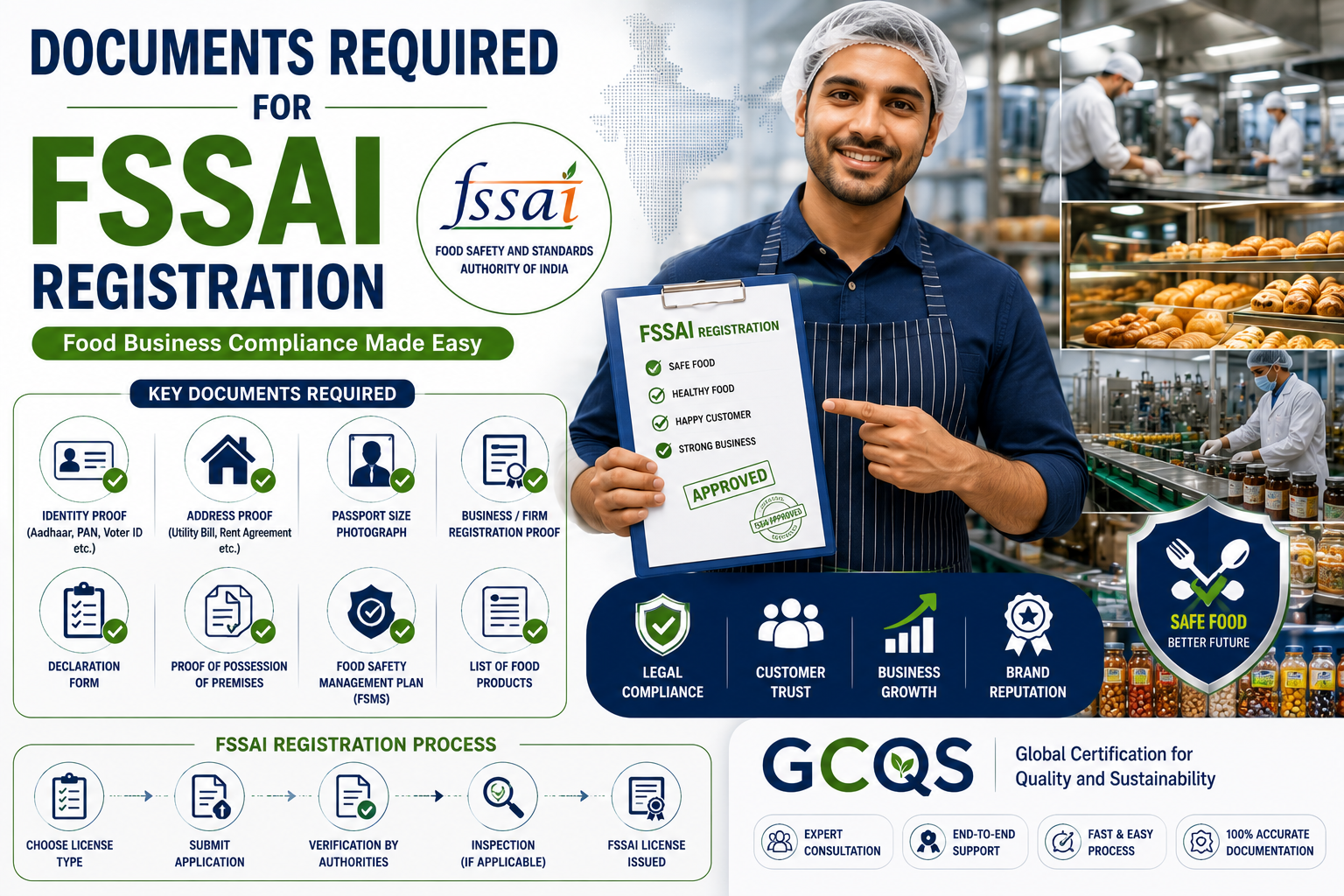
3. Documents Required for Basic FSSAI Registration
Simple registration is used for small-scale food operators who have a yearly turnover of up to ₹12 lakh.
These are some basic documents that are needed for FSSAI licensing in India:
3.1. Recent Passport-size Photograph
A photograph of the applicant.
3.2. Identification Proof
Either one of these:
- Aadhaar Card
- PAN Card
- Voter ID
- Driving License
- Passport
3.3. Proof of Address
This includes documents like:
- Electricity Bill
- Water Bill
- Telephone Bill
- Rent Agreement
- Tax receipt of property
3.4. Proof of Business Address
Proof of the address of the food business being run.
3.5. Declaration Form
A signed declaration confirming compliance with food safety regulations.
4. Documents Required for State FSSAI License
Firms that have a turnover of more than ₹12 lakh but not more than ₹20 crore usually need a State License.
Documents required for the FSSAI Application include:
4.1 Form B Application
The prescribed form needs to be properly filled and duly signed.
4.2 Identity & Address Proof
It is proof of the applicant’s identity and address.
Constitution Documents of Business
4.3 Partnership Deed
Incorporation Certificate
MOA (Memorandum of Association)
AOA (Articles of Association)
4.4 Proof of Possession of Premises
- Rent Agreement
- Lease Deed
- Possession Documents
- List of Food Products
List of all the products which are going to be processed/manufactured/sold.
4.5 FSMS (Food Safety Management System)
This is a document containing the procedure for food safety measures adopted by the firm.
4.6 Details of Equipment/Machinery
Details about the equipment/machinery being used in processing/ manufacture of foods.
4.7 No Objection Certificate (from Municipality)
If applicable, a No Objection Certificate from local authorities.
5. Documents Required for Central FSSAI License
The companies which have an annual turnover in excess of ₹20 crore or those engaged in import-export business activities will need a Central License.
The list of additional documents that can be attached along with FSSAI license application in India is:
- Import/Export code (IEC)
- Ministry of Commerce Certificate
- Water Analysis report
- FSSAI approved NOC (No Objection Certificate)
- Raw material source
- Food recall plan
- Authority Letter (with relevant personnel details)
6. Step-by-Step FSSAI Registration Process
6.1 Step 1: Determine the License Type
Find out whether you need a Basic Registration, State License, or Central License for your business.
6.2 Step 2: Collect Required Documents
Collect all required documentation for the FSSAI application prior to applying.
6.3 Step 3: Apply Online for FSSAI
Submit your FSSAI application via their website portal and attach the required documents.
6.4 Step 4: Verify by Authorities
Your application and attached documentation are verified by the relevant authorities.
6.5 Step 5: Inspection (When Necessary)
Inspection at the premises might be performed in some cases.
6.6 Step 6: Issue FSSAI Certificate
Issue your FSSAI certificate following the successful verification procedure.
7. Mistakes to Avoid When Applying for FSSAI Certification
- Failing to submit complete documentation.
- Attaching blurry or faulty documentation.
- Supplying false information on your business.
- Incorrect selection of the category of the license.
- Omitting food safety management requirements.
You can make sure your FSSAI certification goes much faster if you avoid these mistakes.
8. Why Choose Global Certification for Quality and Sustainability?
Applying for an FSSAI license may not be straightforward due to documentation and licensing procedures. Global Certification for Quality and Sustainability offers professional help in obtaining FSSAI Registration in India. They ensure that your organisation is provided with the necessary documents and registered in a seamless manner.
They offer a range of services including:
- Complete registration services
- Provision of required documentation
- Assistance with compliance issues
- Application filing within a short period of time
- Professional consultancy for food businesses
9. Conclusion
FSSAI Registration in India is mandatory for all food businesses for proper regulation and gaining customer trust. Making use of the correct FSSAI application documents and understanding the process of applying for the same will save time and avoid delays.
For those who own a small food business or a large manufacturing plant, obtaining the appropriate FSSAI documents in India will serve as the first step towards success. Professional help can simplify this task for your benefit.