Common Mistakes to Avoid During FSSAI Registration
There are many legal duties to be fulfilled while setting up a food business in India, and one of the most significant among them is getting FSSAI registration online in India. Regardless of whether you run a food stall, restaurant, cloud kitchen, catering company, food manufacturing plant, or even an online food business, it becomes imperative to follow the rules laid down by the Food Safety and Standards Authority of India.
A lot of businesses often fail to register due to some avoidable errors on their part. Knowing about these common pitfalls will help you get your FSSAI Registration for Food Business without any hitches.
Here are some of the common mistakes made while registering for FSSAI.
1. Why FSSAI Registration Is Important
The Food Safety and Standards Authority of India is responsible for ensuring the safety of food products in the country through various quality and hygiene standards set by them. Each of the eligible food business operators (FBOs) should register themselves or obtain the proper license before starting operations.
Getting proper FSSAI Certification in India gives you many advantages:
- Building Trust with customers
- Following all the laws and regulations
- Improving food safety practices
- Helping you grow your business in different locations
- Making it possible to cooperate with food delivery portals and retail food businesses
Above all, it proves your commitment towards Food Safety Compliance India.
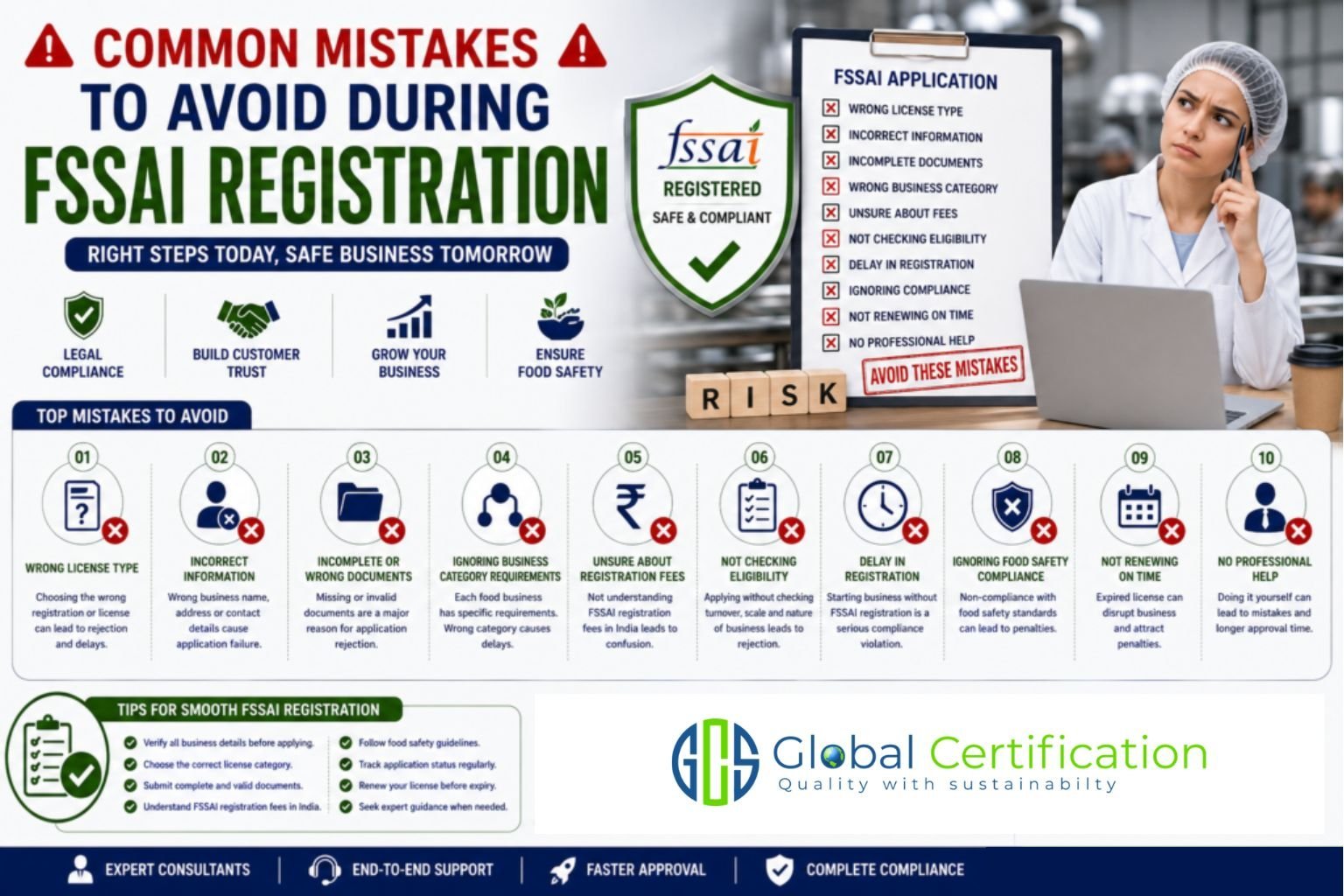
2. Mistakes You Should Avoid While Registering for FSSAI
2. 1. Selecting the Wrong Kind of Registration/License
Choosing the wrong kind of FSSAI registration is one of the biggest mistakes people make while registering for FSSAI.
For a food business, it would be necessary to opt for one of the following categories:
- Basic Registration
- State License
- Central License
The requirement of each category will depend upon some factors like annual turnover, size of business, kind of business and geographic location.
2.2. Providing Incorrect Business Information
Many applications have been held up due to inaccurate information being submitted like:
- Incorrect name of the business
- Incorrect address of the business
- Incorrect contact details
- Mis-matching documents in relation to the application
It is always advisable to crosscheck every piece of information that is being provided for FSSAI registration in India.
2.3. Uploading of Inaccurate or Incomplete Documents
Inaccuracy in documentation constitutes one of the most prevalent causes of rejection of applications.
Documents usually include:
- Proof of identity
- Proof of address
- Documents of business registration
- Photographs of passport size
- Proof of premises
- Plan of food safety management (in case applicable)
It is very important to go through all the documents uploaded by you very carefully.
2.4. Overlooking the Business Category Requirements
Different kinds of food businesses have different requirements of licensing.
For instance:
- Restaurants
- Manufacturers of food products
- Importers of food products
- Cloud kitchens
- Retailers of food products
- Wholesalers
- Transporters of food products
Each category may require additional documentation or approvals during FSSAI Registration for Food Business.
Selecting the wrong business category can delay approval.
2.5. Not Understanding FSSAI Registration Fees in India
Many businesses believe that all types of registrations cost the same.
But the FSSAI registration charges in India depend upon:
- Type of registration
- Type of license
- Size of the business
- Validity period of license
Applicants need to check the charges to be paid before filing the application to avoid problems.
2.6. Submitting Application Without Checking Eligibility
There are many businesses which submit an application for Basic Registration while they need State or Central License.
Eligibility depends upon:
- Annual Turnover
- Nature of the food business
- Production Capacity
- Number of business units
- Export or Import activities
Filing the wrong type of application often leads to the rejection of the application.
2.7. Delay in the process of Registration
Many start-ups begin the business activity without getting FSSAI registration.
It is a very serious compliance issue.
The food business organizations should have proper registration before selling or distributing the food products.
2.8. Ignoring Food Safety Compliance After Registration
Getting the certificate is just the beginning.
It is necessary to maintain Food Safety Compliance India as per the hygienic standards, food handling techniques, and rules.
Inspections and audits might be done to check compliance.
2.9. Not Renewing the License on Time
The validity period for the FSSAI license is fixed.
Many organizations miss out on the renewal deadline which results in:
- Expired license
- Disruptions in business operations
- Fine
- Need to re-apply
Always keep track of the renewal deadline and start the renewal process way ahead of time.
2.10. Attempting to Register without Professional Help
Although most companies manage to register themselves with the FSSAI in India online, complicated cases where manufacturers, exporters, importers, and multi-site businesses are involved need professional help.
Professional certification consultants will be able to:
- Help you figure out the right license
- Help in preparing the documents
- Prevent any mistakes in the application
- Help get approvals quickly
- Stay compliant with regulations
- It will help save time and efforts.
3. Tips for a Smooth FSSAI Registration Process
In order to prevent any sort of delay and rejection, following best practices will help:
- Confirm your business details before making your application.
- Choose the right category for registration.
- Make sure that you have prepared all the documents that are needed.
- Get familiar with the FSSAI registration fees in India.
- Comply with the food safety guidelines.
- Regularly check the status of your application.
- Renew your license before it expires.
- Consult with experts when needed.
By doing these things, there is much higher possibility for successful registration.
4. How Global Certification for Quality and Sustainability Can Help
Getting FSSAI Certification in India becomes very easy when you have got experts guiding you through the entire process.
Global Certification for Quality and Sustainability guides food businesses through their FSSAI registration process, including documentation, filing, compliance, choosing and renewing licenses. With the help of their experienced team, food businesses find it easier to comply with the Food Safety and Standards Authority of India guidelines.
If you have decided to start up a food business or to expand an already existing one, you definitely need professional help.
5. Conclusion
Registration with FSSAI for a food business is a critical requirement in establishing legal operations and increasing trust among customers. By taking precautions against some of the common pitfalls, like choosing an incorrect license, giving out erroneous information, ignoring documentation, and failing to renew on time, you will avoid wasting your precious time.
The requirements from the Food Safety and Standards Authority of India, commitment to Food Safety Compliance India, and collaboration with professionals like Global Certification for Quality and Sustainability will make sure that your registration process will be smooth and without difficulties.