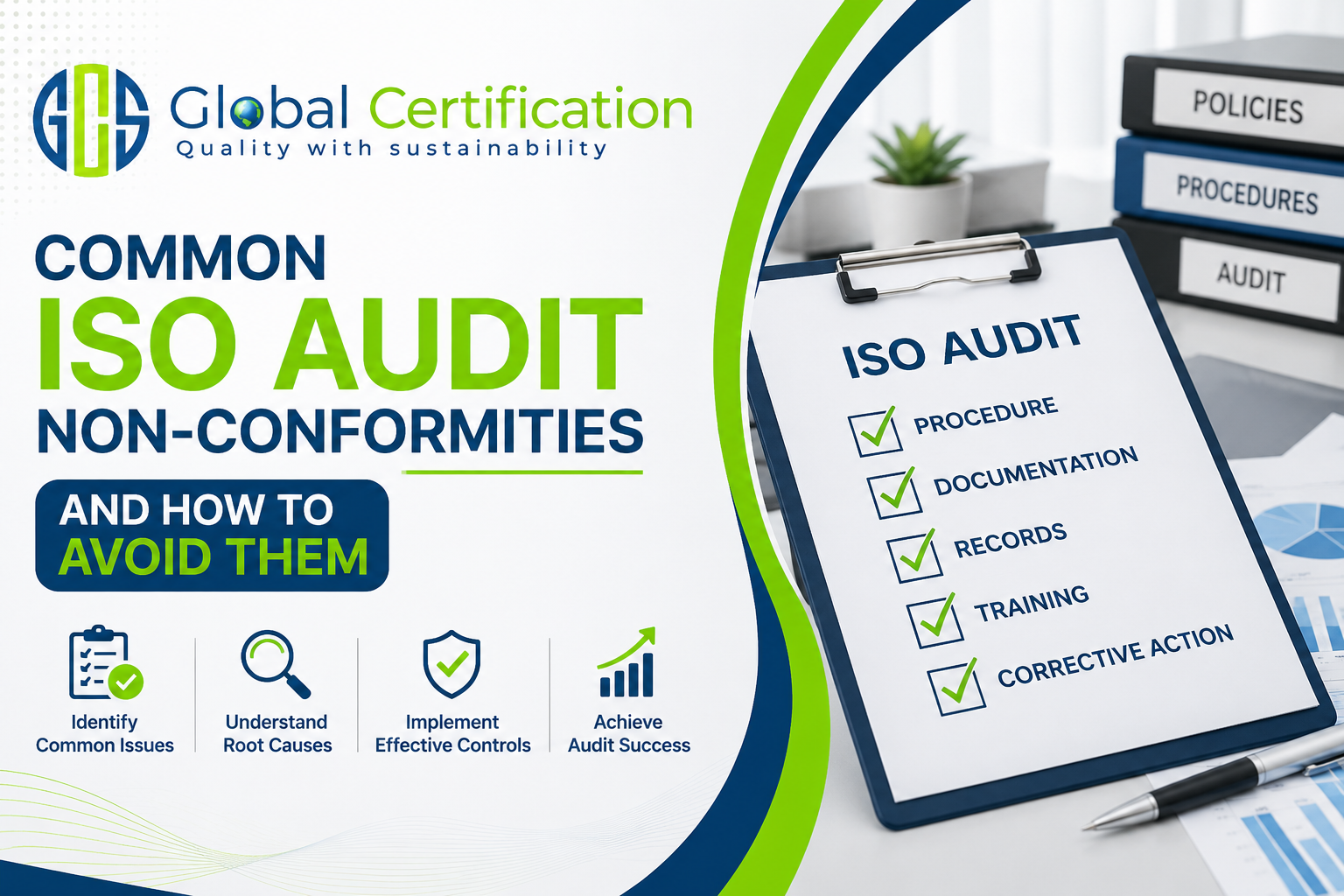
Common ISO Audit Non-Conformities and How to Avoid Them
ISO Certification is a major achievement in improving quality, safety, efficiency, and customer satisfaction. But companies often encounter certain difficulties in conducting either internal or external audits because of ISO audit non-conformities. It may cause delays, increase costs and negatively influence company reputation.
It would be useful to work with an ISO Certification Consultant to foresee possible gaps in your company’s performance and comply with all the ISO requirements. Regardless of whether you have just applied for ISO Certification in India or you have already got the certificate, knowing the main problems is the very first step towards success.
We will talk about the most frequent ISO Audit Non-Conformities and ways to avoid them in our blog.
What Are ISO Audit Non-Conformities?
Non-Conformities in ISO Audits refer to cases in which the processes, documents, or systems of an organisation are not meeting the requirements of a particular ISO standard. These non-conformities are identified by auditors while conducting audits of the organisation.
These non-conformities can be broadly categorised as follows:
Major Non-Conformities: Major issues which affect the functioning of the management system.
Minor Non-Conformities: Minor issues which may not have a serious effect on the management system.
Common ISO Audit Non-Conformities
1. Poor Documentation
Incomplete, outdated, or non-existent documents are one of the most common audit findings. Organisations often neglect to update their procedures, policies, and/or work instructions after any change in operations.
How to Avoid It:
- Control all documents.
- Periodically review and revise all the records.
- Make sure that only the latest approved documents are available for employees.
2. Lack of Employee Awareness
Employees are essential for ISO certification compliance. Auditors often come across instances where the staff is not aware of the company’s policies and/or quality objectives.
How to Avoid It:
- Organise training sessions for your employees.
- Arrange refresher training sessions on ISO standards.
- Test employee knowledge internally.
With the help of an experienced ISO Certification Consultant in India, you can create effective training sessions.
3. Poor Internal Audits
Many organisations conduct internal audits for the sake of checking off the boxes rather than improving their processes. Ineffective internal audits do not reveal any real compliance problems.
How to Avoid It:
- Plan periodic internal audits.
- Conduct audits by competent and independent internal auditors.
- Check on previous audit findings and their resolution.
4. Ineffective Corrective Actions
Other companies identify the problem but do not look into its cause. Merely solving the problem without knowing why it happened normally results in recurring non-conformities.
How to Avoid It:
- Conduct root cause analysis.
- Institute preventive actions.
- Monitor effectiveness of corrective actions.
5. Insufficient Record Keeping
Lack of inspection, calibration, training, or maintenance records is another possible source of audit findings.
How to Avoid It:
- Have well-organized digital or hard copies of your records.
- Develop record retention procedures.
- Ensure accessibility of the records during audits.
6. Non-Conformity to Legal Requirements
Most ISO standards require the organisation to comply with legal regulations. Inability to identify changes in those regulations normally produces audit findings.
How to Avoid It:
- Know the relevant laws.
- Periodically check your compliance status.
- Have compliance assessments conducted regularly.
ISO Compliance Consulting services ensure that your organisation stays abreast of regulatory requirements.
Special Focus on Food Safety Organisations
Companies working in the food industry have some extra compliance requirements. Companies that seek ISO 22000 food safety certification in India should show that they have effective food safety management systems.
Examples of non-conformities include:
- Insufficient hazard analysis
- Faulty critical control point monitoring
- Deficient hygiene records
- Incomplete evaluation of suppliers
- Lacking traceability system
Monitoring, training of employees, and food safety practices minimise the risk of audit non-conformities.
Advantages of Avoiding ISO Audit Non-Conformities
There are many advantages to avoiding non-conformities during an audit:
- Faster certification
- Minimised corrective action costs
- Enhanced efficiency
- Greater customer trust
- Better compliance with regulations
- More business opportunities
- Superior reputation
Organisations with improved management systems will have easy surveillance audits and successful certification.
Best Practices for Successful ISO Audits
The preparation for the ISO Audit is a long process which should be carried out continually rather than on a spur of the moment.
Here are some best practices:
- Have quality goals.
- Ensure documentation is current.
- Perform internal audits regularly.
- Train staff.
- Control the performance of processes.
- Implement corrections right away.
- Evaluate the performance of the management system periodically.
- Stay up-to-date with ISO standards revisions.
These best practices enable organizations to have a culture of continual improvement while minimizing audit risks.
Why Choose An ISO Certification Consultant?
It may be difficult to understand the requirements for certification if you are new to the ISO. An experienced ISO Certification Consultant will guide the applicant throughout the certification process.
The usual services provided by them include:
- Gap analysis
- Documentation
- Staff training
- Assistance with internal audit
- Monitoring of compliance
- Certification
- Implementation of corrections
Selecting an experienced ISO Certification Consultant in India will ensure that your organization adheres to industry best practices and certification requirements.
Why Choose Global Certification for Quality and Sustainability?
Global Certification for Quality and Sustainability is dedicated to assisting in attaining internationally certified ISO certifications through professional consultancy and solutions. From the start to success in acquiring ISO Certifications, you will be provided with ISO Compliance Consulting Services according to the requirements of the business.
If you are looking for ISO Certification in India, ISO Management System Certification in India, and ISO 22000 Food Safety Certification in India, Global Certification for Quality and Sustainability can provide all the required consultancy.
Conclusion
ISO Certification goes beyond mere auditing; efficiency and continuous improvement are the core of ISO Certification. Knowing about the ISO Audit Non-Conformities that are frequently witnessed and adopting appropriate actions can help you to mitigate the risks involved in the auditing process and enhance your performance.
To obtain ISO Certification in India and maintain it, all you need is to collaborate with an expert ISO Certification Consultant and make the best out of ISO Compliance Consulting Services. With the help of Global Certification for Quality and Sustainability, you can transform ISO Compliance into a Competitive Advantage and achieve sustainable growth in this dynamic environment.