How Food Safety Certifications Improve Consumer Trust
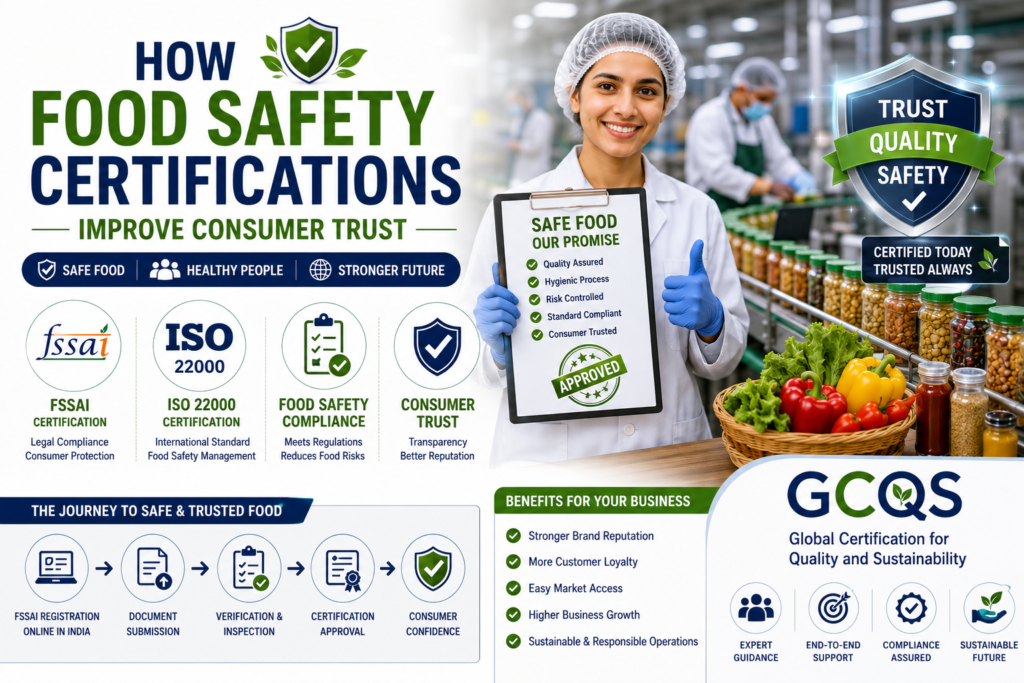
Today, in the highly competitive world of the food sector, customer trust is one of the most valuable assets that a company can possess. Consumers are becoming increasingly conscious about food quality, hygiene, and safety prior to buying food products. Regardless of whether the organisation is a restaurant, food manufacturer, catering company, or food packaging brand, food safety standards are extremely important for success in the long run. Here comes the importance of Food Safety Certification.
FSSAI Certification in India, ISO 22000 Certification, and various other Food Safety Compliance Certifications assist organisations in demonstrating their dedication towards providing consumers with safe and high-quality food products.
1. Why Consumer Trust Matters in the Food Industry
There is a direct relationship between food products and human well-being. A single food safety issue will affect the reputation of a brand, bring in fines, and cause huge economic losses. People now prefer those brands that reveal transparency in terms of safety and quality criteria.
The presence of food safety certificates for food makes people sure of its proper production, processing, storage, and distribution according to specific safety criteria.
2. Understanding Food Safety Certificate
Food Safety Certificate is the official confirmation of the fact that the food company operates in accordance with an established food safety management system and adheres to certain industry rules. There is a whole range of criteria that are assessed while providing such certificates, including hygiene, contamination, quality control, and risk assessments.
A food safety certificate gives a framework for hazard identification and prevention.
3. The Importance of FSSAI Certification in India
Food Safety and Standards Authority of India (FSSAI) is the authority that manages food safety standards in India. To get the FSSAI certification in India, it is compulsory for any food business entity, such as manufacturers, distributors, retailers, and even food service operators.
Nowadays, FSSAI registration in India online is preferred by many organisations because of its ease and efficiency. With an FSSAI license, it can be said that your business organisation follows national food safety norms and standard food handling practices.
Advantages of FSSAI certification include:
- Legal permission to conduct business in the food sector.
- Increased customer trust and reputation of the business.
- Better market access and business opportunities.
- Higher food safety management standards.
- Decreased chances of legal hassles.
Customers trust FSSAI-certified businesses more than those that do not have this certification.
4. How ISO 22000 Certification Enhances Food Safety
While FSSAI ensures that businesses comply with regulations in India, the ISO 22000 Certification ensures that there is an international standard for food safety management systems.
ISO 22000 combines the Hazard Analysis and Critical Control Points (HACCP) concept with risk management practices. This assists companies in recognising any risks related to food safety in the supply chain and setting up measures to ensure food safety.
The benefits of ISO 22000 Certification are as follows:
- Enhancement of food safety management systems.
- Recognition by the international community.
- Operational efficiency.
- Effective risk recognition and management.
- Boosting confidence among stakeholders.
This makes ISO 22000 a relevant certification for global business expansion.
5. The Role of Food Safety Compliance Certification
A Food Safety Compliance Certification indicates that the organisation is complying with all the laws, rules, and guidelines related to food safety. It becomes very essential for such industries whose products have direct influence on the consumers’ well-being.
The benefits of compliance certifications are:
- Showing accountability and transparency.
- Reducing food contamination.
- Enhancing employee awareness.
- Improving customer relations.
- Developing competitive edge.
Nowadays, customers like those brands which can provide a certificate of compliance with food safety laws.
6. How Certifications Build Consumer Trust
6.1. Demonstrate Commitment to Quality
Food safety certification is an indication that the organization values quality in its operations. Customers will have confidence in businesses that are audited on a regular basis.
6.2. Boost Transparency
Certifications offer a means by which the food safety procedures of a company are verified independently. The transparency offered by certification processes makes consumers confident that the company adheres to set standards.
6.3. Decrease Health Risks
Certified firms use precautionary measures that reduce risks associated with contamination and illnesses. Customers feel assured buying their products.
6.4. Build a Good Reputation
Organisations with good reputations concerning food safety gain a competitive advantage over other players in the market. Certifications help in demonstrating professionalism.
6.5. Foster Customer Loyalty
Loyalty arises out of consumer satisfaction with the product. Trust makes consumers stick to certain brands.
7. Global Certification for Quality and Sustainability
Apart from food safety concerns, today’s consumers are also environmentally aware and care about the responsibility of companies towards the environment. Thus, Global Certification for Quality and Sustainability allows showing commitment to both issues, product quality and ethical business activities.
These certifications are aimed at continuous improvement, resource efficiency, and ethical business operations, as well as increasing customers’ confidence in the company. Companies that value their sustainability tend to attract environmentally aware customers, thereby improving their market position.
8. Conclusion
In our days, food safety certifications play an important role in gaining the trust of customers. With such types of certifications as FSSAI registration in India, FSSAI Certification in India, ISO 22000 Certification, and Food Safety Compliance Certification, one will be able to show his commitment to providing safe and high-quality products.
Considering the increasing demands of consumers, obtaining certifications becomes a necessity rather than a choice for companies. Thus, the adoption of Global Certification for Quality and Sustainability along with food safety certifications allows getting customers’ trust and achieving sustainable development in the food sector.