ProTerra vs Organic Certification: Key Differences
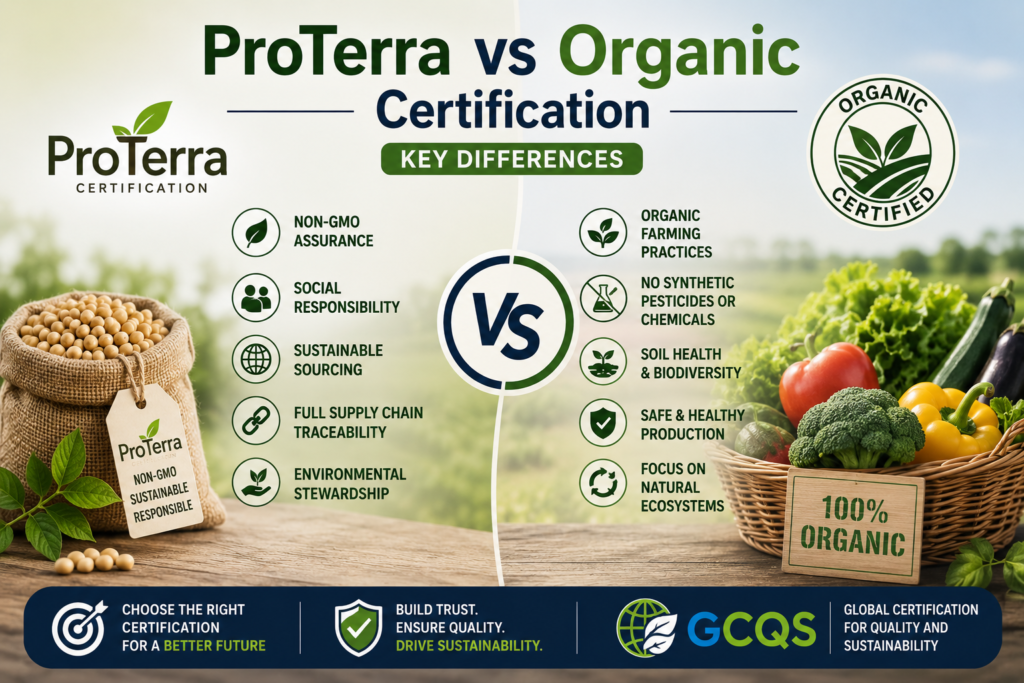
The concepts of sustainability, ethical sourcing, and food safety have become highly relevant in the modern, extremely competitive business environment. Certifications have become an essential element, allowing organisations to gain customer confidence as well as meet the required quality standards. Some of the most common certifications related to the agricultural industry or food are ProTerra Certification and Organic Certification.
Despite being alike in relation to sustainability and responsible production of agricultural or food items, ProTerra Certification and Organic Certification have many differences between them, making it imperative for businesses to be aware of such differences before selecting one over another. Several companies in India seek assistance in acquiring a ProTerra Certification in India.
1. What is ProTerra Certification?
ProTerra certification is a globally accepted sustainability certification program that mainly targets agricultural crops and commodities, food, feed, and biofuel industries. It emphasises environmental responsibility, social accountability, and GMO-free production processes.
The ProTerra certification program guarantees the following features about the products:
- Non-GMO (free from Genetically Modified Organisms)
- Sustainable sourcing
- Socially responsible
- Environment-friendly
- Traceability through the entire supply chain
The ProTerra certification service is commonly utilised in sectors like soy farming, the animal feed industry, the food manufacturing process, and agricultural export.
Many organizations who require ProTerra certification services in India choose the assistance of a professional certification consultant.
2. What is Organic Certification?
The certification of organic products serves as proof that agricultural products have been produced through organic practices. Other requirements for organic production include the following:
- Lack of chemical fertilisers
- No usage of pesticides
- Non-GMO seeds
- No synthetic growth regulators
- No antibiotics in animals
Some core concepts in organic farming involve employing natural mechanisms, biodiversity, and improved soil quality.
Certification processes vary depending on the country involved, and some of the most common include:
- USDA Organic (United States)
- India Organic/NPOP (India)
- EU Organic Certification (European Union)
Organic products are highly sought after in the food and beverage industry, cosmetics, and wellness industry.
3. Main Objectives of ProTerra Certification
ProTerra Certification aims to promote sustainability through the entire chain. This can be achieved by promoting the following:
3.1 Environmental Sustainability
Through ProTerra standards, it becomes possible to minimize deforestation and land use.
3.2 Social Responsibility
Through this certification, fair labour practices are encouraged.
3.3 Non-GMO
This is one of the most important characteristics of the ProTerra certification.
3.4 Transparency in the Supply Chain
This involves traceability from the point of sourcing the materials all through to the distribution of the product.
4. Main Objectives of Organic Certification
The certification of organic food products entails consideration of agricultural practices as well as the quality of the produce.
4.1 Organic Farming Practices
In organic farming practices, there is no use of any chemicals in the process.
4.2 Fertility of the Soil and Biodiversity
There is sustainability in organic farming practices, particularly with regards to the fertility of the soil and biodiversity.
4.3 Human Safety
Organic produce is deemed safe for human consumption due to its lack of chemicals.
4.4 Sustainability
Organic farming practices contribute to sustainability.
5. Key Differences Between ProTerra and Organic Certification
5. 1. Scope of Certification
- ProTerra Certification emphasizes sustainable practice, ethical sourcing, and non-GMO production in its certification process.
- Organic Certification is mostly concerned about agricultural practices and banning synthetic pesticides.
5.2. GMO Restrictions
- Both certifications ban GMOs, but ProTerra has more stringent rules about GMO-free supply chains.
- 3. Social Responsibility
- ProTerra has numerous provisions for social responsibility concerning labor, decent employment conditions, among others.
- Organic Certification tends to emphasise agricultural practices without necessarily focusing on social compliance.
5.3. Traceability in Supply Chain
- ProTerra certification demands full traceability in the supply chain.
- Organic Certification also insists on traceability, but mainly for organic integrity in agriculture.
5.4. Industry Application
Applications of ProTerra include:
- Exported agricultural goods
- Animal feed production
- Food processing
5.5. Commodities trading
Organic Certification is mostly applied in:
- Organic foods
- Cosmetics production
- Herbal products
- Livestock and dairy industries
6. Why Businesses Choose ProTerra Certification
ProTerra Standards are becoming popular among businesses as they aim at increasing their sustainability efforts and meeting the requirements of international buyers.
Some important advantages include:
- Improving access to international markets
- Building consumer confidence
- Establishing sustainability credibility
- Improving supply chain management
- Meeting international trade requirements
Firms interested in getting ProTerra certification services in India will find professional assistance very useful in getting through the process of certification and passing audits.
7. Need for Professional Assistance in Certification
Businesses need to have proper documentation, process alignment, and audits to get certifications internationally. In this case, certification consultants become very helpful.
Global Certification for Quality and Sustainability (GCQS) assists businesses in understanding requirements for certifications and implementing necessary compliance measures for international standards. Having expertise in the business sector, GCQS will assist companies in achieving certifications related to sustainability and quality.
No matter whether you run an agricultural, food processing, export, or supply chain management business, professional advice can be very useful.
8. Conclusion
However, the ProTerra Certification and the Organic Certification differ in their objectives. Where the former focuses on sustainable and socially responsible manufacturing processes, the latter has an emphasis on organic farming, along with the absence of any chemicals in the process.
Organisations must be aware of what they require in light of their industrial requirements or niche in the market to select the appropriate certification for themselves. With the growing popularity of responsible sourcing and sustainable manufacturing processes in the international market, the requirement for certification by organisations is gaining importance.
For those organisations requiring Professional ProTerra Certification Services in India, Global Certification for Quality and Sustainability (GCQS) is the way to go.