Common ISO Certification Mistakes Businesses Should Avoid
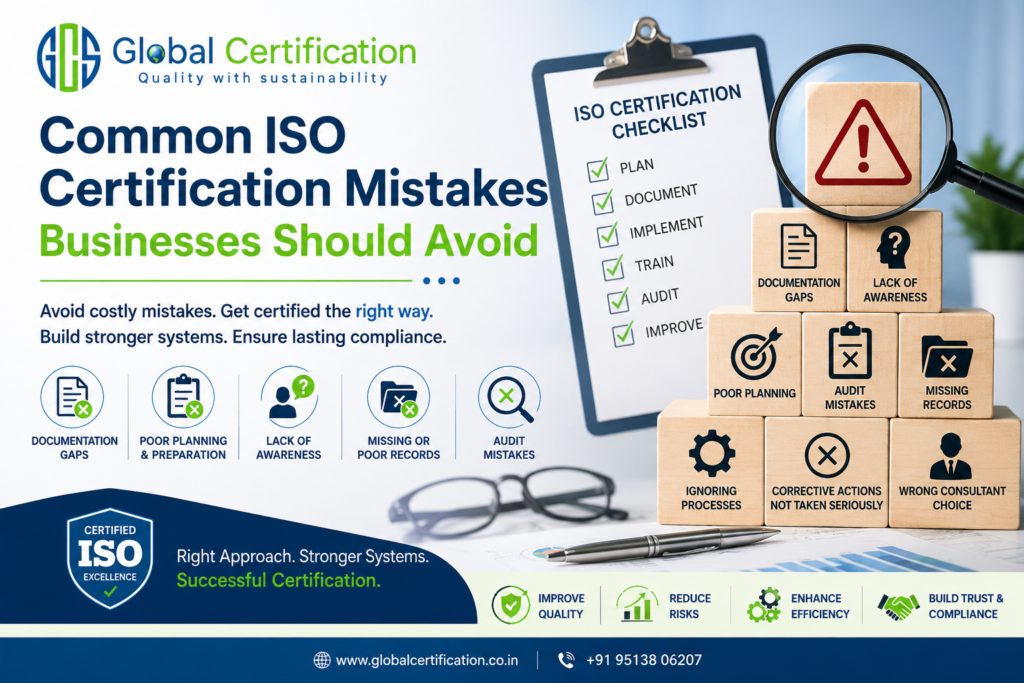
ISO certification can enable companies to improve quality, handle risks, enhance their client’s confidence, and have better processes. But being ISO-certified is not just about document preparation and audits. There are some avoidable ISO certification mistakes that companies commit while preparing for ISO certification, which might cause delays, non-conformance, extra costs, and stress.
Knowing about the common mistakes in ISO certification prior to your certification process will make your process easier and more successful. No matter whether you are preparing for ISO 9001, ISO 14001, ISO 45001, or ISO 22000 food safety certification in India, you must plan accordingly.
1. Treating ISO Certification as Only a Documentation Exercise
The most widespread mistake is the fact that companies tend to concentrate their efforts on creating a set of documents such as policies, manuals, and procedures. Even though these documents play an important role, ISO requirements aim to enhance the way an organisation works.
An auditor expects to see evidence that documented processes are used during work. If employees cannot understand the process or no records are kept, then documentation will not help at all.
An organisation should ensure that its ISO management system is effective, understandable, and linked to its business activities.
2. Being Late in Preparing for ISO Certification
Inadequate preparation is yet another common problem. Some organisations start working on their ISO requirements just a few weeks prior to the upcoming audit, which may cause poorly created documentation, lack of records, lack of employee training, and other process gaps.
ISO certification preparation needs to start long before the certification audit is scheduled.
3. Not Understanding the Applicable ISO Standard
Each ISO standard has its own unique objective and requirements. ISO 22000 has the requirement for food safety management, whereas ISO 9001 has the requirement for quality management.
The company needs to have a clear understanding of the standard that applies to its business as well as its requirements. Misinterpretation of requirements leads to unnecessary effort and compliance gaps.
When it comes to the ISO 22000 food safety certification in India, the requirements for food safety hazard, operational control, monitoring, traceability, and others should be well-known.
4. Ignoring Training and Awareness of Employees
Compliance with ISO standards is not the responsibility of only one manager or one department. The employees at various levels are crucial for the maintenance of the management system.
Preparation of the procedure and lack of communication about the procedure to employees is a common ISO mistake. The employees need to know their responsibilities, procedures, requirements for quality or safety, and the importance of maintaining records.
5. Making ISO Audit Mistakes
Many firms tend to concentrate more on the audit than on improving their systems. This way, firms might end up making some ISO audit mistakes, such as inadequate documentation, discrepancies, lack of proof or failure to prove that the correction has taken place.
All the employees need to be ready to describe their work without any hesitation.
The firm needs to carry out the internal audits before the certification audit so as to find out about its weaknesses.
6. Ignoring Internal Audits
Internal audit is an important component of a good management system. However, some businesses consider it just a formality and only carry it out because it is required by the standard.
It is one of the biggest ISO compliance mistakes that businesses need to avoid.
Internal audit will check whether processes are functioning properly and requirements are adhered to.
7. Failing to Maintain Proper Records
The ISO certification process demands that evidence of implementation be shown. This includes documentation such as training records, inspection records, customer feedback, audit reports, maintenance records, corrective actions records, and process performance records.
Lack of record keeping or inconsistent records can make it hard to demonstrate compliance during an audit.
An organization needs to develop a method that will be simple yet effective in keeping the records and examining them periodically.
8. Selecting the Consultant Solely Because of Cost
Price is certainly one aspect to consider, but choosing an ISO certification consultant only because he charges the lowest price will bring about difficulties in future.
A consultant for ISO certification in India needs to know about the organization’s industry, processes, ISO requirements, and implementation problems. The right consultant helps you identify the gap instead of providing prepared documentation.
The right consultant can make your ISO certification preparation process systematic and effective.
9. Not Taking Corrective Actions Seriously
However, this does not signify the completion of the process of ISO certification, as there is a need to know the reason behind the problem and take necessary measures to solve it. The solution of the problem on a superficial level without knowing the actual cause could result in recurrence of the same.
Avoiding Common Mistakes During ISO Certification
Firms could avoid problems during ISO certification by following a process-based approach that includes the following activities:
Understanding the requirements of the chosen ISO standard.
- Making a gap analysis.
- Preparing realistic documents.
- Training staff members and raising awareness.
- Maintaining proper record keeping.
- Conducting internal audits.
- Correcting non-conformities and taking corrective actions.
- Reviewing the performance of the management system.
- Working with an ISO certification consultant.
Choose the Right Guidance for ISO Certification
ISO certification should be treated as a chance to enhance business processes instead of merely earning a certificate. Not making ISO certification mistakes, preparing employees correctly, keeping evidence, and constantly reviewing the processes may make the whole process of certification much easier.
Organisations searching for professional help can contact Global Certification for Quality and Sustainability, which gives guidance to organisations that are trying to get certified under various ISO standards. Thanks to a proper attitude and professional help, the companies may get their compliance enhanced, get rid of difficulties associated with audits, and create management systems that will ensure the future growth of the business.
The ISO management system should be created not only for the audit.