BRCGS vs ISO 22000: Which Food Safety Standard Is Right for Your Business?
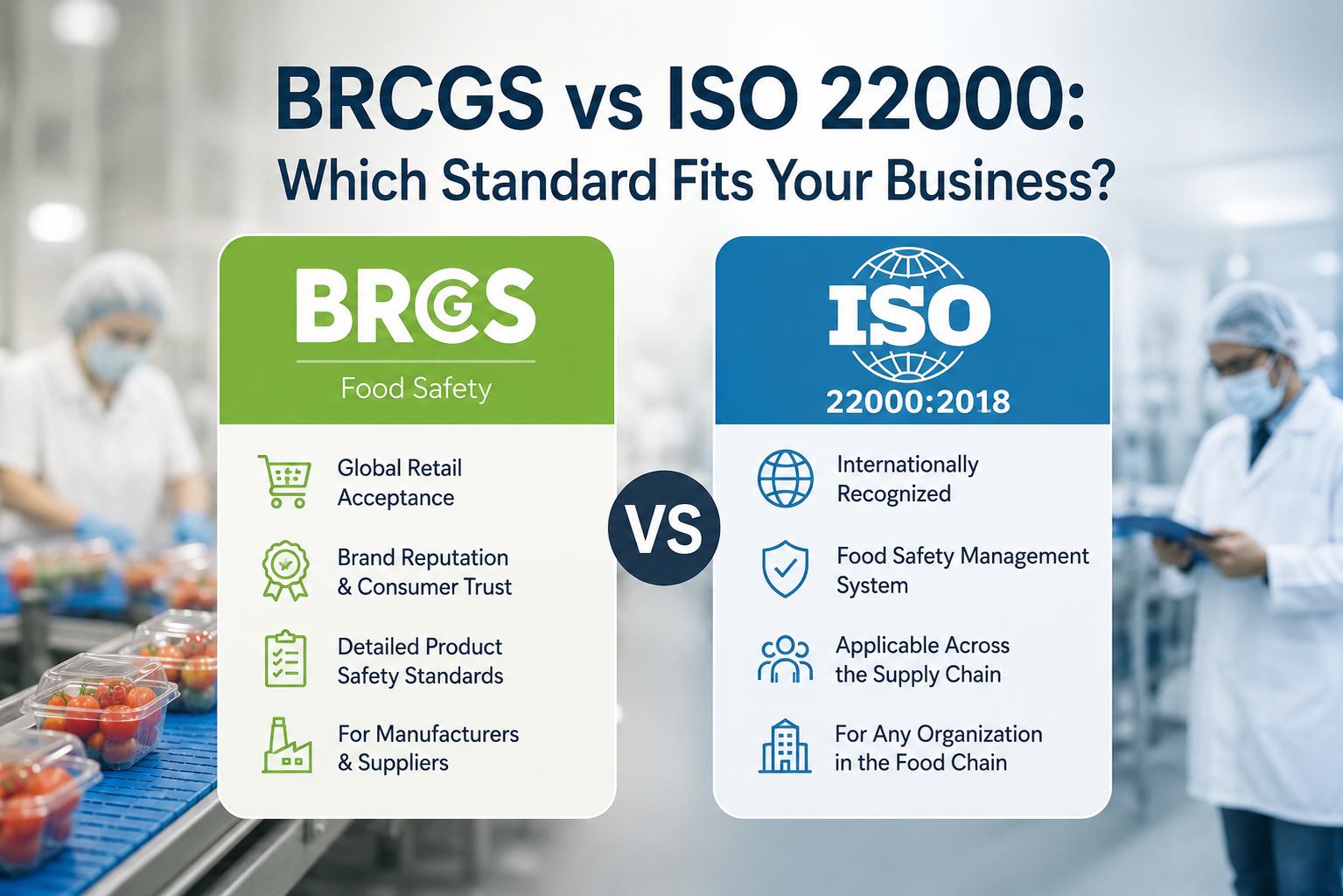
Executive Summary: Deciding between BRCGS vs ISO 22000 is based on your markets and needs. BRCGS (Global Standard – Food Safety) is a retailer-focused, product-specific standard benchmarked by GFSI, and has stringent demands regarding product quality and safety and its supplier approval. On the other hand, ISO 22000 is a general standard for Food Safety Management System (FSMS) applicable to all organisations involved in food production. This standard combines HACCP and risk management into a process-oriented framework. In this post, we will be comparing the two standards in terms of scope, format, HACCP / Risk management approach, supplier requirements, auditing frameworks, international acceptance, cost and complexity, etc. Here’s how to certify your business if you’re a small, medium or large food company in India.
1. Overview of BRCGS vs ISO 22000
BRCGS Food Safety is an internationally recognised standard created by the British Retail Consortium. It offers a comprehensive approach towards controlling product safety, authenticity, legality and quality within food production. The BRCGS standard is widely used (more than 22,000 sites in over 130 countries) and designed specifically for food/pet food manufacturing (there are dedicated standards for food packaging, storage, etc.). BRCGS contains detailed requirements concerning the HACCP plan, Good Manufacturing/Good Hygiene Practices (GMP/GHP), quality management system, and supplier approvals. What is particularly important about the BRCGS standard is that it was the first globally accepted food safety standard benchmarked by GFSI.
ISO 22000 is a standard FSMS that was developed by ISO. The standard states the requirements of the management system to control food safety hazards throughout the entire food chain from production to consumption. ISO 22000 is purposefully designed to be generic and hence applicable to any company along the food chain, whether agricultural, manufacturing, hospitality, retail, logistics, etc. The standard is based on four principles: interactive communication, system management (PDCA), PRP and HACCP principles. This way, ISO 22000 ensures process-oriented risk management. Moreover, the standard explicitly incorporates risk-based thinking, both related to organisational risks and HACCP hazard risks, along with such requirements as traceability and readiness for emergencies. Although ISO 22000 is not benchmarked by the GFSI, it remains a worldwide known standard to prove FSMS credibility to stakeholders.
2. Certification Process
Both systems involve the implementation of a compliant food safety management system and getting an independent audit done. However, the steps involved in the process are different. In the case of BRCGS, the first step involves registering oneself with an accredited certification body, implementing all the aspects related to BRC (which may involve conducting gap analysis and developing an HACCP plan) and scheduling an audit. The auditor uses the method of vertical audit (traceability method) and audits all sections during one audit session. Non-conformities, if any, have to be rectified with supporting evidence before certification can be issued. The next step would be certification, which is valid for a year.
The process for ISO 22000 is more like any other ISO management system, in which the company implements its FSMS, often based on an ISO 22000 gap analysis, implements PRPs and HACCP, and documents these procedures. Following that, an accredited registrar performs Stage 1 (documented system) and Stage 2 (on-site implementation of documented system) audits. Subsequently, surveillance audits will take place annually throughout the 3-year certification period. In contrast to BRCGS, ISO 22000 audits are not performed using a graded scoring method, so minor nonconformances can typically be corrected following the audit, within an allotted period of time. Both BRCGS and ISO 22000 require documented evidence of continuous improvement (such as objective evidence and corrective actions). As ISO 22000 is a generic standard, there is much more freedom with the way that certain procedures can be documented in comparison to BRCGS, which provides checklists and mandatory frequencies throughout many sections.
Regarding the timeline of certification, this can vary anywhere from 6-12 months following completion of initial preparations. (Certification costs and timelines “vary by scope.”)
3. Which Standard Suits Which Business
- Small business: Smaller processors or producers of food can more easily implement an ISO 22000 FSMS because of its flexibility and emphasis on systematic hazard management. It builds upon a basis of food safety management certification while being able to adapt to the resource restrictions of small organisations. If a small enterprise’s output is sold locally or is not intended for retail distribution, ISO 22000 might do. But if a small manufacturer plans to sell their output to major supermarkets and chains or to export, then BRCGS may be necessary.
- Medium-sized business: Medium enterprises need to determine their market. An ISO 22000 certification system is widely used because of general compliance issues. BRCGS may also be considered if the output is distributed through retailers. Many mid-size companies choose to certify to both systems (or to the FSSC 22000, which is recognised by GFSI). In addition, the resource availability must be taken into consideration since BRCGS is quite resource-heavy and ISO 22000 depends on the organisation’s resources.
- For larger businesses: The largest food manufacturing and exporting companies require the highest levels of confidence. They might opt for BRCGS (or FSSC 22000, including ISO 22000) as these are recognised by large retailers and foodservice chains across the world. This helps them gain access to international markets. For global companies, ISO 22000 can supplement other certifications or cater to the needs of those markets that accept ISO certification. Both of these certifications can be handled by large companies with adequate staffing; therefore, market needs dictate the certification process.
In conclusion, if your company trades with large retailers or in export markets that require such certification, then obtaining BRCGS certification is a must. For a comprehensive food safety management system in any food chain stage, obtaining ISO 22000 certification becomes necessary. Most Indian companies go for both certifications.
4. Role of Consultants in India
Certification is a daunting task, and hence most of the food companies seek the help of experts in this field. Some of the services that are provided by BRCGS and ISO certification consultants include:
- Gap analysis & planning – Analysing the existing food safety program of the company in relation to the selected standards and outlining the required changes.
- Documentation & implementation – Drafting manuals, procedures and recording sheets like HACCP plans, GMP programs and quality control records.
- Training – Training the workers in HACCP principles, food safety management system principles, sanitation and preparation for audits.
- Conducting internal audits & pre-assessment – Doing pre-assessment and internal audit to test the preparedness of the firm and to spot areas that need improvement.
- Supplier programs & traceability – Setting up supplier approval programs and checking traceability, particularly in the case of BRCGS.
- Audit support: Assisting during the audit process and follow-up, ensuring prompt corrective action on any non-conformities.
The role of consultants may further facilitate the process. According to the ISO implementation guidelines, “Evaluate consulting firms: independent consultants can assist in formulating an appropriate, realistic, and economical strategy plan.” In the Indian scenario, Indian consultants will be well versed with the Food Safety and Standards Authority of India (FSSAI) and export regulations, as well as the process of obtaining certification from the relevant Indian certifying agencies. The Indian consultants thus serve as a bridge to make food safety certification feasible for companies, big or small.
5. How GCQS Can Help
GCQS-Brand Name is a leading consulting firm based in India focusing on food safety standards. The organisation has experience with both BRCGS and ISO 22000 certification programs. The experts at GCQS provide comprehensive solutions such as carrying out gap analysis, developing food safety management and HACCP documents, conducting training for employees, and even carrying out supplier audits. They have expertise with accredited certification organisations, making sure that the audits go smoothly. Using the knowledge and experience of GCQS, food manufacturing and processing companies in India can meet all the stringent demands.
6. Conclusion
However, both are equally important and relevant to achieve food safety compliance and certifications. While ISO 22000 is a flexible and broader food safety scheme that suits the food industry at large, BRCGS offers a stricter product-centred food safety system that many global retailers demand. Hence, to choose between the two, it depends on your clients’ expectations, market goals, and your internal capabilities. Smaller companies can go for the former option, while larger exporters are likely to need the latter one.
To find out how you can get your company food safety certified, turn to the right professionals for assistance. You may search for BRCGS certification consultants in India or ISO 22000 food safety certification consultants in India. GCQS – Brand Name is an expert consultancy that specialises in helping Indian food companies receive their FSMS certificate in accordance with either of the two schemes. Start implementing them now and gain a competitive advantage in the business sphere.
Sources: Authoritative documents have been quoted for comparing BRCGS vs ISO 22000.