Food Traceability: Why It Matters for ISO 22000 and Export Compliance
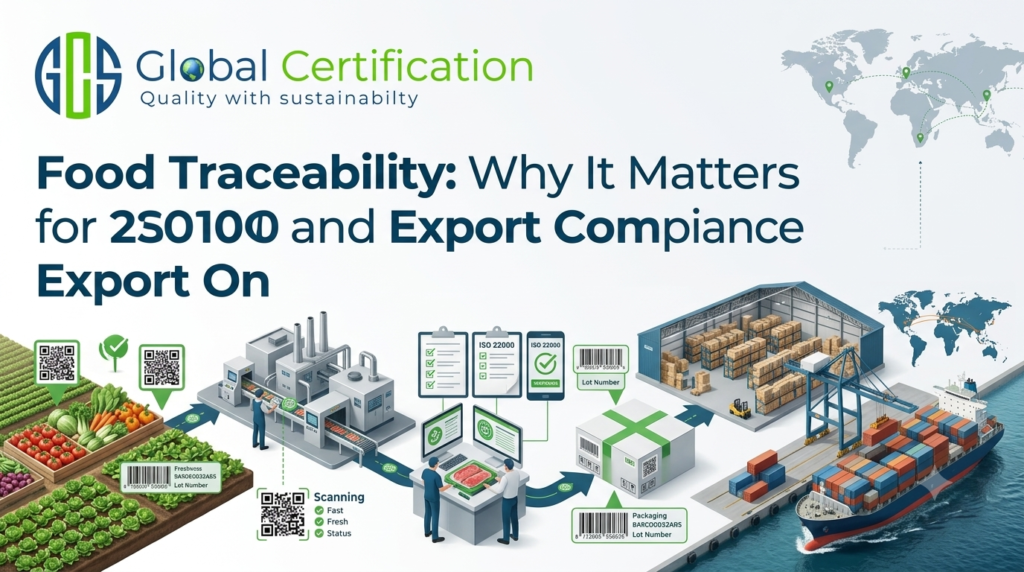
In addition to the production of clean and healthy food, it is important for organisations to be able to trace the origin of the components, the processing of products, storage of products, and distribution of products. Here, food traceability plays a major role.
It is of great value for the producers, processors, exporters, and suppliers of food, as food safety, quality control, and ISO 22000 standards all depend on it.
1. What Is Food Traceability?
Food traceability is defined as the capability of tracing back a food product together with its components at different points along the supply chain.
An efficient traceability system enables the organisation to ask certain questions like:
- From where did we source the raw materials?
- Who was the supplier of a certain ingredient?
- In which production run was that ingredient used?
- When was the food product produced?
- Where was the food product shipped?
- Who received that certain batch of the product?
These pieces of information are helpful to the organisations in case a food safety problem happens.
2. Why Is Traceability Important for Food Businesses?
The logistics of providing food may include multiple providers, producers, storage facilities, distribution, and retailing outlets. Absent detailed documentation, tracking down the problem will prove challenging and time-consuming.
A good system of traceability will help to do the following:
- Find out which batches are affected by a problem
- Lessen the negative effects of any product recalls
- Keep control over food safety risks
- Improve management of suppliers
- Keep records of the food production process
- Satisfy customer needs
- Establish trust with buyers and importers
For the exporting firm, the importance of traceability lies in the expectations that international customers may have with respect to documented control of food safety and product information.
3. ISO 22000 Traceability Requirements
ISO 22000 is the food safety management system standard accepted worldwide. The traceability component of the standard is quite significant as organisations have to develop systems for the identification and tracking of products and relevant materials.
The traceability requirements of ISO 22000 mostly relate to the development of traceability systems, through which one would be able to track incoming materials and ingredients to the beginning stages of distribution of the final product.
Companies need to develop appropriate identification systems, keep relevant records, and make sure that the traceability systems perform adequately.
For instance, a food-producing company may provide each product with a batch number. Such batch numbers could be related to such information as manufacturing dates, raw material lot numbers, packaging materials used, processing information, quality control records, and distribution details.
4. Understanding the ISO 22000 Traceability Process
The ideal traceability system within ISO 22000 framework must be realistic, well documented, and easy to understand. The following might serve as a good example of a process:
4.1. Supplier and Ingredient Traceability
The organization is required to document the supplier data, ingredients or raw materials, and batch numbers related to the raw materials used.
4.2. Production Traceability
A record showing the link between production batches and raw materials used. This could include information regarding the date of production, production equipment, processing procedures and quality control.
4.3. Identification of Finished Product
It is important to ensure that the finished products are appropriately coded for easy identification.
4.4. Distribution Records
The company needs to ensure there are records indicating the destinations of the produced product.
4.5. Traceability Testing
Traceability testing will enable businesses to identify potential gaps in the traceability system by doing mock recalls or similar activities from time to time.
5.Traceability and Export Compliance
The exportation of foods internationally involves meeting various criteria in relation to the market requirements and regulatory requirements for that matter. Often, documentation becomes the key means through which a food business can prove that its safety measures have been adhered to.
Traceability plays a very big role in the export of foods as it enables an exporter to answer questions from buyers, initiate a recall if needed, show production processes, and take control over the food distribution process.
For a company interested in international exports of food products, cooperation with an ISO 22000 consultant in India can greatly facilitate preparation for certification.
6. Why Hire an ISO 22000 Consultant
Setting up a food safety management system is quite difficult for any business. However, an experienced ISO 22000 consultant in India can greatly aid in understanding all the relevant criteria, developing documentation, establishing a traceability process, conducting internal audits, and preparing employees for audits.
Companies interested in obtaining ISO 22000 food safety certification in India should pay close attention to implementing their traceability procedure.
7. Strengthen Food Safety with GCQS
The well-thought-out traceability system has the potential to bring structure and effectiveness to food safety management practices through product identification, risk management, recall procedures, and a demonstration of commitment towards food safety.
The Global Certification for Quality and Sustainability (GCQS) provides help to companies aspiring to improve management systems and achieve certification standards. Under proper guidance, food safety procedures can be implemented successfully both internally and on an international level.
Ultimately, traceability is not just another requirement but a useful tool in business practice aimed at consumer safety, control within the business, consumer satisfaction, and successful food exports.