What Is FSMA Rule 204 and How Can Indian Food Exporters Prepare?
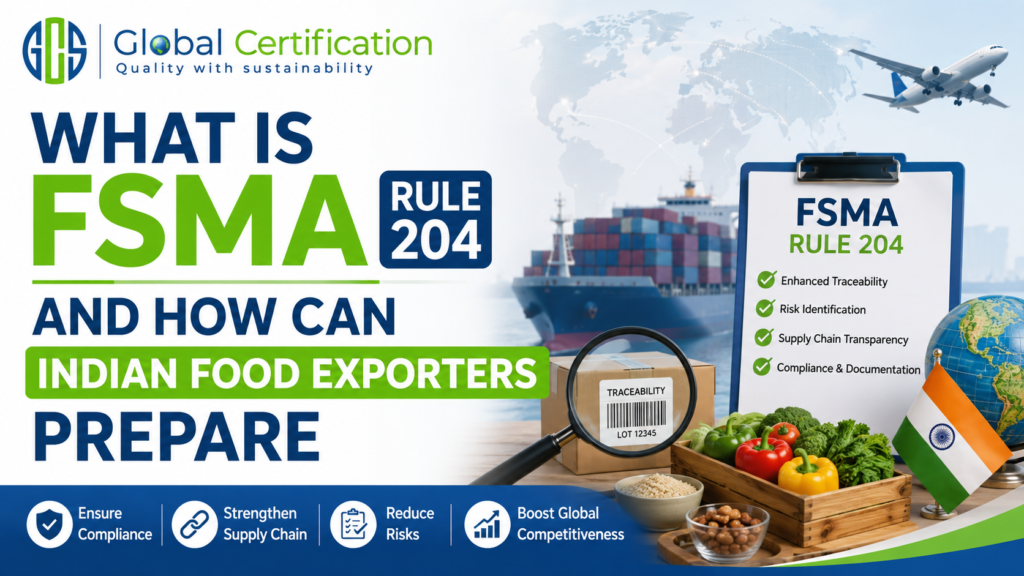
The food suppliers from India who export their products to the United States should keep in mind the changes in the standards for traceability and safety of food. An example of such a standard is the FSMA Rule 204, which was renamed by the FDA as the Food Traceability Rule. The aim of the rule is the improvement of traceability of some foods in cases when food security events occur.
It means that in order to be FSMA compliant, food suppliers should be aware of this rule in order to avoid disruptions in the export of their goods.
1. What Is FSMA Rule 204?
FSMA Rule 204 pertains to traceability of foods within the country. It is a provision enacted under FSMA, specifically Section 204(d), by the U.S. Food and Drug Administration. The provision imposes certain recordkeeping requirements for establishments that are involved in manufacturing, processing, packing, or holding particular foods as listed by the FDA on its Food Traceability List.
The purpose of the rule is clear: in the event of any contamination or food safety problems, FDA should be able to identify or track the source in question and take action for its quick removal.
There are two major components that are essential under this rule. The first is Critical Tracking Events (CTEs), which could include such actions as harvest, cooling, packing of primary containers, transportation, receiving, and transforming. Relevant key data elements (KDEs) must be maintained.
2. Which Foods Are Covered?
FSMA Rule 204 is not applicable to all food products. It applies to foods covered in the Food Traceability List (FTL) maintained by the Food and Drug Administration (FDA) and food products containing any FTL listed foods when the specified form of the FTL listed food is used in those products.
FTL includes such categories as certain fresh fruits and vegetables, fresh-cut produce, shell eggs, certain cheese products, seafood, ready-to-eat deli salads and salads, and nut butters.
Indian exporters thus must first identify whether their product falls under the FTL or not.
3. Relevance of FSMA Rule 204 for Indian Food Exporters
For Indian business organizations, complying with FSMA requirements in India means developing an effective traceability system not only because it is required by the U.S. legislation. It is also required by business considerations since traceability means following product flow from its place of origin to the US consumer.
In turn, information may be received from farmers, processors, warehouses, freight companies, distributors, and US importers. Absence or discrepancy of information at any of these points will create difficulties in traceability.
This is especially true for companies that deal with foods falling under the FSMA Rule 204.
4. Key Requirements for FSMA Rule 204 Compliance
4.1. Identify Applicable Products
First, determine whether any of the products that you manufacture, process, package, or store are included on the Food Traceability List, and don’t simply assume that all food products fall under Rule 204.
4.2. Determine the Critical Tracking Events
Outline the supply chain process and find out which CTEs apply to your company. Depending on the nature of your business, the list may comprise the following CTEs: reception, shipment, primary packaging, harvesting, chilling, and transformation.
4.3. Collect the Key Data Elements
KDEs provide valuable data related to what was done to food products at each of the above-mentioned tracking events.
4.4. Use Traceability Lot Codes
Traceability Lot Code (TLC)
The TLC refers to any identifier that will be used to distinguish the traceability lot in question. According to the regulation, TLC should be applied at certain points, such as initial packaging and/or transformation, based on the specific food type and operation.
Indian exporters need to ensure consistency between production, packaging, storing and shipment of foods through lot identification.
4.5. Traceability plan development
Regulated firms need to develop and maintain a traceability plan outlining the way of maintaining the required records, identification of covered foods and assigning lot codes wherever necessary.
5. How Can Indian Food Exporters Prepare?
In order to prepare practically, a gap analysis is where one must start. Assess the existing food safety system and traceability processes in light of the requirements that apply to the products in question.
Furthermore, establish a written procedure for tracing products. This involves correlating the purchase data, batch data, packaging data, lot data, storage data, shipment data, and customer data wherever necessary.
Companies can also consider training their employees who have the responsibility of ensuring quality and manufacturing, logistics, documentation and exporting. All this is to know how much to document.
It is advisable to work with experienced FSMS consultants as they will assist in finding any gaps, documenting, improving traceability and integrating food safety and export.
6. What About the FSMA Rule 204 Compliance Date?
The initial deadline for compliance with the rule has been set for January 20, 2026. However, current FDA information claims that Congress ordered the FDA not to apply the rule before July 20, 2028, in response to the 30-month delay issue. FDA is going to comply with the Congress directive.
Therefore, Indian exporters have some time left to be prepared and not wait till the moment when the compliance issue arises.
7. Improve Food Export Compliance in India
Food export compliance in India requires more than simple food safety certificate maintenance. Those exporting food products to the USA must have a traceable system as a regular operational procedure.
Global Certification for Quality and Sustainability could assist enterprises in obtaining appropriate food safety and compliance systems. Properly organised planning, documentation, staff training, and coordination of the supply chain could help in building an FSMA-compliant food export operation in India.
8. Conclusion
FSMA Rule 204 is a significant milestone on the way to quick and efficient traceability in the food sector. Preparing for the FSMA Rule 204 should concentrate on determining the list of relevant foods, identifying the CTEs and KDEs, tracing the traceability lot codes, and preparing a proper traceability plan.
Getting prepared at the initial stage of implementation can help Indian food exporters cope with compliance with FSMA Rule 204 and increase the level of transparency in the supply chain of foods as well as the level of trust with customers of Indian exporters.