How to Prepare for a Food Safety Certification Audit
Food safety is one of the major objectives for organisations engaged in manufacturing, processing, packaging, storage, and transporting of food products. The completion of a certification audit means that the organisation has an efficient system in order to manage food safety risks and to ensure consistent performance. Being ready for the audit could simplify the process and provide business opportunities for improving food safety performance through the detection and correction of existing weaknesses.
1. Preparation for Food Safety Certification in India
The preparation for food safety certification in India includes such activities as comprehension of the requirements of the audit and proper preparation of documentation, staff, operations, and facilities.
2. Requirements Understanding
The initial phase is to understand the requirements of the food safety standard used in the audit. Requirements depend on the field of activity and kind of food safety certification. They could include requirements in respect of hazard analysis, hygiene, traceability, documentation, action taken for correction, employees’ qualification, and operations’ control.
3. Identification of Requirements and Creation of Checklist
The next step is a careful review of the standard with the purpose of requirements’ identification and creation of a checklist for managers.
4. Review Your Food Safety Management System
It is highly important that food-related businesses focus on the issue of food safety. Successful completion of the audit shows that the company has efficient systems ensuring food safety and consistent performance. Proper preparation is useful since the audit may go more smoothly for the organization and help it recognize its strengths and areas for improvements.
In order to prepare for certification for food safety India, one should know about the audit criteria and be ready to submit required documents, educate and prepare employees, facilities, and processes.
5. Understand the Requirements of Certification
The first thing is to learn about the requirements of the chosen standard against which the audit will be done. It depends on the business as well as the type of the required certification but in general, it concerns hazard control, hygiene, traceability, documentation, corrective actions, competence of the employees, and operational controls.
5.Prepare Documentation and Records
Document review is an integral part of many certification audits. Document management must be organized in such a way that documents could be promptly found for any requests.
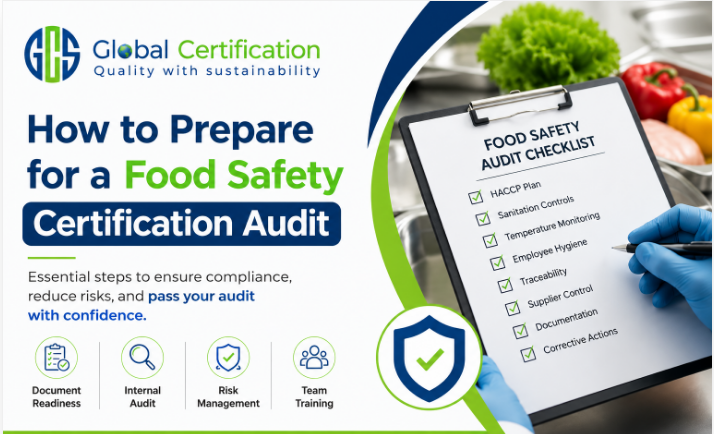
Such documents could include food safety policy, hazard analysis record, standard operating procedure, sanitation schedule, pest control documentation, training records, equipment maintenance report, calibration certificate, supplier evaluation, inspection record, traceability information, and correction action report.
Make sure that each document is properly approved, has proper version management, review date, and distribution management. Outdated procedures must be deleted from operational areas to avoid misleading instructions for employees.
6. Train and Prepare Employees
It is especially important that employees get ready for the audit because the auditor may check their actions and answer questions related to food safety procedures. Employees must be aware of their responsibilities and the reasons behind certain controls.
Train employees on personal hygiene, cleaning, contamination prevention, allergen control, temperature control, handling procedures, and food safety issues reporting.
The employees must not be trained to say certain things because auditors will see whether employees really know how to carry out the process. Confident and informed employees prove that a company has an effective food safety system.
7. Inspect Your Facility and Equipment
Before the audit, carry out a comprehensive inspection of the work environment. Check for hazards such as lack of housekeeping, damage to facilities, inappropriate storage, lack of labelling, presence of pests, expired items, broken machines, or contamination risks.
Check whether the cleaning schedule is properly implemented and whether the equipment is being properly maintained and calibrated. Storage places must be neat, labeling must be adequate, and products must be processed in accordance with established procedures.
Proper cleaning and organisation create a good impression and make food safety management more efficient.
8. Consult with a Food Safety Consultant
Certification preparation can be hard, especially when doing so for the first time. Consulting with a Food safety certification consultant can bring professional expertise into all phases of the process – documentation, certification process, internal audits, and corrections to any non-compliances.
A professional food safety consultant in India can guide companies through all steps to ensure proper preparation for the external audit. Professional food safety certification consultancy can also minimise uncertainties about the certification process.
9. Be Ready for the Audit Day
Prior to the actual audit date, make sure that your key personnel are available and that the necessary documents are readily accessible. There is no need for employees to alter their procedures due to the presence of the auditors.
Answer any queries with honesty and transparency. Once a nonconformity is detected, be certain of what exactly needs to be done in order to correct the issue and implement a solution. It is essential to realise that an audit must provide you with a chance to improve upon your food safety system rather than see it as a means of passing or failing the test.
10. Conclusion
The process of preparing for an audit entails much more than getting the paperwork in order. Businesses will have to create an efficient food safety management system, keep the right record, train their employees, perform inspections, conduct internal audits, and improve their methods constantly.
Food safety certification companies such as those providing food safety certification in India can definitely help businesses in preparing for the certification process and get certified efficiently. Global Certification for Quality and Sustainability can offer its experience to assist businesses in complying with their certification requirements.