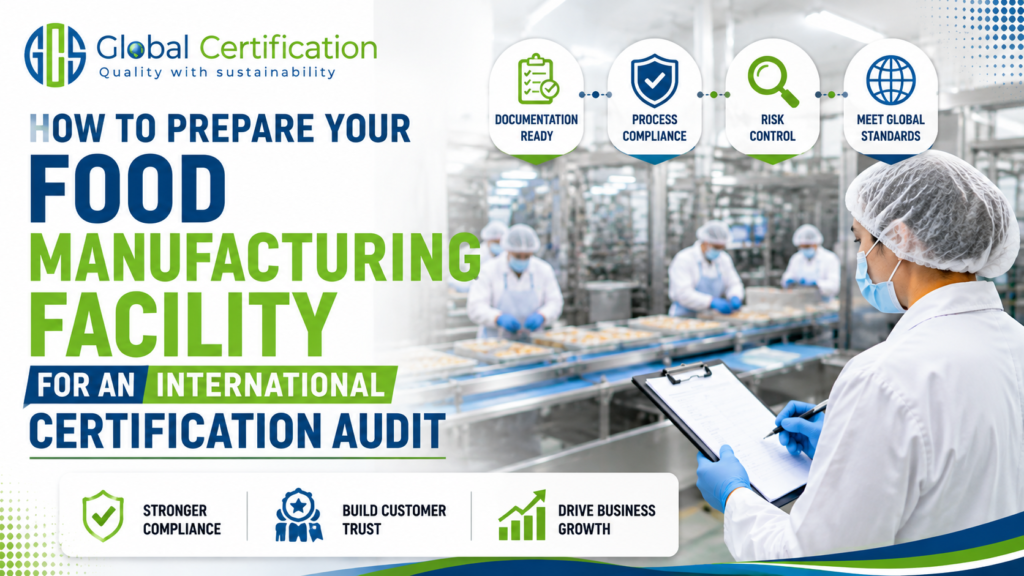
How to Prepare Your Food Manufacturing Facility for an International Certification Audit
For food producers, obtaining international food safety certification is vital in terms of proving quality, safety, and conformance to regulatory standards. It is not enough just to have all the systems and processes in place; correct food certification audit preparation is vital in making sure that people, processes, documentation, and facilities will be ready for thorough scrutiny by the auditors.
If you want your business to be ISO 22000 certified, FSSC 22000 audited, or any other type of internationally recognised food safety certification, then a careful approach will definitely come in handy.
Understand the Certification Requirements
Preparing the audit for food manufacturing begins by having an understanding of what is expected according to the standard that your company will use for audit purposes. Study the standards’ clauses, requirements concerning documentation, operational procedures, and food safety goals.
When it comes to ISO 22000, it is crucial to concentrate on the food safety management system, identification of hazards, risk assessment procedure, communication procedure, operational procedures, and continuous improvement procedure.
For companies preparing for FSSC 22000, it would be useful to study the audit checklist for FSSC 22000 since it would help identify what will be reviewed during the audit. The checklist is intended as a preparation tool, but not just for documentation purposes.
Conduct an Internal Gap Assessment
Before the certification audit, perform a thorough internal assessment of your premises. Assess how well your current food safety management system meets the certification standard’s requirements.
During a gap assessment, you should focus on such issues as:
- Food safety policy and objectives
- Hazards analysis and critical control points
- Prerequisite programs
- Cleaning and sanitation
- Pest control
- Supplier management
- Employee hygiene
- Traceability
- Product identification and labelling
- Equipment maintenance
- Calibration records
- Emergency preparedness
- Preventive and corrective actions
This step may help you identify shortcomings when you still have the opportunity to resolve them.
Review Documents and Records
Robust documentation is one of the key aspects of proper audit preparation. Auditors expect you to provide evidence of not only having documented procedures but implementing them regularly as well.
Assess procedures, work instructions, monitoring documents, inspection reports, training records, internal audit reports, corrective action documentation, and management reviews.
Make sure all records are well-kept, accurate, authorised and accessible. The absence of necessary signatures, the presence of wrong dates, incomplete monitoring reports, and outdated procedures will only raise unnecessary questions during the audit process.
Inspect Your Production Facility
Certification preparation should not be limited to documentation. Carry out an inspection of the facility where you manufacture your products from the point of view of the auditor.
Inspect production areas, storage facilities, worker hygiene facilities, facilities that manage the waste, equipment, drainage, pest management methods, and cleaning areas. Look for any damage, bad housekeeping, potential cases of cross-contamination, wrongly stored materials, and equipment.
A neat facility reflects a situation where the food safety practices have been incorporated into the daily work of your business rather than the preparations for the audit.
Training of Staff Before the Audit
Your staff are key to the process of getting certified. The auditors can speak with the workers to find out if they know food safety practices and their duties.
Carry out additional training of the employees about hygiene, sanitation, handling allergens, avoiding contamination, critical control points, emergency procedures, and reporting procedures.
The workers need to be aware of the relevant procedures but not to learn what answers to give the auditor.
Verify Traceability and Recall Procedures
Traceability is yet another key issue to test before an international audit. Perform a mock traceability exercise to see whether you are able to trace your raw material, batches of production, packing, storage, and distribution.
It is necessary to perform the test of your product recall process as well. Check whether there are clear assignments of responsibility and whether the required information is available. The test should reveal any weaknesses in communications, documentation, or product tracing.
Complete Corrective Actions
Check previous internal audits, inspections, customers’ complaints, incidents, and nonconformities. Ensure that your corrective actions were completed and that the effectiveness of these actions was checked.
Never close your findings just on paper. Find the root cause and take necessary measures to prevent reoccurrence of the problem. Showing continual improvement will help you demonstrate audit readiness.
Conduct a Final Pre-Audit Review
Just a few days or weeks before the certification audit, make sure to perform a readiness check. Inspect the facility, review important documentation, meet up with employees, review records, and ensure that there are no unfinished corrective actions left to attend to.
Store readily needed documents systematically. Make sure that there are people in charge of the audit and that the employees know where to turn to in case the auditor asks for certain documentation.
Collaborate With the Right Certification Specialists
Preparing for an international certification audit might be difficult, especially for organisations going for the certification for the first time. Having certified professionals on your side will enable the manufacturer to become familiar with the standards and develop proper management systems.
Global Certification for Quality and Sustainability is the company that assists organisations with their reliable certification and assessment needs. With the right preparation, food manufacturers can handle their audit easily.
Conclusion
Certification success does not mean just getting ready for the auditor in the last few days. Instead, it shows proof of consistent management of food safety within the whole organisation. Preparation for the food certification audit, employee training, reviewing documents, self-assessment, inspections of the facility, and other activities can greatly contribute to this process.
Making the audit of the certification ISO 22000 or FSSC 22000 an instrument for improvement of everyday food safety will help build a more efficient management system and achieve international food safety certification.