ISO, BIS, CE and FDA: How to Build the Right Certification Strategy for Your Product
Launching any product in today’s competitive environment, it involves much more than having a beautiful design and reliable function. There is a need to meet all the required standards, safety regulations, and other requirements. This is when product certification is needed. Certification allows showing that a product, process, and even a company meet certain requirements and standards.
The most popular types of certifications include ISO, BIS, CE, and FDA certifications. But each of these certifications plays its own role and may be used for specific products and markets.
1. Understanding ISO, BIS, CE and FDA Certifications
Before selecting a certification, it is important to understand what each one represents.
ISO certification is mostly indicative of the adoption of a certain management system or standard by the organisation. According to the type of business, ISO certifications related to the organisation may include quality management, environmental management, information security, occupational health and safety, and others. ISO certification of the product may also be considered when there is a corresponding ISO product standard.
BIS certification is linked to the Bureau of Indian Standards and has a significant impact on the quality and safety of products in the Indian market. Some products have to meet certain Indian Standards in order to be manufactured, imported, sold, and/or distributed in the Indian market of India. In case one intends to get BIS certification in India, it is necessary to understand whether his/her product falls under a mandatory certification/registration procedure.
CE marking refers primarily to products put on the market of the European Economic Area. It shows that the manufacturer has checked his product according to all relevant requirements of the EU.
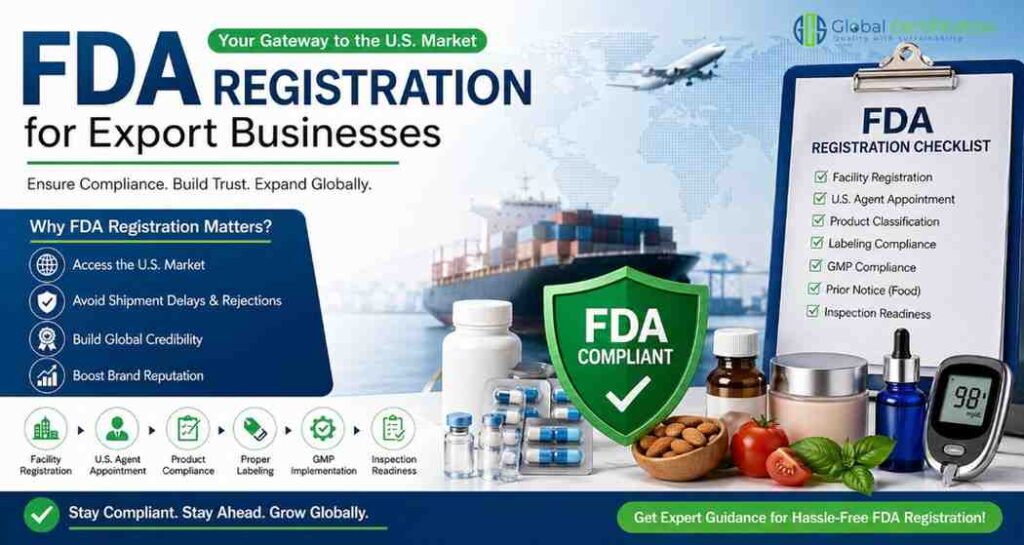
FDA requirements are particularly significant for products entering the USA, regulated by the U.S. Food and Drug Administration. The requirements may vary according to the particular category of the product.
2. Why a Certification Strategy Matters
One typical error made when it comes to certifications is the assumption that if one certificate is acquired, then the product will be deemed fit for all destinations.
Some of the benefits that could accrue through certification include:
- Identification of necessary regulatory requirements
- Minimisation of regulatory risks
- Enhancement of customer confidence
- Facilitation of entry into new markets
- Improvement of product quality systems
- Minimisation of unnecessary costs in certification
- Improvement of business’s reputation with respect to safety and reliability
Rather than gathering certifications in order to enhance marketing efforts, companies should consider certifications that are relevant to their products and markets.
3. Start With Product and Market Assessment
It all starts by understanding the nature of your product and where you want to sell it. Classification of products will determine the required regulatory requirements.
For instance, if you want to sell a product that will reach Indian customers, it should have BIS certification in case of an Indian Standard that applies to it. For products meant to go into European countries, the applicable CE requirements have to be followed. Products entering the USA should meet FDA requirements in case of FDA-regulated products.
Assessment will help firms develop a realisable compliance strategy rather than chase certifications that do not apply to their business.
4. Selecting the Correct Certification
Certifications vary depending on the business goals.
ISO certification will fit if you aim to develop a good quality management system. BIS certification services will assist your firm in case of manufacturing a regulated product in India. For European markets, conformity with CE will have to be evaluated. FDA requirements will have to be evaluated for health care, food, medical, pharmaceuticals, cosmetics, and other regulated products entering the USA.
Some businesses will be required to conform to more than one standard or regulatory regime.
5. Prepare Documentation and Testing
Certification does not consist of just making an application for it. According to the relevant standards, businesses might require technical data, product specifications, test reports, manufacturing data, quality documentation, labels, risk analysis, declarations, and any other evidence that demonstrates their compliance with certain standards.
Product testing might be needed through relevant laboratories and assessments. Keeping up-to-date with accurate documentation may facilitate the certification process.
6. Work With the Right Certification Experts
Certification standards might be complicated, especially if a company works in different markets. Professional assistance will allow a business to understand applicable standards, produce documentation, coordinate testing, and know what regulations demand from them.
BIS certification companies, as well as organisations providing ISO and other compliance solutions, will help a business to make a certification strategy based on its product and target market, rather than making a “one size fits all” strategy.
7. Build Certification Into Your Product Strategy
The best time for certification would be during the development phase of the product rather than post-manufacturing.
The best practice also entails monitoring any changes in standards and certification records, as well as periodic review of the compliance status.
8. Conclusion
Different organisations have their requirements in the form of ISO, BIS, CE, and FDA certifications, and it is also important to note that there is no one certification that works universally. The right method would be to evaluate your product, define your markets, find out mandatory requirements, and then proceed to document and test your product to make it eligible for the right certification.
With appropriate planning and advice from the right experts, companies can use product compliance certification both to comply with regulations and enhance product quality, as well as customer confidence and even sustainable market expansion. Global Certification for Quality and Sustainability can assist in developing the right certification strategy.