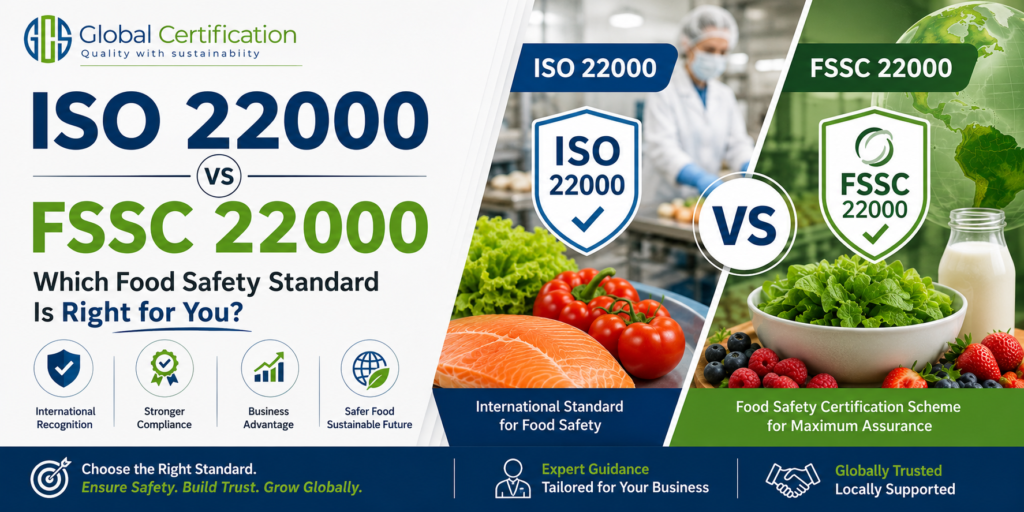
ISO 22000 vs FSSC 22000: Which Food Safety Standard Is Right for You?
Food safety has turned out to be one of the most significant priorities of companies in the food industry. Customers require products that are safe and of high quality, whereas regulatory bodies call for strict compliance with the food safety standards. Proper Food Safety Certification would not only give confidence to customers but also boost the reputation of your company in the domestic and foreign markets.
When you are going to introduce the Food Safety Management System to your company, you may need to know which certification is preferable: ISO 22000 Certification or FSSC 22000 Certification. Knowledge of the difference between these two types of certification will assist you in choosing the best one according to your needs.
The Global Certification for Quality and Sustainability tells about the differences between ISO 22000 vs FSSC 22000 in the blog below.
1. Understanding ISO 22000
ISO 22000 is a widely used international standard that is intended for companies that operate within the food chain. The standard provides a model for establishing, implementing, maintaining and updating a Food Safety Management System.
The model includes:
- Hazard Analysis & Critical Control Points (HACCP)
- Food Chain Communication
- Risk-based thinking
- Continuous improvement
- Compliance with the food safety law
By obtaining the ISO 22000 food safety certification in India, companies can prove that they intend to produce safe food products in compliance with the requirements of customers and law.
2. What Is FSSC 22000?
FSSC 22000 (Food Safety System Certification 22000) is an internationally recognised scheme of food safety certification which is based on the ISO 22000 standard. The scheme includes specific requirements and prerequisite programs (PRPs) for certain industries.
FSSC 22000 is approved by the Global Food Safety Initiative (GFSI). Therefore, it is very popular among multinational corporations, retailers and international food producers.
Food producers that export their products or cooperate with the leading global brands prefer to receive the FSSC 22000 Certification.
3. ISO 22000 vs FSSC 22000: Key Differences
3.1. Scope
ISO 22000 deals with setting up a comprehensive Food Safety Management System for food chain organisations.
FSSC 22000 takes a step further by incorporating technical requirements and controls in addition to the requirements of ISO 22000.
3.2. GFSI Approval
One of the main differences between ISO 22000 and FSSC 22000 is Global Food Safety Initiative (GFSI) approval.
- ISO 22000 is not approved by the Global Food Safety Initiative.
- FSSC 22000 is wholly approved by the GFSI.
This gives FSSC 22000 more advantage than ISO 22000 for companies serving global retailers and global food brands.
3.3. Certification Criteria
ISO 22000 requires:
- Food safety policy
- Hazard analysis
- Risk assessment
- Implementation of HACCP
- Continuous improvement
The FSSC 22000 criteria include all of the above, in addition to:
- Additional Prerequisite Programs (PRPs)
- Food Fraud Prevention
- Food Defense
- Equipment Management
- Environmental Monitoring when applicable
3.4. Industry Acceptance
ISO 22000 certification is generally accepted by firms that want to improve their food safety performance.
FSSC 22000 Certification is more favorable in industries that need adherence to global food chains and multinational clients.
4. Benefits of ISO 22000 Certification
Advantages of ISO 22000 food safety certification in India include:
- Better food safety performance
- Better regulatory compliance
- Better customer confidence
- Greater operational efficiency
- Lower food safety risk
- Better brand reputation
- Better process control internally
ISO 22000 is applicable to:
- Food manufacturers
- Food processors
- Packaging companies
- Warehouses
- Transport companies
- Restaurants
- Catering companies
5. Advantages of FSSC 22000 certification
Selecting FSSC 22000 certification brings other business advantages such as:
- Worldwide recognition
- Accepted by multinational customers
- Better food safety control
- Better export prospects
- Greater supply chain confidence
- Audit reduction
- Competitive advantage in the international marketplace
FSSC 22000 is particularly valuable for companies that supply supermarkets, retailers, and global food brands.
6. Which Certification Should You Choose?
Certification is determined by the purpose of your business.
ISO 22000 Certification is required if:
- You wish to have an effective Food Safety Management System
- Are serving domestic markets
- Require internationally accepted food safety management practices
- Wish to enhance food safety management internally
FSSC 22000 Certification is required if:
- You export food products
- Are supplying multinational companies
- Have to have GFSI approved certification
- Require better international market acceptance
- Require retailer-specific certifications
7. Why Should You Consider an ISO Certification Consultant In India?
Implementing food safety management standards involves technical knowledge, proper documentation, training of employees, internal audits, and successful certification audits.
ISO Certification Consultant In India can assist you in:
- Knowing requirements of certification
- Creating proper documentation
- Doing gap analysis
- Implementation of food safety management measures
- Training of employees
- Internal audit
- Certification audits
Professional guidance helps reduce implementation time and improves the chances of successful certification.
8. How Global Certification for Quality and Sustainability Can Help
Global Certification for Quality & Sustainability provides complete food safety certification services to businesses within the food industry. If you need ISO 22000 Certification or FSSC 22000 Certification, we can help you with the entire process of getting certified.
The services we provide include:
- Gap Assessment
- Documentation Assistance
- Implementation of Food Safety Management System
- Training for Employees
- Internal Auditing
- Preparation for Certification Audit
We can assist you in getting internationally certified food safety standards through an effective certification process.
9. Conclusion
Deciding between ISO 22000 or FSSC 22000 comes down to the size of the business, the client’s demands, and the plans for expansion. Both will help in increasing food safety performance and compliance as well as building customer trust. However, in case of companies whose target market is international or global markets, the choice of FSSC 22000 Certification is beneficial from a business perspective. For businesses that are committed to implementing an effective Food Safety Management System, ISO 22000 food safety certification in India is definitely worth considering.
For professional consultation regarding the choice of the best possible Food safety certification services, consider contacting Global Certification for Quality and Sustainability.