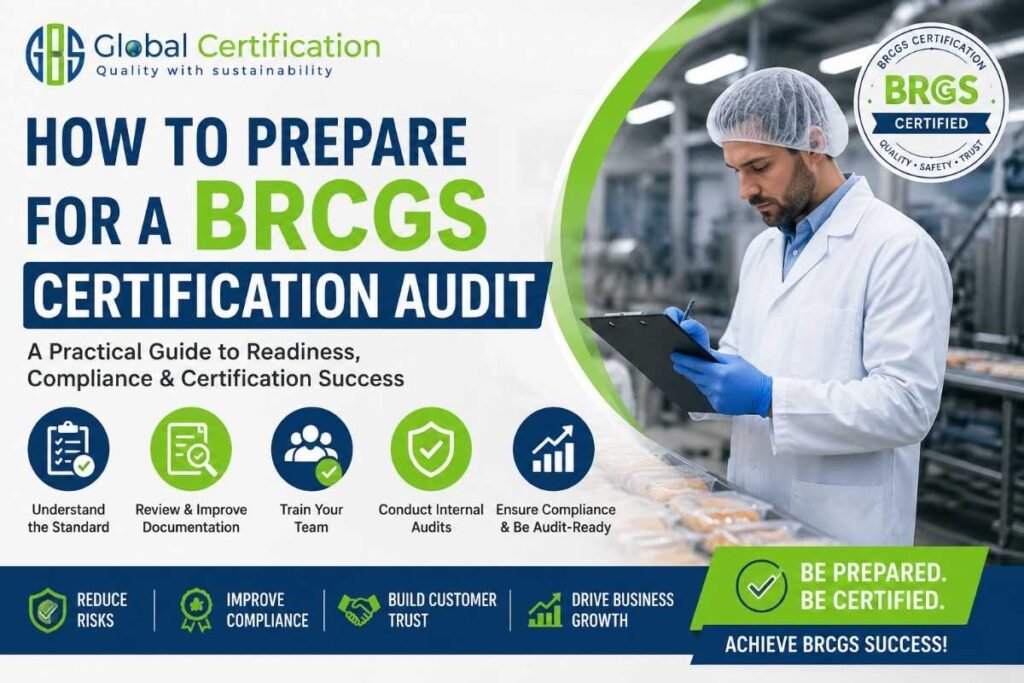
How to Prepare for a BRCGS Certification Audit
Food safety has now become more than just a compliance mandate; it has emerged as a critical component in establishing customer trust and entering the international market space. Companies dealing in food production, processing, packaging, and storage usually go for BRCGS Certification to prove their dedication towards quality and food safety standards. But passing the audit for obtaining BRCGS certification is not an easy task.
Getting professional assistance from BRCGS certification consultants in India will be immensely helpful in simplifying the whole procedure. In this blog, we will take you through all the necessary steps that are required for BRCGS Audit Preparation.
1. What is a BRCGS Certification Audit?
The audit of a BRCGS certification will be a comprehensive assessment process carried out by a recognised certification body for the purpose of ensuring your organisation’s adherence to the BRCGS Food Safety Standard.
Certification will show that your organisation adheres to international standards on food safety and has the intention of providing safe and high-quality products.
2. Why Proper BRCGS Audit Preparation Matters
Too many companies are underprepared when it comes to the preparations needed before the audit. Good BRCGS audit preparation allows companies to:
- Identify their non-conformances before the official audit
- Decrease non-conformities
- Enhance food safety management
- Boost confidence among employees
- Build customer trust
- Increase efficiency
- Expand into international markets
Furthermore, good preparation decreases stress while applying for the certification and increases the chances of success on the first try.
3. Know the Requirements of the BRCGS Standard
First, you need to know the requirements of the newest version of the BRCGS Food Safety Standard. You have to analyse all the relevant requirements such as:
- Commitment from senior management
- HACCP implementation
- Food safety and quality management system
- Site standards
- Product control
- Process control
- Personnel requirements
- Risk management
A professional BRCGS consultant in India will be able to clarify all these requirements for you.
4. Conduct a Gap Analysis
Before booking the audit, conduct a comprehensive gap analysis.
Gap analysis involves comparing your current food safety management practices with those recommended by BRCGS to find out which areas need work.
Gap analysis usually considers:
- Documentation
- Food safety management procedures
- Facilities
- Equipment
- Sanitation practices
- Internal audits
- Supplier approval
- Product traceability
Gap analysis is commonly conducted by professional BRCGS consultants India at the beginning of any BRCGS certification project to develop an efficient implementation strategy.
5. Improve Documentation and Recordkeeping
Documentation is one of the most critical parts of the BRCGS audit process.
Make sure that your organization has up-to-date and controlled documentation, including:
- Food safety manual
- HACCP plan
- Standard operating procedures (SOPs)
- Cleaning schedules
- Pest control documentation
- Calibration documentation
- Training documentation
- Internal audit reports
- Corrective action reports
- Supplier approval documentation
Incomplete or outdated documentation is one of the most frequent sources of audit nonconformances.
6. Train Your Employees
The participation of employees is crucial during the audit.
The following information needs to be known by everybody:
- Policy on food safety
- Personal hygiene standards
- Cleaning standards
- Allergens controls
- Traceability process
- Handling practices
- Procedure on corrective actions
With adequate training, employees will be able to provide answers to the auditors’ questions and stick to standard procedures.
An experienced Food safety certification consultant can also organize awareness and training programs for employees from various departments.
7. Perform Internal Audits
Internal audits allow an organization to detect deficiencies before the certification audit.
A thorough internal audit should confirm:
- Compliance with procedure documentation
- Efficiency of corrective actions
- Condition of equipment
- Practices of employees
- Housekeeping
- Tracing of products
- Food defense
- Risk management
Eliminate all nonconformities prior to arranging the certification body for the audit.
8. Verify HACCP Implementation
The HACCP is the basis of the BRCGS Food Safety Standard.
Make sure you:
- Identify hazards
- Validate critical control points
- Monitor and document monitoring systems
- Develop corrective action plans
- Carry out verification activities
- Maintain records
Your HACCP plan must accurately depict your current production process.
9. Enhance Facility Cleanliness and Maintenance
Facility cleanliness and maintenance will be inspected by auditors.
Concentrate on:
- Clean production areas
- Preventing pests
- Disposal of waste
- Maintaining equipment
- Structure of buildings
- Storage conditions
- Quality of water
- Prevention of cross-contamination
Inspections prior to the audit could avoid observations.
10. Conduct a Mock Audit
One of the best methods for preparation involves undertaking a mock audit.
In mock audits, you can practice:
- Answering auditor’s questions
- Document verification
- Production processes evaluation
- Detecting problems overlooked in previous stages
- Boosting the confidence of employees
In many cases, it becomes necessary to employ the services of an independent BRCGS certification consultant to conduct mock audits similar to the official assessment.
11. Work With Expert BRCGS Certification Consultants
It can be difficult to get prepared for certification without the help of professionals. Collaboration with BRCGS certification consultants in India will allow you to save your time and avoid mistakes during implementation.
Services provided by expert BRCGS certification consultants in India include:
- Gap assessment
- Documentation creation
- HACCP implementation
- Training of employees
- Internal audit
- Mock audit
- Planning corrective actions
- Preparation for final audit
Professional consultation greatly increases the chances of being certified at first attempt.
12. Why Choose Global Certification for Quality and Sustainability?
Global Certification for Quality and Sustainability offers expert consultancy services to companies looking for BRCGS certification in India. They guide the clients through all the stages of certification, starting from an assessment to certification.
With their practical industrial experience, customised consultancy services, and high emphasis on food safety compliance, they offer companies the opportunity to establish management systems that will conform to international standards while delivering better performance.
13. Conclusion
Preparation of a company for a successful BRCGS audit involves planning, commitment, documentation, employee training, and continuous improvement. Companies that prepare well in advance are bound to succeed in their certification process.
If you are looking for a BRCGS certification consultant, a BRCGS certification consultant in India, or even a food safety certification consultant, Global Certification for Quality and Sustainability will be happy to help your company attain BRCGS certification.