Common US FDA Compliance Mistakes for Cosmetic Businesses
Entering the US cosmetics market holds immense promise in terms of growth, but it brings stringent regulatory obligations as well. Companies violating FDA compliance rules for cosmetics in the US may run into issues of delayed imports, warning letters, product recalls, or even restrictions on selling their products in the United States.
It does not matter whether you are a new company or an existing cosmetic manufacturer; you need to know how the FDA compliance process works in order to avoid costly pitfalls.
In this blog, we talk about common FDA compliance blunders made by cosmetics companies and how Global Certification for Quality and Sustainability can help your business enter the US market.
1. Why US FDA Compliance Matters for Cosmetic Businesses
The United States has one of the biggest cosmetics markets in the world and therefore a good location for any company producing cosmetic products. Compliance with US FDA regulations for cosmetic businesses includes meeting certain criteria on product safety, product labelling, manufacturing processes, and facility registration.
Cosmetic businesses need to be more attentive to FDA regulations due to the updated regulation of the cosmetics business under the Modernisation of Cosmetic Regulation Act (MoCRA).
Good compliance can bring many benefits for a business, including:
- Consumer trust
- Regulatory fines avoidance
- Shipping rejection prevention
- Market access in other countries
- Brand reputation improvement
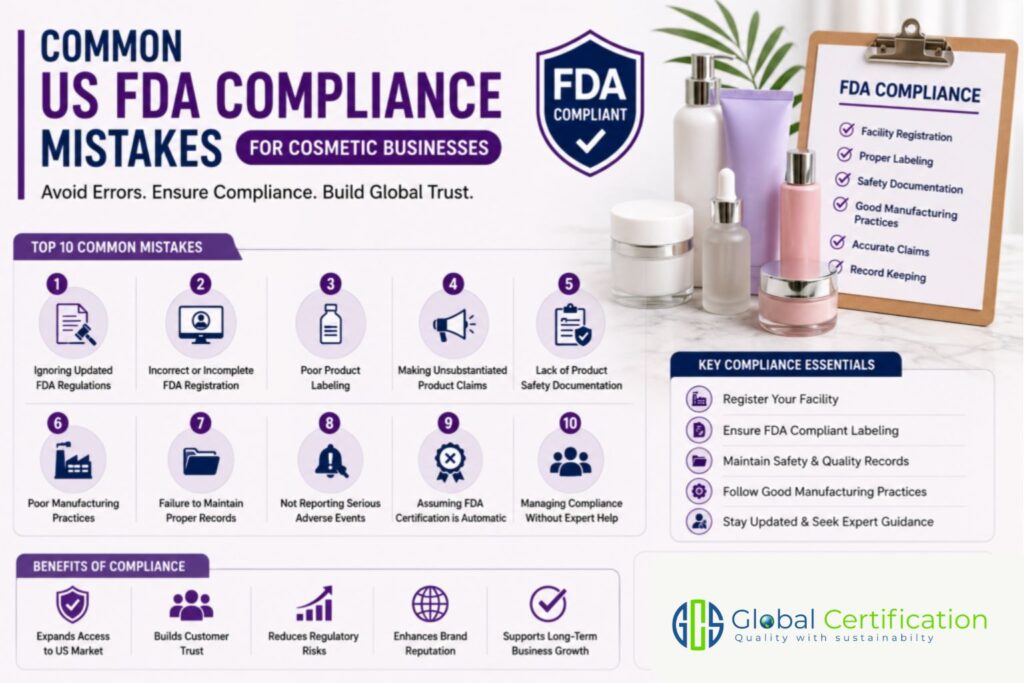
2. Ignoring Updated US FDA Cosmetic Regulations
The first and foremost mistake is the use of outdated regulatory information. US FDA cosmetics regulations have gone through a sea change since MoCRA came into effect, and have increased compliance responsibilities.
Cosmetic companies usually neglect:
- Keeping track of regulatory changes
- Understanding safety requirements
- Conducting a periodic review of product literature
- Updating their internal compliance processes
Businesses need to stay up-to-date with the latest US FDA regulations to ensure continuous market access.
3. Inaccurate or Incomplete US FDA Cosmetic Registration
Most cosmetic manufacturers are of the view that registration is either not necessary or that it is done in an incorrect manner.
Right US FDA cosmetic registration includes the correct submission of the following information:
- Details of the manufacturing facility
- Products list
- Responsible person details
- Product classification
An experienced FDA compliance consulting firm in India helps businesses submit all these details correctly and in a timely.
4. Poor Product Labeling
Labeling issues constitute some of the major reasons for FDA observations.
Typical labeling mistakes include:
- Failure to declare ingredients
- Wrong product identity
- Inadequate manufacturer information
- False or misleading claims
- Impropriety of warning statements
Labeling mistakes can even lead to detention of shipments.
Before exportation, companies should thoroughly examine the labels according to the prevailing FDA cosmetic regulations.
5. Failing to Back Product Claims
Most cosmetic companies unknowingly categorise their products as drugs through therapeutic product claims.
Some of the claims made include:
- “Treatment of acne”
- “Cure for eczema”
- “Skin infection removal”
- “Medically repair damaged skin”
- These claims might warrant further FDA drug approval.
Cosmetic companies must ensure compliance with the cosmetic regulations on their marketing, website, and package information.
6. Lack of Product Safety Documentation
The FDA requires cosmetic companies to provide sufficient substantiation regarding the safety of their products.
Many times, companies do not have:
- Toxicology studies
- Safeties of ingredients
- Stability information on products
- Microbiological testing
- Records of safety assessment
Keeping adequate documents, it shows that their products are safe under normal use.
7. Poor Manufacturing Practices
Even though cosmetics are not governed by GMP as drugs are, manufacturers should still practice good manufacturing practices.
Some manufacturing problems include:
- Lack of hygiene control
- Quality test failures
- Bad storage of raw materials
- Documentation failure
- Insufficient training of employees
Good quality management systems decrease compliance risks and increase customer satisfaction.
8. Failure to Maintain Proper Records
It is often forgotten how vital documentation can be.
The business has to keep records, which include:
- Production batch records
- Records from suppliers
- Product testing results
- Customer complaint records
- Corrective measures
- Records of product distribution
Documentation helps in regulatory inspections and allows for effective dealing with customer complaints.
9. Failure to Report Serious Adverse Events
Under recent changes in regulations, some serious adverse events have to be reported to the FDA within certain time limits.
A business that does not set up a complaint handling procedure might violate compliance requirements unknowingly.
Post-market surveillance is crucial for regulatory compliance.
10. Assuming US FDA Certification Is Automatic
A lot of exporters have misunderstanding about the concept of FDA certification in India.
The FDA does not certify cosmetics by giving an approval certificate saying the products are “FDA approved.” It is necessary to comply with all the required rules and regulations via registration, documentation, labeling, and quality systems.
Professional assistance will allow you to understand what kind of regulations are expected from you instead of having false impressions.
11. Managing Compliance Without Professional Assistance
FDA compliance contains various technical requirements which can be difficult for a business inexperienced in international regulations.
FDA compliance consultancy services in India provide a number of advantages:
- Accurate regulation guidance
- Fast registration
- Label compliance
- Documentation
- Regulation updates
- Minimal compliance risks
Consultants assist businesses in saving their time and money.
12. How Global Certification for Quality and Sustainability Can Help
Global Certification for Quality and Sustainability offers full support for cosmetic companies trying to meet US FDA compliance regulations.
These include:
- US FDA cosmetic registration help
- Regulatory compliance consultation
- Documentation development
- Labeling compliance
- Quality management advice
- Continuous regulatory support
- Export compliance help
With their knowledgeable specialists, companies can be sure to comply with the US FDA for cosmetic businesses without any regulatory risks.
13. Advantages of Complying with US FDA Regulations
FDA compliance can bring many benefits for a company, including:
- Easier access to the US cosmetic market
- Greater customer confidence
- Lower regulatory risks
- Higher product credibility
- Better international business opportunities
- Improved quality management practices
This also proves that a company is serious about product safety and quality standards.
14. Conclusion
Entering the US cosmetics market, it involves much more than just offering high-quality products. Companies need to be well aware of FDA cosmetic regulations in the USA, have proper registration with the US FDA for cosmetics, proper documentation, and proper labelling and manufacturing.
Mistakes during compliance are something that you should always avoid because they will save your company from a lot of trouble, including delays, penalties, and a negative reputation. Getting FDA compliance services in India from experts like Global Certification for Quality and Sustainability will make your compliance easier and help your cosmetic company be FDA compliant.
With proper guidance and preparation, you can easily get US FDA certified in India and enter the most competitive cosmetics market in the world.