Who Needs an FSSAI License in India? Eligibility and Requirements
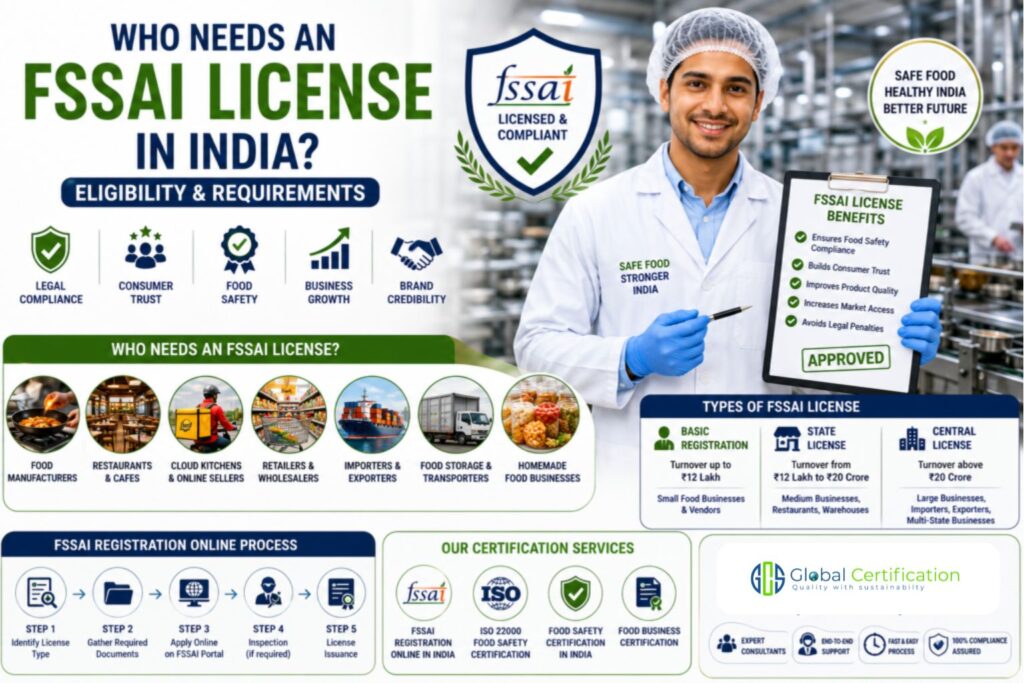
Food safety and quality in India are governed by the Food Safety and Standards Authority of India (FSSAI). Be it whether your venture is a food startup, restaurant, cloud kitchen, food manufacturing unit, or an online food business, it is legally mandatory to obtain an FSSAI License in India.
Due to rising demands for safe and hygienic food products, there has been an increasing registration of FSSAI in India through online channels. This blog will discuss who requires an FSSAI License, its eligibility and other details.
1. What is an FSSAI License?
The FSSAI license is the compulsory license granted by the Food Safety and Standards Authority of India under the Food Safety and Standards Act, 2006.
It works as evidence that the food business complies with prescribed standards for safety and hygiene.
This is helpful for businesses in proving their Food Safety Certification as well as for legal purposes, along with assurance from consumers about their products’ quality.
2. Why is an FSSAI License Important?
Here are some advantages of having an FSSAI License in India:
- Ensures adherence to all food safety regulations.
- Creates consumer trust and enhances brand image.
- Gives credibility to the business.
- Promotes business growth and collaboration.
- Enhances food quality control and hygiene.
- Prevents any legal troubles for the business.
The FSSAI license is regarded as a preliminary step in acquiring Food Business Certification.
3. Who Needs an FSSAI License in India?
Any individual or company that engages in the production, processing, packing, storage, distribution, transportation, and selling of food products needs an FSSAI license or registration.
3.1. Food Producers
Companies that manufacture food products like snacks, beverages, dairy products, spices, bakery products, and packaged foods should have an FSSAI license.
3.2. Restaurants and Cafes
FSSAI registration is mandatory for restaurants, cafes, food courts, and eatery businesses that serve food directly to customers.
3.3. Cloud Kitchens and Online Food Sellers
With the advent of food delivery platforms, an FSSAI License in India is required by cloud kitchens and food sellers who sell food online.
3.4. Food Retailers and Wholesalers
Food retailers and wholesalers of food products are required to have an FSSAI license.
3.5. Food Importers and Exporters
Food importers or exporters will have to acquire the relevant FSSAI license to ensure compliance with domestic and international food safety standards.
3.6. Homemade Food Business
Private individuals who sell homemade food products, snacks, bakery products, or catering services will also be required to register under the FSSAI.
3.7. Food Storage and Transportation Firms
Firms that engage in the activities of storing, refrigeration, transportation, and logistics of food products must be registered under FSSAI.
4. Types of FSSAI Licenses
The kind of license that is needed depends on the type of business and its size.
- Basic FSSAI Registration
- For small food businesses.
- For annual turnover up to ₹12 lakh.
- For petty food manufacturers and small vendors.
- State FSSAI License
- For medium food businesses.
- For annual turnover from ₹12 lakh to ₹20 crore (depends upon the business category).
- Needed for restaurants, manufacturers, distributors, and warehouses in a state.
- Central FSSAI License
- For large food businesses.
- Needed for those who exceed the specified turnover.
- Needed for importers/exporters and multi-state businesses.
5. Eligibility Requirements for FSSAI License
Some eligibility criteria should be satisfied for applying for the FSSAI registration online in India.
5.1 Business Registration
The applicant needs to have a legal business entity in the form of:
- Sole Proprietorship
- Partnership Firm
- LLP
- Private Limited Company
- Public Limited Company
- Business Address
It is necessary to have a legitimate business address along with the evidence thereof.
5.2 Details of Food Business Activities
The applicant needs to furnish details about:
- Type of food items
- Processing/manufacturing activities
- Warehousing facilities
- Distribution channels
- Proof of Identity and Address
It is necessary for the business owner or authorised person to furnish identity and address proofs.
5.3 Compliance with Food Safety Regulations
It is mandatory to comply with FSSAI regulations regarding hygiene, sanitisation, and food handling.
6. Documents Needed for FSSAI Registration
The following documents are usually needed:
- PAN card of the business
- Identity proof of proprietor/directors
- Address proof of business premises
- Passport-size photograph
- Business registration document
- Details of food products handled
- Declaration form
- Details of the manufacturing unit (if any)
The documents will depend on the kind of license sought.
7. How to Apply for FSSAI Registration Online in India
Steps in applying for an FSSAI license are as follows:
7.1 Step 1: Identification of License Type
Find out whether your business needs Basic Registration, State License or Central License.
7.2 Step 2: Gathering of Required Documents
Gather all required documents before applying for the license.
7.3 Step 3: Applying for the License
Submit the application either through the official website of FSSAI or with the help of professional Food Safety Certification Services agencies.
7.4 Step 4: Inspection (In case of requirement)
Some businesses can get inspected by food safety agencies.
7.5 Step 5: License Issuance
Once successfully verified, you will receive your FSSAI license, which should be displayed at your business premises.
8. Importance of Food Safety Certification in Business Expansion
Getting Food Safety Certification in India is not only about following laws and regulations, but also about showing dedication to the quality, health and effectiveness of products.
The benefits of having proper Food Business Certification for any company are as follows:
- Enhanced customer trust
- Increased marketability
- Easier cooperation with retail and distribution chains
- Improved reputation of the brand
- Competitive edge in the food business
8. Conclusion
Obtaining an FSSAI License in India is extremely important for almost all food industries, irrespective of their size. For small-scale as well as large-scale industries involved in any kind of food business in India, getting an FSSAI license would ensure the safety of food, the legality of operations, and also the satisfaction of consumers. Getting an FSSAI license in India through online means could ensure the credibility of the firms.
In case the organisations are looking for professional services in obtaining Food Safety Certification, Food Safety Certification in India and Food Safety Certification Services, then Global Certification for Quality and Sustainability is the name that the organisation should seek.