How Foreign Manufacturers Can Obtain BIS Certification in India
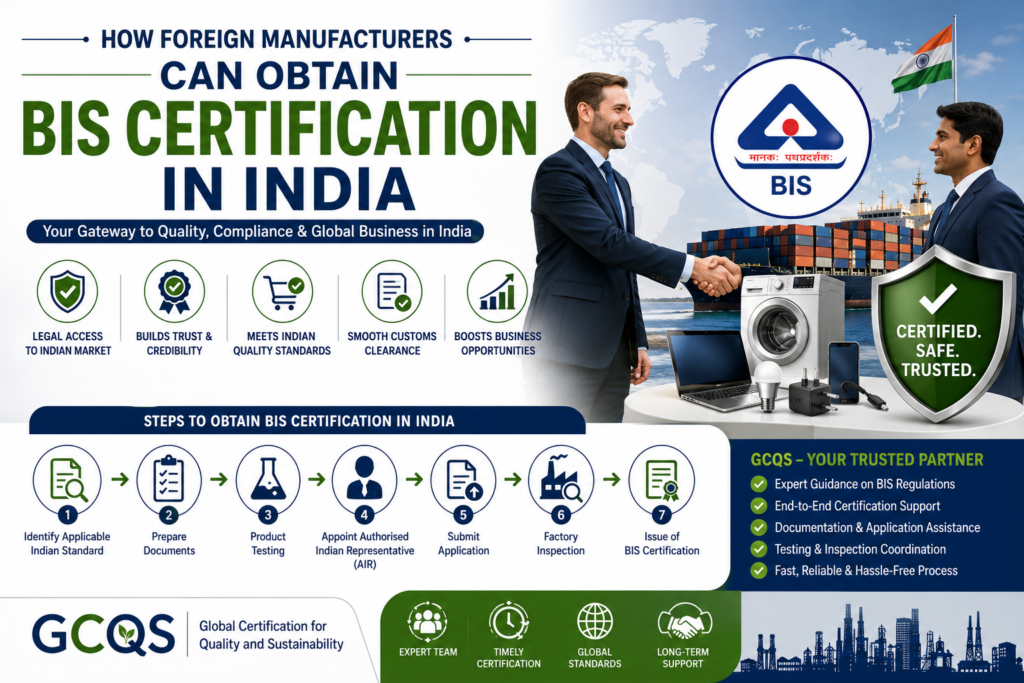
The consumer market in India is one of the most rapidly growing markets across the globe, thereby providing excellent scope for foreign manufacturers to operate their businesses there. But prior to selling any such products, compliance with the quality and safety requirements laid down by the Bureau of Indian Standards (BIS) becomes extremely important.
Be it electronics, electrical appliances, chemicals, machinery, or consumer goods, BIS Certification for foreign manufacturers working in India is almost always a pre-requisite. Professional help from Global Certification for Quality and Sustainability (GCQS) will facilitate the process immensely.
1. What is BIS Certification?
The Bureau of Indian Standards (BIS) certification is a form of conformity assessment procedure where it can be determined whether a certain product complies with the standards set forth by the Indian standards regarding its quality, safety, and performance.
The Bureau of Indian Standards certificate facilitates:
- Product Quality and Safety
- Standardization
- Avoiding substandard products
- Consumer Confidence
It is also an important procedure that foreign manufacturers have to follow when exporting goods to India.
2. Why BIS Certification is Important for Foreign Manufacturers
India has made it mandatory for several types of products to undergo BIS certification as per certain Quality Control Orders. Certification is necessary for products, and only after that can they be imported or sold legally in India.
Some of the advantages of getting BIS Certification for Manufacturers and Importers are as follows:
- Legal entry into the Indian market
- Building customer trust
- Higher credibility of their products
- Avoidance of any problems regarding customs clearances
- Competitiveness in the market
Manufacturers can save themselves time and trouble through BIS Certification Services.
3. Types of BIS Certification Available for Foreign Manufacturers
Most foreign manufacturers usually register through the BIS certification scheme known as the Foreign Manufacturer Certification Scheme (FMCS) or other BIS certification schemes.
Types of BIS certifications include:
3.1. BIS FMCS Certification
FMCS BIS certification pertains to foreign manufacturers producing products that comply with mandatory Indian standards and need the Standard Mark (ISI mark).
3.2. BIS CRS Registration
This BIS compulsory registration scheme is meant for electronic and IT items, including:
- Mobile phones
- LED Lights
- Power adapters
- Laptops
- Smart Devices
3.3. BIS Scheme X Certification
Some regulated products may need Scheme X certification.
Knowledge of the relevant certification scheme is important for obtaining BIS certification.
4. Step-by-Step Process to Obtain BIS Certification in India
4.1 Step 1: Identify the Applicable Indian Standard
The first step involves checking the need for mandatory BIS certification.
For this, manufactures have to find out:
- Relevant Indian Standard (IS)
- Corresponding Certification Scheme
- Requirements for testing of the product
There are professional BIS certification consultants available who help you determine the right classification of the product.
4.2 Step 2: Documentation
For foreign producers, BIS requires extensive documentation, which includes the following:
- License for production
- Documents related to factory registration
- Product specifications
- Quality control procedure
- Testing report
- Information about the authorized Indian representative (AIR)
Documentation plays a crucial role in making the process easy for the applicant.
4.3 Step 3: Product Testing
The product needs to be tested according to relevant Indian standards.
Tests will be done in recognised BIS laboratories to check the following:
- Safety norms
- Performance criteria
- Quality criteria
Test reports play a vital role in the whole certification application process.
4.4 Step 4: Appoint an Authorised Indian Representative (AIR)
In general, foreign manufacturers are supposed to appoint an authorised Indian representative who will act as the liaison between BIS and the company.
4.5 Step 5: Submit the Application
After completion of the documentation and testing phase, the product is submitted to BIS.
The following documents should be included in the submission:
- Details about the product
- Testing certificates
- Factory information
- Certificate of compliance
Professional assistance can assist in fulfilling all the requirements.
4.6 Step 6: Factory Inspection
In some cases, a factory inspection by BIS may be conducted to check:
- Manufacturing process
- Quality control system
- Production capacity
- Compliance with Indian standards
Successful inspection will be a major step towards certification.
4.7 Step 7: Issue of BIS Certification
On successful evaluation, the product is certified, and a BIS certificate is issued that enables the manufacturer to use the appropriate BIS certification mark.
The manufacturer can then market the products in India.
5. Common Challenges Faced by Foreign Manufacturers
Many foreign companies find that there are several issues involved when trying to get certified, including:
- Understanding of Indian laws
- Finding the appropriate standard
- Handling the paperwork required
- Coordinating testing and inspections
- Adhering to new and constantly evolving regulations
This can cause delays and raise costs. That’s why many firms opt for professional BIS certification assistance to help simplify the whole process.
6. Global Certification for Quality and Sustainability (GCQS) and BIS Certification
Global Certification for Quality and Sustainability offers a wide range of services that are useful to any business looking to obtain BIS Certification from India.
This company will assist you with:
- Determining product eligibility for BIS Certification
- Guiding you on relevant regulations
- Preparing all of the required documents
- Submitting your application
- Laboratory coordination
- Testing and inspections
And many other things necessary for certification.
7. Conclusion
Entering the Indian market will provide a wide range of opportunities for foreign manufacturers; however, compliance with relevant laws is just one important issue among others that need to be sorted out. The Bureau of Indian Standards certifies that the product is of high quality and meets Indian requirements.
Professional BIS certification services make the certification process easier and quicker for companies wanting to penetrate the Indian market. With the help of Global Certification for Quality and Sustainability (GCQS) certification experts, it will become easier to get your company certified.