How to Choose Between Different Food Safety Certifications for Your Business
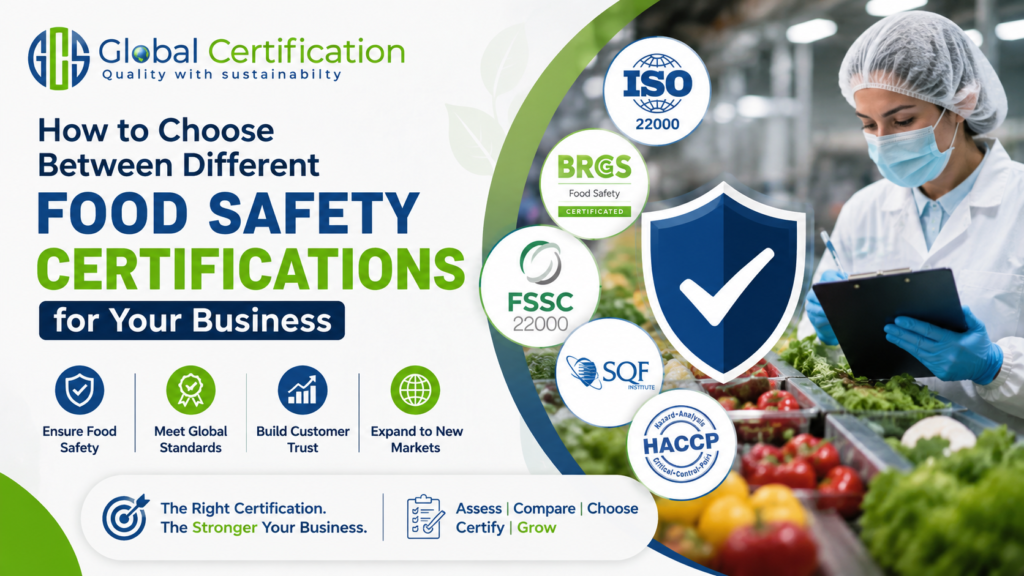
Food safety is an integral part of every business that deals in any way with manufacturing, handling, storage, packaging, or distribution of food products. The existence of food safety certification proves that your company implements a system for identifying potential hazards and risks, as well as maintaining food safety standards on a consistent level. Nevertheless, with various certifications such as ISO 22000, HACCP, and BRCGS, making a choice can become complicated.
Making the right choice will depend on such factors as the size of your business, the type of products, your customers, regulatory requirements, and objectives.
Why Is Food Safety Certification Important?
Food Safety Certification is an objective recognition of systems that have been created for managing risks related to food safety. It may help organisations improve controls, gain consumer trust, fulfil buyer requirements, and enter into new markets.
Such a certification system will encourage personnel to implement certain processes of hygiene, hazard management, traceability, documentation, and corrective measures.
Before certification, it is necessary for businesses to examine their existing food safety management systems and understand what standards need to be met by consumers, regulators, retailers, and supply chain partners.
Understanding ISO 22000 Certification
ISO 22000 standard is a globally accepted standard of food safety management systems. It provides a systematic structure for the identification and control of hazards through all the food chains in organisations.
The main strength of ISO 22000 is the wider system-based management concept used in it. It blends HACCP concepts into a management system, which includes communication, management system elements, and continual improvement.
This standard could suit any food manufacturer, processor, storage and transportation firm, packer, catering firm, or firms linked to the food chain.
Those firms that wish to develop an internationally applicable management system could contact an expert ISO 22000 certification consultant for assistance.
Understanding HACCP Certification
HACCP certification emphasises the identification of food safety hazards and measures for prevention.
HACCP certification means Hazard Analysis and Critical Control Points.
The HACCP system includes identification of biological, chemical and physical hazards in addition to identification of the necessary controls at critical points.
It may be more relevant to have the HACCP certification for those organisations that are seeking to implement a system to ensure food safety hazards.
HACCP certification is most commonly related to food production and processing, catering, hospitality and food manufacturing businesses.
A HACCP Certification Consultant can assist the business in carrying out hazard analysis, setting the critical points and documenting the procedures.
Is BRCGS Certification Needed?
BRCGS certification is also relevant, especially for those businesses that are supplying food to retailers and big brands, or for customers who need the BRCGS certification. The BRCGS standard has aspects such as food safety, food quality, authentic products, operating procedures, site standards, and suppliers’ management.
If you intend to sell your product to retailers, then BRCGS certification may be relevant for you rather than going for other certifications on the grounds of food safety needs.
ISO 22000 vs HACCP vs BRCGS: Which Should You Choose?
There is no one-size-fits-all certification. You should make your selection in accordance with your business needs.
Select ISO 22000 in case of:
- Need for a complete food safety management system.
- Importance of an international recognition system.
- Combining food safety with a managed process system is desirable for you.
- You consider continual improvement as an important part of your business.
HACCP is your choice when:
- Specific hazard prevention is needed.
- HACCP is the specific customer demand.
- The purpose of certification is to improve preventive food safety systems.
- The organisation needs to improve its food safety practices.
When you choose BRCGS certification, your reasons are:
- You serve large retail chains or food brands.
- BRCGS certification is a specific customer demand.
- You serve in markets where retailer certification standards play an important role.
Consider Customer and Market Requirements
An important consideration when making a decision on the right certification is the demands of your consumers. The certification you intend to choose might be right technologically, but might not be commercially viable because of other certification your main consumers are demanding.
Look at supplier demands, agreements, demands from the export market, retailer demands and regulations.
Consider Your Business Size and Internal Systems
Your existing food safety procedures must also determine the choice of your certification. Think about your manufacturing process, your number of employees, variety of products, existing documentation, hazardous substance control, traceability systems and your audit practices.
This can be made possible through engagement with a food safety consultancy firm.
Get Professional Guidance
The preparation for compliance with certification requirements may include documentation, implementation, training employees, internal audit, corrective actions, and management review. Collaboration with an experienced team of food safety certification consultants can simplify the preparation process.
Global Certification for Quality and Sustainability can provide professional help to those who need to know more about food safety certifications and their implementation. No matter whether you are going to choose ISO 22000, HACCP, or BRCGS, you will be able to get some help.
Conclusion
Selecting food safety certification is one of the most significant decisions that you need to make concerning your business, its future development, and success. ISO 22000 presents a complete food safety management system; HACCP is a highly effective system of prevention and hazard management; BRCGS is a useful tool for suppliers of major retailer chains and brands.
Before you make a decision, think about your business requirements and customers’ needs. You can find an expert in food safety certification who can help you make the correct choice and get ready for the certification process.