ISO 45001 vs ISO 14001: Which Certification Does Your Factory Need First?
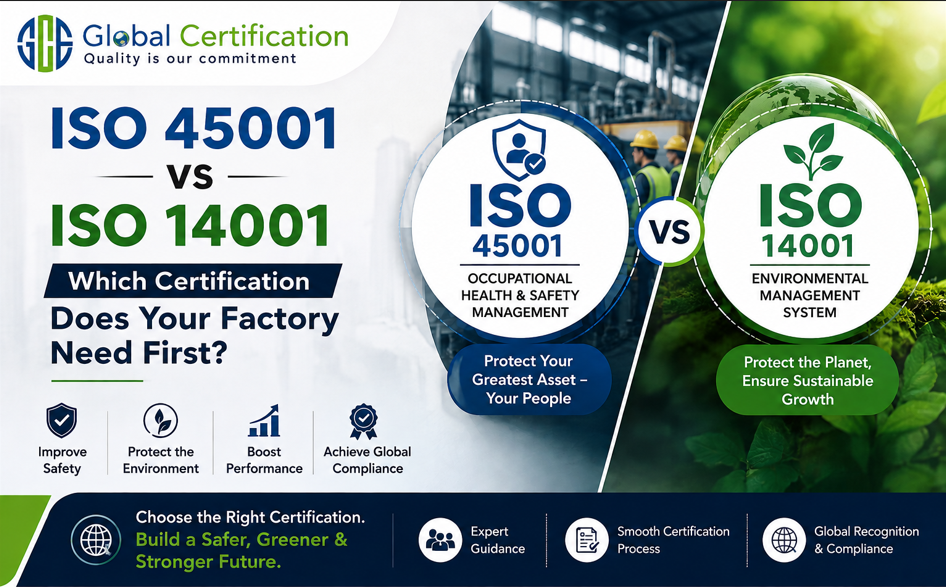
With today’s competitive manufacturing industry, ISO certification in India becomes not only an imperative but also a valuable asset for development, sustainability, and quality assurance. One of the most crucial certificates that can be obtained by factories is ISO 45001 certification in India and ISO 14001 certification in India. Both certifications have their own advantages and disadvantages.
However, if you do not know which certificate your factory should receive first, read this article to understand all the differences and make a decision according to your business preferences.
1. ISO 45001 Certification Explanation
ISO 45001 certification in India is one of the internationally approved standards that are designed to ensure safe workplaces for employees by recognising hazards, decreasing risks and preventing injuries and illnesses of workers.
ISO 45001 certification concentrates on such aspects as:
- Health and safety in the workplace
- Risk assessment
- Employee involvement
- Compliance with laws
- Improvements in safety management
This standard is usually implemented in manufacturing industries, construction companies, engineering companies, warehouses, and logistics businesses.
2. What is ISO 14001 Certification?
ISO 14001 certification in India is the international standard for Environmental Management Systems (EMS). It helps businesses minimise their environmental impact while complying with environmental regulations.
An environmental management system certification enables organisations to:
- Reduce pollution
- Improve waste management
- Lower energy consumption
- Control emissions
- Use natural resources more efficiently
Factories involved in manufacturing, chemicals, food processing, textiles, pharmaceuticals, automotive, and heavy industries often implement ISO 14001 to demonstrate environmental responsibility.
3. ISO 45001 vs ISO 14001: Key Differences
Although both certifications improve organisational performance, they address different aspects of business operations.
| ISO 45001 | ISO 14001 |
| Focuses on employee health and safety | Focuses on environmental protection |
| Reduces workplace accidents | Reduces environmental impact |
| Improves worker wellbeing | Improves sustainability practices |
| Identifies occupational hazards | Identifies environmental risks |
| Enhances workplace safety culture | Enhances environmental performance |
Many factories eventually implement both standards because workplace safety and environmental sustainability often go hand in hand.
4. Which Certification Should Your Factory Choose First?
It depends on your current business issues and operational concerns.
Consider Getting ISO 45001 Certification First In Case:
- The company should consider getting ISO 45001 certification in India first if:
- There are frequent workplace accidents.
- Employee safety is the most critical issue.
- Heavy machines are being used in the factory.
- Dangerous operations are part of the routine production process.
- You want to lower the number of compensation cases and downtimes.
- The customers require strict occupational health and safety standards.
In case of higher operational risk, employee safety needs to be the first priority for the factories.
5. Consider Getting ISO 14001 Certification First In Case:
Your company should consider ISO 14001 certification in India first in case:
- The operation is being regulated by environmental laws.
- Waste management is a significant problem.
- Energy or water is being used heavily.
- The customers require a sustainable manufacturing process.
- Your business wants to reduce environmental impact.
The company is expanding into environmentally conscious international markets.
6. Can Your Factory Implement Both Certifications Together?
Several organisations adopt both ISO 45001 and ISO 14001 since both certifications follow the common High Level Structure (HLS) created by ISO.
Integration becomes easier through the following aspects that businesses can coordinate:
- Risk management
- Internal audit
- Management review
- Document control
- Corrective actions
- Continuous improvement
The integration of a management system saves time and increases efficiency across all departments.
7. Do Not Ignore the Need for Food Safety
If your manufacturing facility produces food, drinks, dairy items, packaged foods, or food items, it might not be sufficient to adopt workplace safety and environmental management.
It would be wise to look at ISO 22000 food safety certification in India that focuses on food safety management in the process of manufacturing.
Several food manufacturing organisations successfully combine:
- ISO 22000 food safety certification in India
- ISO 45001 certification in India
- ISO 14001 certification in India
Together, these standards build customer confidence, improve compliance, and strengthen overall business performance.
8. Benefits of ISO Certification for Manufacturing Businesses
Here are some of the lasting benefits of ISO certification in India:
- Regulatory compliance
- Operational efficiency
- Reduced risk at the workplace
- Environmental excellence
- Greater customer trust
- Increased eligibility for government and corporate tender projects
- Reputation enhancement
- Improved engagement of employees
- Cost reduction
- Global market access
ISO certification is certainly worth the effort for any manufacturer irrespective of its size.
9. Why Hire an ISO Certification Consultant?
The process of certification involves documenting, risk assessment, internal audit, staff training, and compliance. Hiring a professional ISO Certification Consultant in India makes the whole process easier.
ISO consultants help in:
- Gap analysis
- Document preparation
- Process implementation
- Training of staff members
- Internal audit
- Preparation for certification audit
- Compliance assistance
Professional assistance saves time and increases the probability of getting the certification on the first attempt.
10. Conclusion
ISO 45001 certification in India and ISO 14001 certification in India are equally important for manufacturing companies, but which should come first will depend on the current needs of your company.
If the safety of your employees is your main worry, then ISO 45001 is the way to go. If you are concerned about environmental issues, then ISO 14001 would be the better choice. Companies often implement both systems to make their working environment safer, more sustainable, and more effective.
If your factory is producing food products, then ISO 22000 food safety certification in India would be an additional step towards improving the quality and compliance standards in your company.
Global Certification for Quality and Sustainability’s qualified ISO Certification Consultant team in India can help your company get the appropriate ISO certification in India through an efficient and cost-effective process.