ISO Certification vs Compliance: Understanding the Key Differences
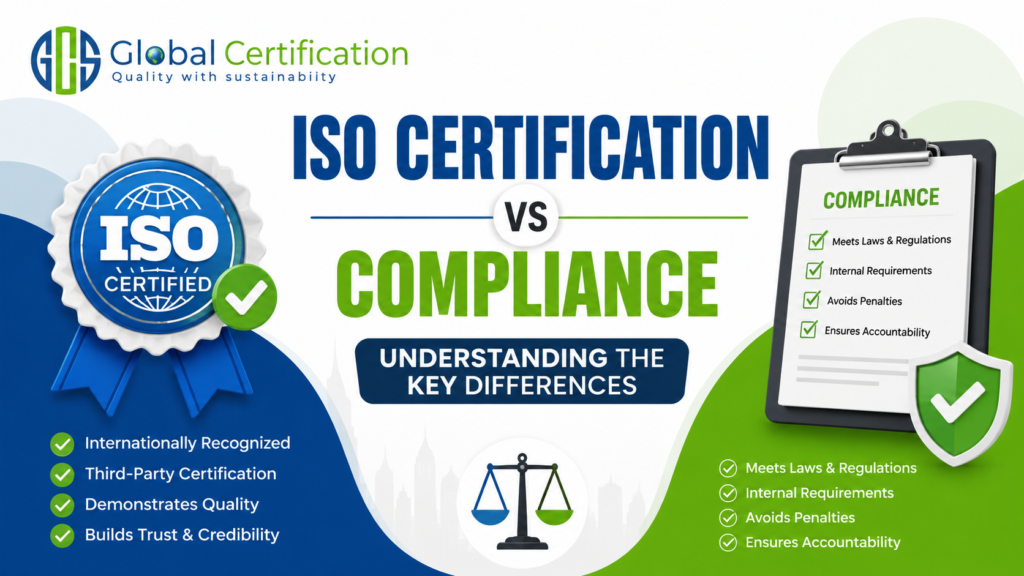
In today’s competitive environment, organisations must adhere to certain quality, safety, and regulatory requirements so as to gain the confidence of the customers and move on to other markets. While both ISO certification and ISO compliance are terms that are interchangeably used, there exists a distinction between the two. This is important to know for any business so that the appropriate option can be considered.
No matter whether your business involves manufacturing, the production of food products, healthcare provision, or even a service business, we have got you covered when it comes to ISO certification services.
1. What Is ISO Certification?
ISO certification is a formal procedure where a certification body independently checks whether the company is compliant with the requirements of a particular ISO standard. The organisation is awarded the ISO certificate after a successful audit showing that it is in compliance with the international standard.
In this regard, firms within the food industry are able to get the ISO 22000 food safety certificate in India to show that their food safety management system is effective.
The ISO certification process usually includes documentation, implementation, internal audit, certification audit, and surveillance audits.
2. What Is ISO Compliance?
ISO compliance is when the company adheres to the requirements outlined in the ISO standard but is not yet certified by the ISO certification body.
The company can adopt the ISO requirements without seeking certification to boost its performance or enhance safety and quality.
While ISO compliance denotes a company’s adherence to the set standards, it does not guarantee any official ISO certificate that can be validated by clients and business partners.
To put it simply:
- ISO Compliance = Adherence to ISO Standards but without ISO certification.
- ISO Certification = Adherence to ISO Standards and Certification.
3. Key Differences Between ISO Certification and Compliance
3.1. Third-Party Verification
For the ISO certification process, an independent certification body must conduct the audit for the organisation’s management system.
ISO compliance is normally a self-assessment or internal evaluation process without certification.
3.2. Official Certification
Certified companies will be awarded a globally recognised certificate.
Non-certified companies cannot claim to be officially ISO certified as they have not yet undergone the certification audit.
3.3. Customer Trust
Certification provides greater assurance as the customers know that there is another independent organization which has already certified the systems of the company.
Compliance, however, still shows dedication but does not guarantee trust from the customer during the evaluation process.
3.4. Market Access
Several governmental projects and international buyers require their suppliers to be certified.
ISO certification, therefore, opens up more opportunities than ISO compliance.
4. Understanding the ISO Certification Process
ISO certification involves the following crucial steps:
4.1 Gap analysis
Analysts analyze the current management system and highlight where improvements are needed.
4.2 Documentation
Policies, procedures, manuals, and documents are prepared in accordance with the chosen ISO standard.
4.3 Implementation
The organisation implements all documentation in all departments.
4.4 Internal audit
Internal audits are done to make sure all systems are working well.
4.5 Certification audit
An accredited certification body analyses the management system of the organisation.
4.6 Certificate issuance
Upon successful completion of all ISO certification criteria, the organisation gets its ISO certificate.
6. ISO Certification Requirements
Despite the fact that the requirements vary from one ISO to another, some of the common ISO certification requirements include:
- Well-established policies and objectives
- Procedures documented
- Training of employees
- Risk management
- Internal audits
- Management reviews
- Corrective and preventive actions
- Continual improvement
Satisfaction of the above requirements can help organisations to consistently provide quality.
7. Benefits of ISO Certification
ISO certification is favoured by many businesses across various industries due to its long-term benefits.
The key benefits of ISO certification include:
- Improvement in customer satisfaction
- Quality improvement of products and services
- Operational efficiency
- Decreased business risks
- Regulatory and legal compliance
- Employee involvement
- Contract opportunities
- Improved market access around the globe
- Business improvement
These advantages make ISO certification a valuable investment for businesses seeking sustainable growth.
8. Why ISO 22000 Food Safety Certification Matters
Food processing industries, food service providers, food packagers, and food distributors should ensure food safety standards.
The acquisition of ISO 22000 food safety certification in India allows the company to:
- Ensure food safety from source to destination.
- Decrease the risks of food contamination.
- Comply with all regulations.
- Gain customer confidence.
- Enter domestic and international marketplaces.
With the development of food safety regulations, ISO 22000 certification allows organisations to have a world-renowned quality food management system.
9. Why Should You Go with ISO Consultants in India?
ISO certification is complicated, particularly for companies seeking ISO certifications for the very first time.
ISO consultants in India help organisations to:
- Perform gap assessment
- Create documentation
- Train employees
- Implement ISO standard
- Perform internal audit
- Help with certification audit
Professional assistance minimises delays and accelerates the process of certification.
10. Choose the Right ISO Certification Partner
Selection of certified ISO services is necessary for having an easy ISO certification process. Global Certification for Quality and Sustainability offers services in consulting, implementation, documentation, training, and certification to businesses from many industries.
No matter whether your business requires ISO certification, implementation of any management system or ISO 22000 food safety certification in India, the right experts can help you have an easy process of getting ISO certification.
11. Conclusion
Though ISO compliance shows that your company complies with the international standard, ISO certification proves that your company has been officially certified by a third party. Knowing this difference enables companies to decide about their needs.
Global Certification for Quality and Sustainability will help your business to comply with ISO certification requirements, benefit from ISO certification, and succeed in the competitive market environment.