HACCP vs ISO 22000: Understanding the Key Differences
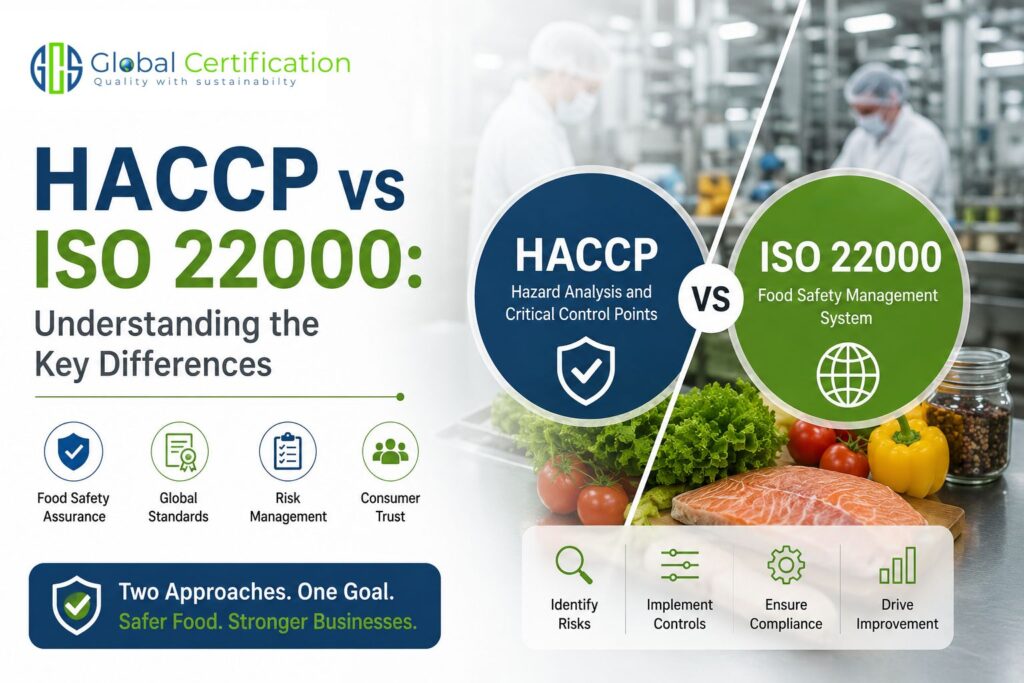
Nowadays, ensuring food safety has become an utmost priority for any company engaged in food production, processing, packaging, storage, and exports. Irrespective of whether you have a small unit that manufactures food products or a large business that does exports, having the right food safety certification is important to gain customer confidence, meet regulatory requirements, and open up new business avenues.
There are many popular standards related to food safety. The two that are considered most popular are HACCP and ISO 22000. Companies often get confused when deciding about opting for either of the two. Are you considering going ahead with HACCP certification in India or ISO 22000 food safety certification in India?
Read further to find out more about both. At Global Certification for Quality and Sustainability, we are your food safety certification consultant in India.
1. What is HACCP Certification?
Hazard Analysis and Critical Control Points (HACCP) is a preventative process focused on food safety and the identification of hazards that can cause danger to consumers.
There is no testing of finished product within HACCP, and only all processes in production are managed and identified, and there are such elements as biological, chemical and physical hazards and critical control points.
Obtaining the HACCP certificate in India means that you implement the international standards for food safety management and provide your consumers with food products.
2. What Is The ISO 22000 Certificate?
ISO 22000 is an international standard for the Food Safety Management System (FSMS), created by the International Organisation for Standardisation (ISO).
The main feature of ISO 22000 lies in its difference from HACCP because ISO 22000 combines the HACCP principles and the management system and includes such elements as risk management, management commitment, communication in the food chain, documentation, continual improvement and legislative requirements.
Companies that wish to receive the ISO 22000 certificate in India have an opportunity to apply to the world approach, which will increase the safety and efficiency.
3. HACCP Certification vs ISO Certification: Key Differences
It is important to understand the difference between HACCP certification and ISO certification for informed decision-making by companies.
3. 1. Scope
HACCP concentrates mostly on the identification and control of food safety hazards in production process.
ISO 22000 includes food safety hazards and management system requirements as well as organisational processes, leadership requirements, and continual improvement.
3.2. International Recognition
Both certifications have international recognition. Still, ISO 22000 food safety certification in India is a preferable choice for multinational buyers and the international logistics chain because it unites management system requirements and food safety requirements.
3.3. Documentation
Documentation associated with HACCP includes hazard analysis, monitoring and corrective measures.
ISO 22000 requires wider documentation that includes policies, objectives, risk assessment, internal audit, management review and continual improvement documentation.
3.4. Business Management
HACCP is a food safety control system.
ISO 22000 is a total management system that provides integration of food safety in business processes.
3.5. Certification Requirements
Some companies start with HACCP certification and move on to ISO 22000 when their needs arise.
4. HACCP or ISO 22000 for Food Exporters?
Which system to use for certification – HACCP or ISO 22000 – depends on your target markets, customer requirements, and business objectives.
If your customers have no specific requirements except basic food safety controls, then HACCP should be enough.
Exporters selling products to international retailers, supermarkets, food manufacturers, or global brands would probably prefer to obtain ISO 22000 certification in India as it gives an additional advantage in their business.
If you have plans to develop your business internationally, then ISO 22000 will be more beneficial in the long term.
5. Advantages of ISO 22000 Food Safety Certification in India
There are several advantages that you will get when obtaining ISO 22000 food safety certification in India, namely:
- Improvement of food safety and quality management
- Better regulatory compliance
- Customer satisfaction
- Better export opportunities
- Food safety risk reduction
- Operational efficiency improvement
- Reputation building
- Process improvement
All these benefits make ISO 22000 one of the most valuable food safety certifications.
6. Benefits of HACCP Certification in India
For the food industry in India, some of the major advantages that HACCP certification offers include:
- Food contamination prevention
- Food safety risk identification
- Efficient production processes
- Regulatory compliance
- Customer confidence building
- Product recall reduction
- Good food safety culture
It continues to be an ideal choice for companies that are looking for a food safety system without a management structure.
7. Which Food Safety Certification Is Right For You?
It depends on your business size, customer demand, regulation, and growth potential.
Opt for HACCP in case:
- You require a food safety system that is easy to implement.
- Your customers demand HACCP certification.
- Your business is at the starting point of its food safety practices.
- Opt for ISO 22000 in case:
- You require an internationally accredited management system.
- You intend to export your food items.
- You desire continuous improvement and better control.
- Your customers demand internationally accepted food safety certifications.
A food safety certification consultant in India will be able to understand your business needs and will be able to suggest the right certification to you.
8. Why Choose Global Certification for Quality and Sustainability?
Getting the certification will be easy with professional help. Global Certification for Quality & Sustainability is a consultancy firm that offers expert consultancy services to all food sector companies.
They help with the following services:
- Gap analysis
- Documentation
- Training employees
- Internal audit
- Certification process
- Compliance assistance
If you need HACCP food safety certification in India or ISO 22000 food safety certification in India, this consultancy firm will help you out.
9. Conclusion
HACCP and ISO 22000 have equal importance in enhancing food safety and customer satisfaction levels. Although HACCP concentrates on preventing food safety issues, ISO 22000 provides a framework through which continual improvement in food safety management is ensured, along with international compliance.
Differences in HACCP certification and ISO certification will help in making an informed choice and taking the right decisions for the future. In case you are confused between choosing HACCP and ISO 22000 for your food export business, a food safety certification expert in India would definitely make things easier.
By relying on Global Certification for Quality and Sustainability, your business can gain the right certification and enhance its food safety management.