BRCGS, FSMS & Food Safety Certifications in India Explained
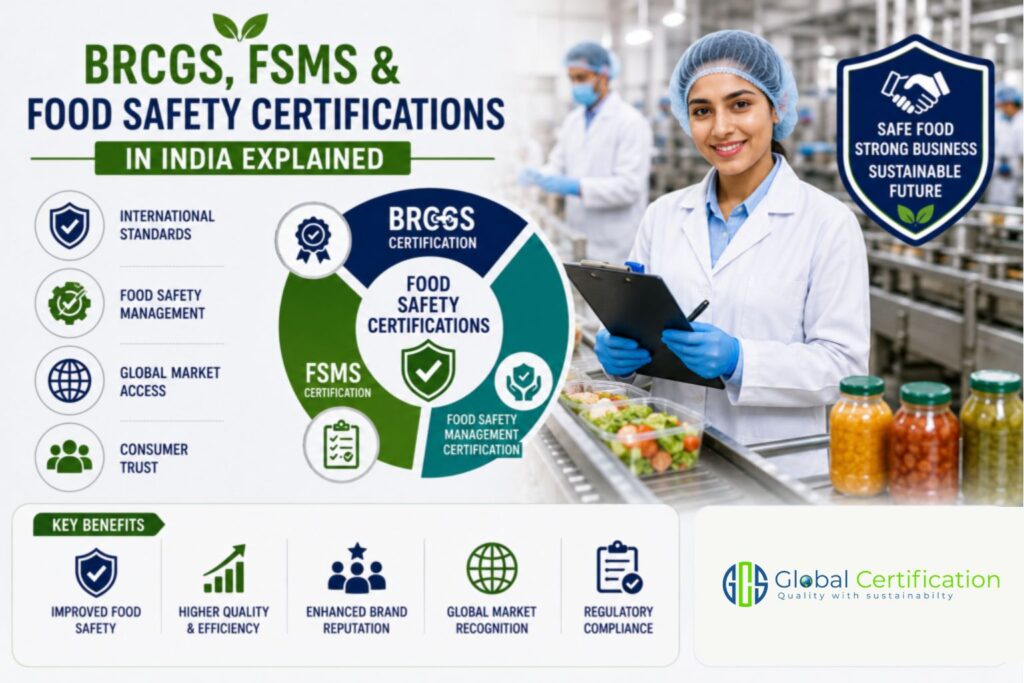
Today, it is necessary for food companies to maintain quality, hygiene, and safety standards in the very competitive food industry environment. It is expected by consumers, retailers, and foreign buyers that food manufacturers should practice food safety standards as per the worldwide accepted standards. Hence, Food safety certification in India has become a necessity for businesses to earn the trust and enter the market successfully.
For food producers, processors, exporters, packers, and storers, certifications such as BRCGS certification in India and FSMS certification in India would be useful to show your dedication to food production with higher standards. With the assistance of professionals at Global Certification for Quality and Sustainability, one can fulfil this need easily and effectively.
What is BRCGS Certification?
The BRCGS (Brand Reputation through Compliance Global Standards) is considered one of the most prestigious food safety certification standards. Initially formulated by the British Retail Consortium, this standard has gained recognition from retail chains, food producers, and government agencies all around the world.
The BRCGS certification in India ensures that food companies comply with very high-quality, hygienic, and operational standards during food production. This is considered one of the most important certifications for companies involved in exporting their food products.
By working with expert BRCGS certification consultants in India, companies can be sure of understanding all the requirements of the certification procedure and completing certification audits successfully.
Understanding FSMS Certification
A Food Safety Management System (FSMS) refers to a system that helps companies control and mitigate food safety risks throughout the food production process.
FSMS certification in India shows that the company has put in place a system for controlling food safety and monitoring it to ensure the consistency of the products.
FSMS certification usually covers such aspects as:
- Food safety risk assessment
- Identification and control of hazards
- Hygiene and sanitation management
- Training and awareness of employees
- Document management
- Monitoring and improvement
The implementation of an efficient FSMS helps mitigate the risks of food contamination and increases efficiency.
Why Food Safety Certification Matters
Today’s consumers are far more knowledgeable than ever before. Transparency about the quality of the food and its manufacture is expected.
There are many advantages to choosing Food Safety Certification in India:
- It builds consumer confidence
- It ensures adherence to food safety laws
- It reduces risks
- It improves quality management
- It increases export potential
- It creates positive retailer relationships
- It prevents food safety incidents and recalls
Those companies which opt for food safety certifications position themselves as trusted providers both within India and abroad.
Benefits of BRCGS Certification for Food Businesses
There are various benefits from obtaining BRCGS certification in India.
Recognition in International Markets
BRCGS certification is approved by top retailers and food buyers all over the world, which makes international trade much easier.
Higher Food Safety Standards
Certification ensures systematic risk management, allowing organizations to consistently produce safe food products.
Increased Efficiency
Clear processes minimize mistakes and improve the performance of the company.
More Client Trust
Clients and partners would be more willing to collaborate with companies following international requirements.
Role of Professional BRCGS Certification Consultants
Getting ready for certification demands careful planning, documentation, staff training, and internal auditing. It’s at this point that professional BRCGS certification consultants come into play.
Professional BRCGS certification consultants in India help businesses in such aspects as:
- Gap assessments
- Preparation of documentation
- Development of food safety procedures
- Training of staff members
- Internal auditing
- Audit preparation for certification
- Initiatives on continuous improvement.
Their expertise simplifies the certification process while helping businesses achieve compliance more efficiently.
Who Should Obtain Food Safety Certifications?
Industries that can gain from Food Safety Management Certification include:
- Manufacturers of food products
- Manufacturers of food products
- Manufacturers of beverages
- Producers of packaging materials
- Cold storage facilities
- Warehousing companies
- Companies dealing with catering
- Exporters/importers
- Dairy and meat processing industries
- Confectionery and bakery manufacturers
No matter what the size of the business, adopting internationally recognised food safety standards ensures better quality and more client trust.
Choosing the right certification company
It is quite useful to select a well-experienced certification company when it comes to getting certified. The role of the right partner includes providing all the necessary technical assistance and support while preparing for the certification process and audits.
Global Certification for Quality and Sustainability works with companies from different industries, helping them to gain internationally recognised management system certifications such as BRCGS Certification in India, FSMS Certification in India and others.
Conclusion
In order for companies to compete effectively, they must use food safety systems that are internationally acknowledged and that change with time. The benefits of using BRCGS certification in India and FSMS certification in India include improved compliance, quality of products, increased customer trust, and business expansion.
By utilising the experience and professionalism of BRCGS certification consultants in India and Global Certification for Quality and Sustainability, firms will be able to establish their food safety systems, acquire food safety management certification, and secure their future in the food industry.