ISO 22000 Certification Process Explained: Step-by-Step Guide for Companies
Maintaining food safety standards has become a primary concern for businesses in the food chain. Regardless of whether you are into food manufacturing, food processing, food packaging, storage, distribution, or restaurants, it becomes extremely important for you to maintain the best food safety standards.
One of the widely recognised food safety standards across the world is the ISO 22000 Food Safety Certification in India. This standard helps you in setting up an effective Food Safety Management System (FSMS).
In this guide, we at Global Certification for Quality and Sustainability have laid down the procedure for the ISO 22000 certification process.
1. What is ISO 22000 Certification?
ISO 22000 standard is an international standard for Food Safety Management System (FSMS). The standard integrates food safety principles, hazard analysis, risk assessment and control and other practices for ensuring the safety of food products.
The ISO 22000 standard applies to all kinds of organisations involved in the food chain, including its manufacture, processing, transportation, storage, packaging, and even retailing.
2. Why is ISO 22000 Important for Food Businesses?
Getting ISO 22000 food safety certification in India gives companies some benefits, which include:
- Improvement in food safety and quality management
- Boosting customers’ trust and brand reputation
- Meeting the regulatory requirements
- Improved risk management and hazards control
- Business development through domestic and foreign market access
- Continual improvement in food safety practices
It makes the ISO 22000 certification worthwhile for a company to invest in.
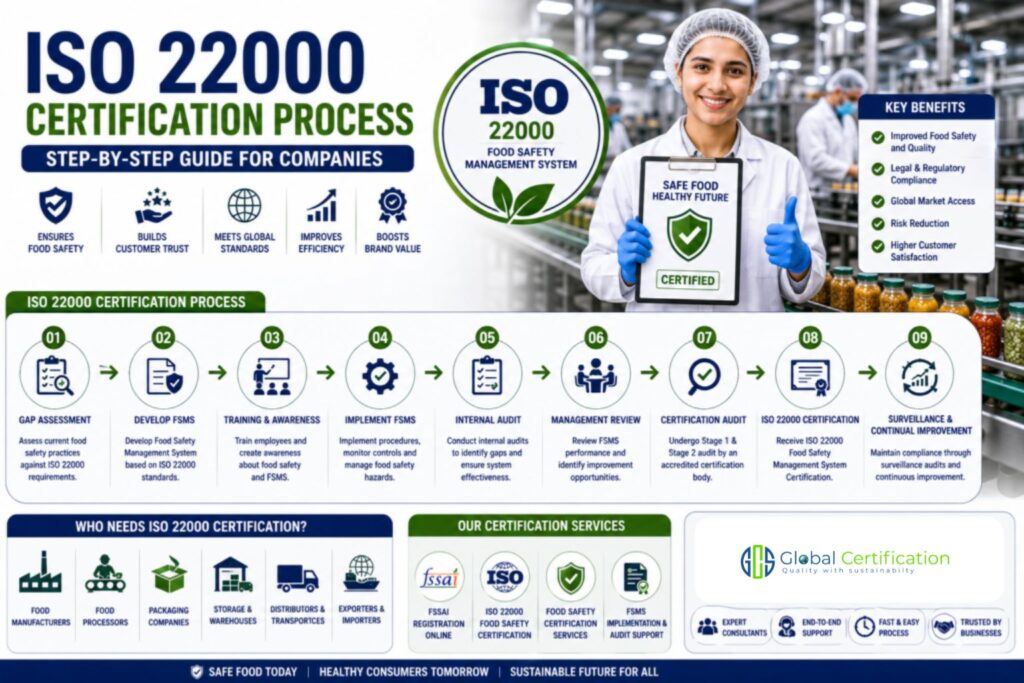
3. ISO 22000 Certification Process Explained
The ISO 22000 certification process consists of a number of steps that allow you to put in place an efficient Food Safety Management System.
3.1 Step 1: Perform a Gap Assessment
The first step consists of assessing your food safety practices according to ISO 22000 standards.
Gap assessment will let you assess:
- Existing compliance
- Areas for improvement
- Missing documentation
- Food safety threats and weaknesses
It will help you plan your ISO 22000 implementation process.
3.2 Step 2: Develop a Food Safety Management System (FSMS)
After the identification of the gaps, the organisation needs to develop a Food Safety Management System based on the ISO 22000 criteria.
The following elements should be included:
- Food safety policy and objective
- Hazard Analysis and Critical Control Point (HACCP)
- Risk assessment process
- Operational prerequisite program (OPRP)
- Procedures for documentation and work instruction
This step becomes the basis for the development of the FSMS certification process.
3.3 Step 3: Employee Training and Awareness
Implementation of a Food Safety Management System is possible only with the involvement of personnel.
Training should cover the following areas:
- Food safety principles
- ISO 22000 criteria
- Hazard analysis and its prevention
- Hygiene rules
- Emergency actions
Training ensures employees understand their responsibilities and contribute to maintaining food safety standards.
3.4 Step 4: Implement the FSMS
After the development of the system and training of employees, the organization will now implement all procedures that have been documented.
The following are activities included in this step of the implementation of the ISO 22000 standards:
- Monitoring of critical control points
- Food safety documentation
- Inspection and auditing
- Supplier controls
- Control of food safety hazards
Implementation is very important to ensure compliance during certification audits.
3.5 Step 5: Conduct Internal Audits
Before the application for certification, companies can conduct internal audits to check the effectiveness of the Food Safety Management System.
Internal audits will help in:
- Identifying non-conformances
- Ensuring compliance with the ISO 22000 standard requirements
- Increasing efficiency
- Preparation for external audit
These problems should be solved before going to the next stage in the FSMS certification process.
3.6 Step 6: Management Review
Management will need to review the performance of the Food Safety Management System.
The review should include the following elements:
- Audit findings
- Food safety objectives
- Customer feedback
- Risk management performance
- Opportunities for improvement
Management involvement demonstrates commitment to food safety and continuous improvement.
3.7 Step 7: Certification Audit by an Accredited Body
The certification body performs the ISO 22000 certification procedure in two phases.
Phase 1 Audit
In this phase, the auditors assess the following:
- Documentation
- Procedures and policies
- Scope of the management system
Preparation for Phase 2
The purpose is to establish whether the organization is ready for the entire certification audit.
Phase 2 Audit
In this phase, the auditors assess:
- Implementation of FSMS
- Awareness of employees
- Operational control
- Conformity with the requirements of ISO 22000
- Effectiveness of food safety practices
Upon successful completion, certification is granted.
3.8 Step 8: ISO 22000 Certification
Once the audit is completed and non-conformities are addressed, the organisation will be awarded Food Safety Management System Certification.
The certification proves compliance with food safety standards internationally and increases credibility among clients, regulatory agencies, and business partners.
3.9 Step 9: Surveillance and Continual Improvement
Certification is an ongoing process. The organisation has to continue developing and maintaining its Food Safety Management System.
Surveillance audits are conducted to ensure continued compliance and promote continual improvement in food safety practices.
4. Common Challenges During ISO 22000 Implementation
Some of the difficulties that businesses might come across when pursuing ISO 22000 food safety certification in India include:
- Employee unawareness
- Poor documentation
- Process resistance
- Insufficient resource allocation
- Poor risk assessment
Engaging professionals with experience in certification will make the implementation of ISO 22000 much simpler.
5. Conclusion
Getting ISO 22000 food safety certification in India is a wise move for any business interested in food safety and customer satisfaction. Implementing a proper ISO 22000 certification process will allow organisations to implement a Food Safety Management System effectively.
At Global Certification for Quality and Sustainability, we guide our clients through the entire FSMS certification process. We help you analyse any gaps that might be present, implement an FSMS, get the certification and maintain it afterwards.