How to Get Organic Certification for Your Farm
There is an increasing demand for organic farming practices worldwide because more people tend to adopt sustainable methods for farming. Certification of organic farming practices is an important step in achieving success, which all farmers need to take into consideration when undertaking such a venture. It makes no difference whether you are practising large-scale farming or small-scale farming, since you must understand the whole process to make things easier.
This blog post is intended to equip you with complete information on the whole process, as well as help from Global Certification for Quality and Sustainability (GCQS) for obtaining certification.
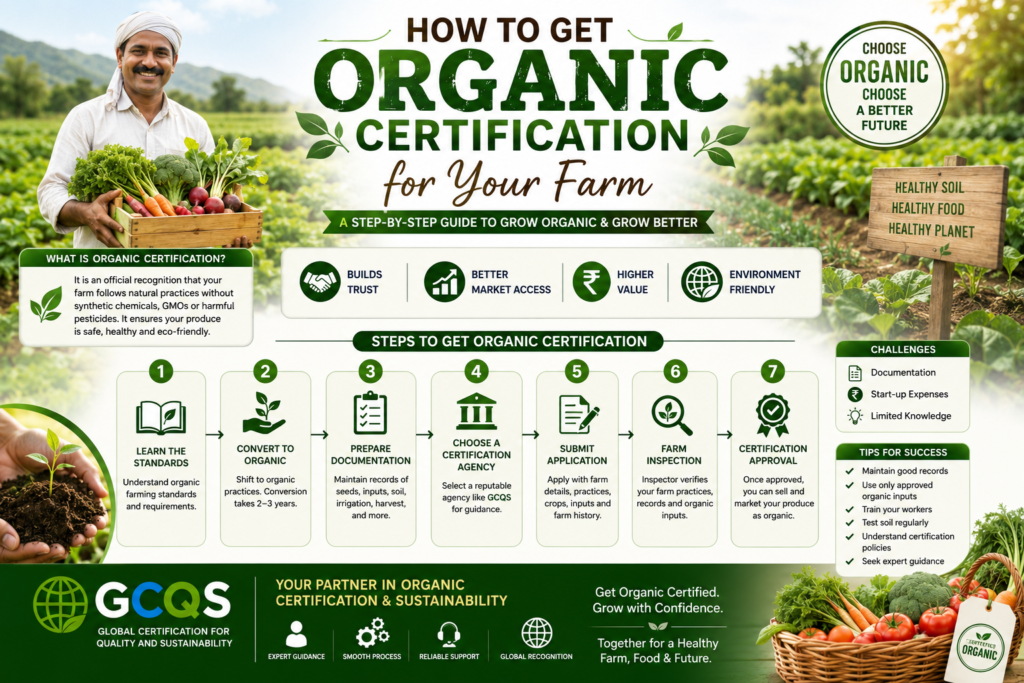
1. What Is Organic Farming Certification?
Organic certification refers to an officially recognised validation that confirms the use of organic agricultural methods by a farm as per the recognised standards. The accepted standards tend to restrict the application of synthetic fertilisers, pesticides, GMOs, and other forms of harmful chemicals.
This form of certification proves that the products harvested from such farms are organic and safe for consumption.
2. Why Is Organic Certification Necessary?
There are a number of reasons why organic certification is essential for farmers and agribusinesses.
2.1 Builds Customer Trust
Customers have more confidence in purchasing products certified organic because they are guaranteed to meet high-quality standards.
2.2 Boosts Market Availability
Organically certified products usually have greater market presence, especially in supermarkets and overseas markets.
2.3 Ensures High Value of Products
Organic products always have higher values than conventional products.
2.4 Promotes Environmental Protection
Organic farming promotes environmental conservation through practices like soil and water conservation.
3. Steps to Get Organic Certification for Your Farm
Organic farming certification entails a process. Below are some steps to aid individuals who might be considering taking part in the certification process for organic farming.
3.1. Get Knowledge of the Organic Farming Standards
Before beginning the certification process, one needs to acquaint oneself with the organic farming standards that currently exist in the area or place where you intend to sell your organic products. Some of the organic farming standards include:
- Soil Management
- Rotation of Crops
- Weed and Pest Management
- Livestock Farming Management
- Seeds Utilization
- Processing and Storage Processes
- All these should be observed.
3.2. Conversion from Conventional Farming to Organic Farming
After acquiring knowledge about the organic farming standards, you may require conversion to organic farming if you were using fertilisers and pesticides. You will take at least two to three years to transition to organic farming.
- Some of the things that will be done during this time are:
- Stop Using the Materials That Are Not Allowed
- Start Using Organic Fertilisers and Compost
- Controlling Weeds and Diseases Naturally
- Documentation
3.3. Prepare Documentation
Documentation is vital to the process of getting certified. All activities performed on the farm should be recorded accurately.
Common forms of documentation used include:
- Maps of the farm
- Documentations of seed purchases
- Documentation on fertilizer applications
- Methods of irrigation used
- Documents on harvests
- Documentation on pest control procedures
Accurate documentation ensures that all standards of organic farming are adhered to.
3.4. Select a Reputable Certification Agency
Finding the right agency to help with the certification is critical. Global Certification for Quality and Sustainability (GCQS)provides certification assistance to farmers and agricultural companies.
At Global Certification for Quality and Sustainability (GCQS), farmers get professional advice and support during documentation, inspections, and compliance.
3.5. Submit the Application
Once your farm is prepared, you will have to file an application form with the certification agency. The application usually contains the following information:
- Details of the farm
- Agricultural practices adopted
- Information about the crops cultivated
- Material used in cultivation
- History of agriculture on the farm
After reviewing the application, the certification agency proceeds with inspection.
3.6. Inspection of the Farm
After the application is approved, an inspector visits the farm for verification. During the inspection process, they assess the following aspects:
- Agricultural practices adopted
- Storage facilities available
- Conditions of soil and crops cultivated
- System of record keeping
- Utilization of organic material
Inspectors may also collect samples for laboratory testing if required.
3.7. Certification Approval
Certification is granted to the farm if all the requirements have been met. The farmer gets a chance to market his produce as organic.
4. Renewal of the Certificate
The renewal of the certificate usually takes place annually through inspection and adherence to the required standards.
4.1 Difficulties in Getting Organic Certification
While there are many benefits in getting certified, farmers can face some difficulties, such as:
4.2 Documentation
Small farmers will have difficulties documenting since they are not conversant with the process.
4.3 Start-up Expenses
A farmer might incur expenses when transitioning from conventional to organic farming.
4.4 Limited Knowledge
Farmers could also be ignorant regarding organic certification and farming.
Getting professional assistance from organisations like Global Certification for Quality and Sustainability (GCQS) can help farmers deal with the above difficulties.
4.5 Tips for Successful Organic Certification
To have high chances of getting certification approved, it would be wise to follow these tips:
- Maintain good farm records
- Only use accredited organic inputs
- Train your employees on organic farming practices
- Carry out soil testing
- Know the policies of certification
- Seek the services of experienced organic certification consultants
With consistency and sincerity, you will become a certified organic farmer.
5. Conclusion
Certification of organic farming is definitely a lucrative venture for contemporary farmers in improving the quality of their produce. Though the certification process could prove to be challenging, it can be simplified by proper planning and guidance from people who are experienced in the matter.
Through the assistance of Global Certification for Quality and Sustainability (GCQS), the certification process will become easier, and farmers will be able to secure a place for themselves in this rising industry of organic farming. This form of farming not only profits farmers but also provides safe communities for future generations.